

Although much less abundant than the aforementioned groups, commercially
important species were represented by hake (Merluccius merluccius), blue whiting
(Micromesistius poutassou), axillary seabream (Pagellus acarne), spotted seabream
(Pagellus bogaraveo), black seabream (Spondyliosoma cantharus), two horse mackerel species (Trachurus trachurus and T. mediterraneus), chub mackerel (Scomber
japonicus), and the two Mediterranean species of mullets (Mullus surmuletus and
M. barbatus).
The monthly mean temperature and salinity data collected during the surveys
deviated from the annual average temperature and salinity historical series
(Fig. 13.10) consequent with the observed upwelling events during winter and
summer. Such events explain the high species diversity and the timing of spawning
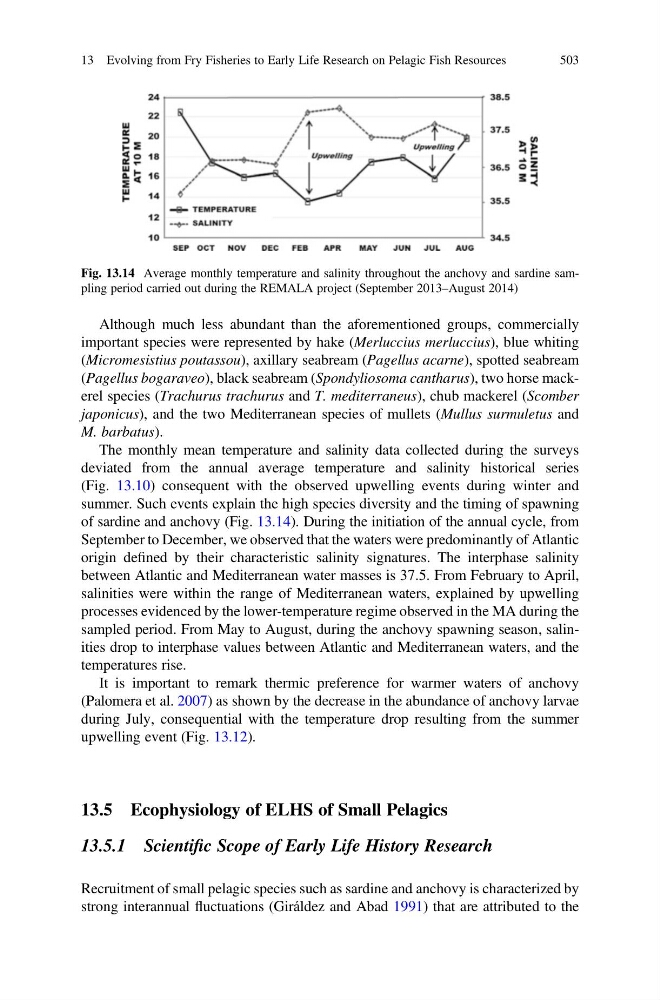
of sardine and anchovy (Fig. 13.14). During the initiation of the annual cycle, from
September to December, we observed that the waters were predominantly of Atlantic
origin defined by their characteristic salinity signatures. The interphase salinity
between Atlantic and Mediterranean water masses is 37.5. From February to April,
salinities were within the range of Mediterranean waters, explained by upwelling
processes evidenced by the lower-temperature regime observed in the MA during the
sampled period. From May to August, during the anchovy spawning season, salinities drop to interphase values between Atlantic and Mediterranean waters, and the
temperatures rise.
It is important to remark thermic preference for warmer waters of anchovy
(Palomera et al. 2007) as shown by the decrease in the abundance of anchovy larvae
during July, consequential with the temperature drop resulting from the summer
upwelling event (Fig. 13.12).
13.5 Ecophysiology of ELHS of Small Pelagics
13.5.1 Scientific Scope of Early Life History Research
Recruitment of small pelagic species such as sardine and anchovy is characterized by
strong interannual fluctuations (Giráldez and Abad 1991) that are attributed to the
Fig. 13.14 Average monthly temperature and salinity throughout the anchovy and sardine sampling period carried out during the REMALA project (September 2013–August 2014)
13 Evolving from Fry Fisheries to Early Life Research on Pelagic Fish Resources
503
important species were represented by hake (Merluccius merluccius), blue whiting
(Micromesistius poutassou), axillary seabream (Pagellus acarne), spotted seabream
(Pagellus bogaraveo), black seabream (Spondyliosoma cantharus), two horse mackerel species (Trachurus trachurus and T. mediterraneus), chub mackerel (Scomber
japonicus), and the two Mediterranean species of mullets (Mullus surmuletus and
M. barbatus).
The monthly mean temperature and salinity data collected during the surveys
deviated from the annual average temperature and salinity historical series
(Fig. 13.10) consequent with the observed upwelling events during winter and
summer. Such events explain the high species diversity and the timing of spawning
of sardine and anchovy (Fig. 13.14). During the initiation of the annual cycle, from
September to December, we observed that the waters were predominantly of Atlantic
origin defined by their characteristic salinity signatures. The interphase salinity
between Atlantic and Mediterranean water masses is 37.5. From February to April,
salinities were within the range of Mediterranean waters, explained by upwelling
processes evidenced by the lower-temperature regime observed in the MA during the
sampled period. From May to August, during the anchovy spawning season, salinities drop to interphase values between Atlantic and Mediterranean waters, and the
temperatures rise.
It is important to remark thermic preference for warmer waters of anchovy
(Palomera et al. 2007) as shown by the decrease in the abundance of anchovy larvae
during July, consequential with the temperature drop resulting from the summer
upwelling event (Fig. 13.12).
13.5 Ecophysiology of ELHS of Small Pelagics
13.5.1 Scientific Scope of Early Life History Research
Recruitment of small pelagic species such as sardine and anchovy is characterized by
strong interannual fluctuations (Giráldez and Abad 1991) that are attributed to the
Fig. 13.14 Average monthly temperature and salinity throughout the anchovy and sardine sampling period carried out during the REMALA project (September 2013–August 2014)
13 Evolving from Fry Fisheries to Early Life Research on Pelagic Fish Resources
503