

zooplankton biomass and abundance in the NW Alboran coastal area were found to
be highly correlated to chlorophyll a in summer (Yebra et al. 2017), indicating that
taxonomic composition and abundance of the phytoplankton are the driving forces
which in turn strongly influence the fate of zooplankton production (Poulet et al.
1995; Laabir et al. 1995). This planktonic production variability would in turn shape
the ichthyoplankton recruitment success in the region since both abundance and
quality of the potential prey for larvae vary significantly, which is probably reflected
in the growth status of small pelagic larvae as is commented below.
13.4 Seasonal Characterization of the Alboran Sea
Ichthyoplankton
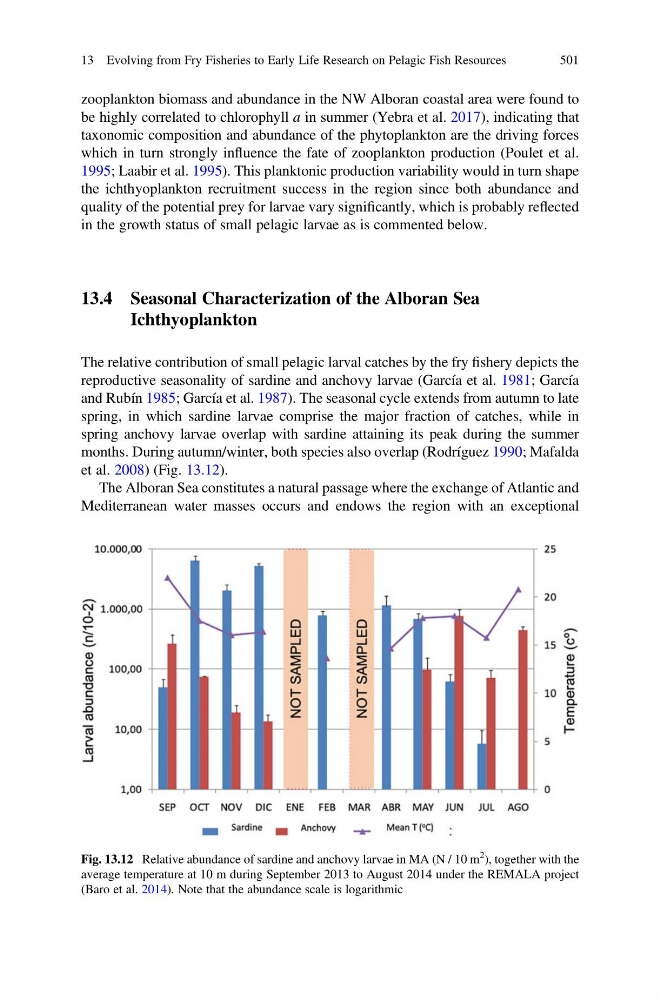
The relative contribution of small pelagic larval catches by the fry fishery depicts the
reproductive seasonality of sardine and anchovy larvae (García et al. 1981; García
and Rubín 1985; García et al. 1987). The seasonal cycle extends from autumn to late
spring, in which sardine larvae comprise the major fraction of catches, while in
spring anchovy larvae overlap with sardine attaining its peak during the summer
months. During autumn/winter, both species also overlap (Rodríguez 1990; Mafalda
et al. 2008) (Fig. 13.12).
The Alboran Sea constitutes a natural passage where the exchange of Atlantic and
Mediterranean water masses occurs and endows the region with an exceptional
Fig. 13.12 Relative abundance of sardine and anchovy larvae in MA (N / 10 m
2
), together with the
average temperature at 10 m during September 2013 to August 2014 under the REMALA project
(Baro et al. 2014). Note that the abundance scale is logarithmic
13 Evolving from Fry Fisheries to Early Life Research on Pelagic Fish Resources
501
be highly correlated to chlorophyll a in summer (Yebra et al. 2017), indicating that
taxonomic composition and abundance of the phytoplankton are the driving forces
which in turn strongly influence the fate of zooplankton production (Poulet et al.
1995; Laabir et al. 1995). This planktonic production variability would in turn shape
the ichthyoplankton recruitment success in the region since both abundance and
quality of the potential prey for larvae vary significantly, which is probably reflected
in the growth status of small pelagic larvae as is commented below.
13.4 Seasonal Characterization of the Alboran Sea
Ichthyoplankton
The relative contribution of small pelagic larval catches by the fry fishery depicts the
reproductive seasonality of sardine and anchovy larvae (García et al. 1981; García
and Rubín 1985; García et al. 1987). The seasonal cycle extends from autumn to late
spring, in which sardine larvae comprise the major fraction of catches, while in
spring anchovy larvae overlap with sardine attaining its peak during the summer
months. During autumn/winter, both species also overlap (Rodríguez 1990; Mafalda
et al. 2008) (Fig. 13.12).
The Alboran Sea constitutes a natural passage where the exchange of Atlantic and
Mediterranean water masses occurs and endows the region with an exceptional
Fig. 13.12 Relative abundance of sardine and anchovy larvae in MA (N / 10 m
2
), together with the
average temperature at 10 m during September 2013 to August 2014 under the REMALA project
(Baro et al. 2014). Note that the abundance scale is logarithmic
13 Evolving from Fry Fisheries to Early Life Research on Pelagic Fish Resources
501