

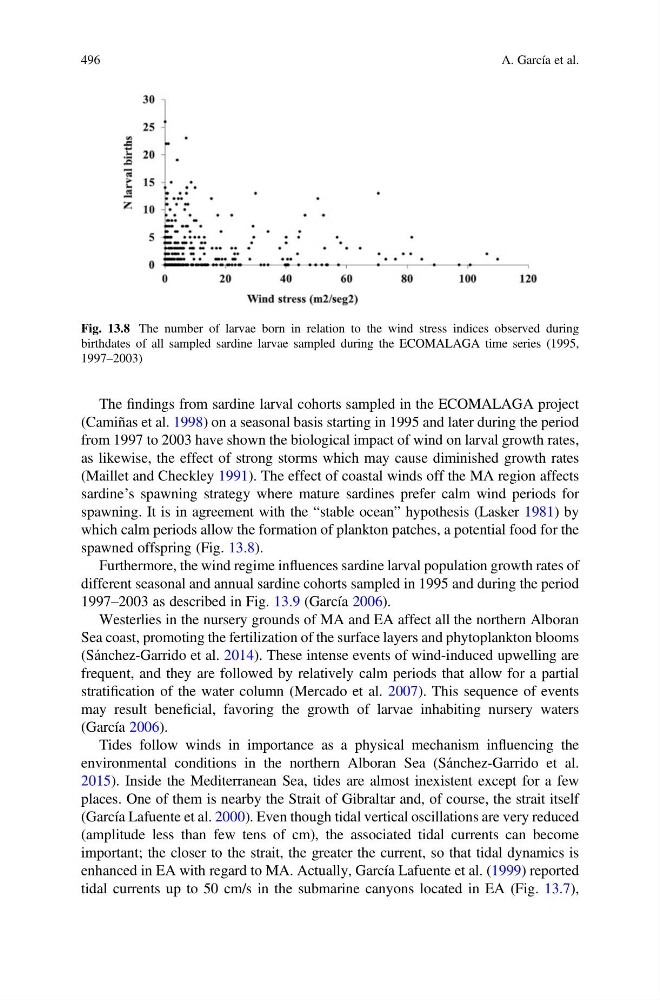
The findings from sardine larval cohorts sampled in the ECOMALAGA project
(Camiñas et al. 1998) on a seasonal basis starting in 1995 and later during the period
from 1997 to 2003 have shown the biological impact of wind on larval growth rates,
as likewise, the effect of strong storms which may cause diminished growth rates
(Maillet and Checkley 1991). The effect of coastal winds off the MA region affects
sardine’s spawning strategy where mature sardines prefer calm wind periods for
spawning. It is in agreement with the “stable ocean” hypothesis (Lasker 1981) by
which calm periods allow the formation of plankton patches, a potential food for the
spawned offspring (Fig. 13.8).
Furthermore, the wind regime influences sardine larval population growth rates of
different seasonal and annual sardine cohorts sampled in 1995 and during the period
1997–2003 as described in Fig. 13.9 (García 2006).
Westerlies in the nursery grounds of MA and EA affect all the northern Alboran
Sea coast, promoting the fertilization of the surface layers and phytoplankton blooms
(Sánchez-Garrido et al. 2014). These intense events of wind-induced upwelling are
frequent, and they are followed by relatively calm periods that allow for a partial
stratification of the water column (Mercado et al. 2007). This sequence of events
may result beneficial, favoring the growth of larvae inhabiting nursery waters
(García 2006).
Tides follow winds in importance as a physical mechanism influencing the
environmental conditions in the northern Alboran Sea (Sánchez-Garrido et al.
2015). Inside the Mediterranean Sea, tides are almost inexistent except for a few
places. One of them is nearby the Strait of Gibraltar and, of course, the strait itself
(García Lafuente et al. 2000). Even though tidal vertical oscillations are very reduced
(amplitude less than few tens of cm), the associated tidal currents can become
important; the closer to the strait, the greater the current, so that tidal dynamics is
enhanced in EA with regard to MA. Actually, García Lafuente et al. (1999) reported
tidal currents up to 50 cm/s in the submarine canyons located in EA (Fig. 13.7),
Fig. 13.8 The number of larvae born in relation to the wind stress indices observed during
birthdates of all sampled sardine larvae sampled during the ECOMALAGA time series (1995,
1997–2003)
496
A. García et al.
(Camiñas et al. 1998) on a seasonal basis starting in 1995 and later during the period
from 1997 to 2003 have shown the biological impact of wind on larval growth rates,
as likewise, the effect of strong storms which may cause diminished growth rates
(Maillet and Checkley 1991). The effect of coastal winds off the MA region affects
sardine’s spawning strategy where mature sardines prefer calm wind periods for
spawning. It is in agreement with the “stable ocean” hypothesis (Lasker 1981) by
which calm periods allow the formation of plankton patches, a potential food for the
spawned offspring (Fig. 13.8).
Furthermore, the wind regime influences sardine larval population growth rates of
different seasonal and annual sardine cohorts sampled in 1995 and during the period
1997–2003 as described in Fig. 13.9 (García 2006).
Westerlies in the nursery grounds of MA and EA affect all the northern Alboran
Sea coast, promoting the fertilization of the surface layers and phytoplankton blooms
(Sánchez-Garrido et al. 2014). These intense events of wind-induced upwelling are
frequent, and they are followed by relatively calm periods that allow for a partial
stratification of the water column (Mercado et al. 2007). This sequence of events
may result beneficial, favoring the growth of larvae inhabiting nursery waters
(García 2006).
Tides follow winds in importance as a physical mechanism influencing the
environmental conditions in the northern Alboran Sea (Sánchez-Garrido et al.
2015). Inside the Mediterranean Sea, tides are almost inexistent except for a few
places. One of them is nearby the Strait of Gibraltar and, of course, the strait itself
(García Lafuente et al. 2000). Even though tidal vertical oscillations are very reduced
(amplitude less than few tens of cm), the associated tidal currents can become
important; the closer to the strait, the greater the current, so that tidal dynamics is
enhanced in EA with regard to MA. Actually, García Lafuente et al. (1999) reported
tidal currents up to 50 cm/s in the submarine canyons located in EA (Fig. 13.7),
Fig. 13.8 The number of larvae born in relation to the wind stress indices observed during
birthdates of all sampled sardine larvae sampled during the ECOMALAGA time series (1995,
1997–2003)
496
A. García et al.