

whereas numerical simulations indicate values of only a few cm/s in MA. The
available kinetic energy of tidal origin is therefore much greater in EA than in MA.
Significant differences between both regions also arise from the response to
offshore mesoscale processes. In EA, the proximity of the jet to the shore
(Fig. 13.7) causes a close dependence of the region dynamics on the fluctuations
in the position of the Atlantic Jet, which are linked to the hydrodynamics of the water
exchange through the Strait. Sarhan et al. (2000) showed that the north-to-south
variation of the main path of the jet drives upwelling in a comparable way to the
classical wind-induced upwelling, although the latter is more productive biologically
due to the characteristics of the upwelled water. This mechanism is much weaker in
the MA region and is concomitant with the wind regime to a large extent.
Considering the physical processes that act on both areas altogether, the EA
region presents more vigorous dynamics driven by tides and by the transfer of
energy from offshore mesoscale processes linked to the proximity of the Atlantic
Jet. Wind-induced dynamics is similar in both regions, so that differences among
them arise from the intensity of the two other mechanisms, which are noticeably
more vigorous in EA. It means more available energy for mixing here and, hence,
more potential for primary production, which is a positive feedback. But there is also
a negative aspect related to the stability of EA as a retention area, because the
accumulation of energy may eventually lead to instabilities. Sánchez-Garrido et al.
(2013) showed that EA is a region prone to the release of submesoscale eddies that
wander across the Alboran Sea carrying biological products with them. Even though
it is essentially driven by the same mechanisms, the MA region has weaker dynamics
because the energy input from offshore and the tidal energy are secondary processes,
and the main driving and fertilizing mechanism here is the wind-driven upwelling.
Neither instabilities like those reported in EA are observed in MA, so that the
stability of this region as a retention area is considerably greater, which has obvious
16,8
16,4
16,0
15.6
15.2
14,8 C0100
C0497
C0598
C0298
C0297
C0500
C1203
C0401
C0195
C0297
C0201
C0100
C1203
C0195
C0298
C0201
14,4
14,0
2,6
2,4
2,2
2,0
1,8
1,6
1,4
1,2
0,15 0,20 0,25 0,30
% Wind stress >5<30
Number of upwelling days
Wind stress >5<30: SL at age: y=13,53 +5,168*X
R 2 =0,50; p<0,05
Upwelling days: OR growth rates: y=1,162 +0,032*X
R 2 =0,81; p<0,05
LS at age (DI cov)
OR growth rate (µm/Day)
0,35 0,40 0,45 0,50 0,55
0
5
10 15 20 25 30 35 40
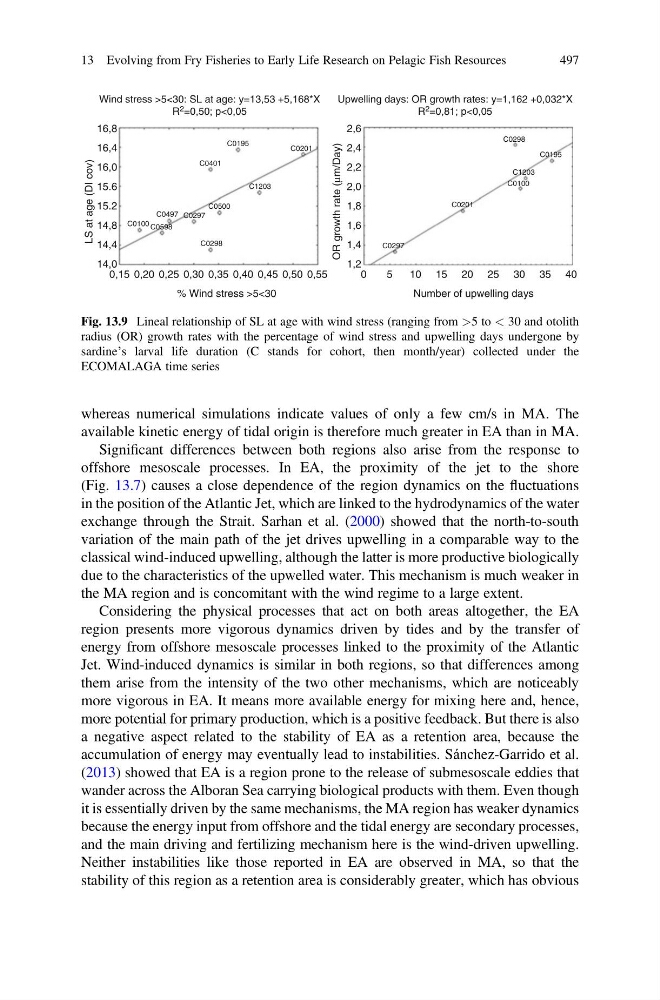
Fig. 13.9 Lineal relationship of SL at age with wind stress (ranging from >5 to < 30 and otolith
radius (OR) growth rates with the percentage of wind stress and upwelling days undergone by
sardine’s larval life duration (C stands for cohort, then month/year) collected under the
ECOMALAGA time series
13 Evolving from Fry Fisheries to Early Life Research on Pelagic Fish Resources
497
available kinetic energy of tidal origin is therefore much greater in EA than in MA.
Significant differences between both regions also arise from the response to
offshore mesoscale processes. In EA, the proximity of the jet to the shore
(Fig. 13.7) causes a close dependence of the region dynamics on the fluctuations
in the position of the Atlantic Jet, which are linked to the hydrodynamics of the water
exchange through the Strait. Sarhan et al. (2000) showed that the north-to-south
variation of the main path of the jet drives upwelling in a comparable way to the
classical wind-induced upwelling, although the latter is more productive biologically
due to the characteristics of the upwelled water. This mechanism is much weaker in
the MA region and is concomitant with the wind regime to a large extent.
Considering the physical processes that act on both areas altogether, the EA
region presents more vigorous dynamics driven by tides and by the transfer of
energy from offshore mesoscale processes linked to the proximity of the Atlantic
Jet. Wind-induced dynamics is similar in both regions, so that differences among
them arise from the intensity of the two other mechanisms, which are noticeably
more vigorous in EA. It means more available energy for mixing here and, hence,
more potential for primary production, which is a positive feedback. But there is also
a negative aspect related to the stability of EA as a retention area, because the
accumulation of energy may eventually lead to instabilities. Sánchez-Garrido et al.
(2013) showed that EA is a region prone to the release of submesoscale eddies that
wander across the Alboran Sea carrying biological products with them. Even though
it is essentially driven by the same mechanisms, the MA region has weaker dynamics
because the energy input from offshore and the tidal energy are secondary processes,
and the main driving and fertilizing mechanism here is the wind-driven upwelling.
Neither instabilities like those reported in EA are observed in MA, so that the
stability of this region as a retention area is considerably greater, which has obvious
16,8
16,4
16,0
15.6
15.2
14,8 C0100
C0497
C0598
C0298
C0297
C0500
C1203
C0401
C0195
C0297
C0201
C0100
C1203
C0195
C0298
C0201
14,4
14,0
2,6
2,4
2,2
2,0
1,8
1,6
1,4
1,2
0,15 0,20 0,25 0,30
% Wind stress >5<30
Number of upwelling days
Wind stress >5<30: SL at age: y=13,53 +5,168*X
R 2 =0,50; p<0,05
Upwelling days: OR growth rates: y=1,162 +0,032*X
R 2 =0,81; p<0,05
LS at age (DI cov)
OR growth rate (µm/Day)
0,35 0,40 0,45 0,50 0,55
0
5
10 15 20 25 30 35 40
Fig. 13.9 Lineal relationship of SL at age with wind stress (ranging from >5 to < 30 and otolith
radius (OR) growth rates with the percentage of wind stress and upwelling days undergone by
sardine’s larval life duration (C stands for cohort, then month/year) collected under the
ECOMALAGA time series
13 Evolving from Fry Fisheries to Early Life Research on Pelagic Fish Resources
497