

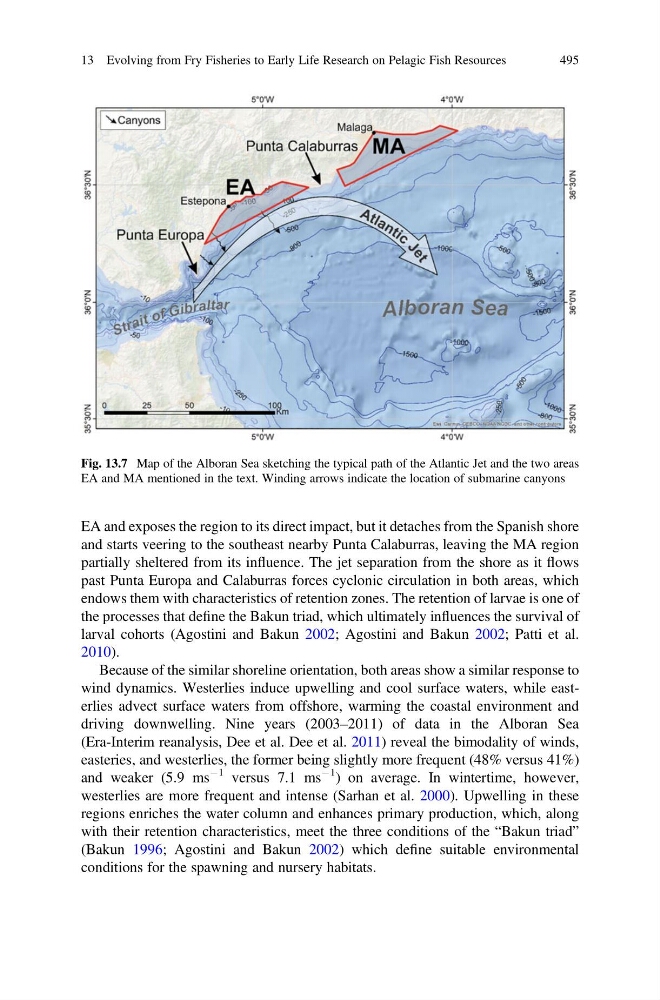
EA and exposes the region to its direct impact, but it detaches from the Spanish shore
and starts veering to the southeast nearby Punta Calaburras, leaving the MA region
partially sheltered from its influence. The jet separation from the shore as it flows
past Punta Europa and Calaburras forces cyclonic circulation in both areas, which
endows them with characteristics of retention zones. The retention of larvae is one of
the processes that define the Bakun triad, which ultimately influences the survival of
larval cohorts (Agostini and Bakun 2002; Agostini and Bakun 2002; Patti et al.
2010).
Because of the similar shoreline orientation, both areas show a similar response to
wind dynamics. Westerlies induce upwelling and cool surface waters, while easterlies advect surface waters from offshore, warming the coastal environment and
driving downwelling. Nine years (2003–2011) of data in the Alboran Sea
(Era-Interim reanalysis, Dee et al. Dee et al. 2011) reveal the bimodality of winds,
easteries, and westerlies, the former being slightly more frequent (48% versus 41%)
and weaker (5.9 ms
À1 versus 7.1 ms
À1 ) on average. In wintertime, however,
westerlies are more frequent and intense (Sarhan et al. 2000). Upwelling in these
regions enriches the water column and enhances primary production, which, along
with their retention characteristics, meet the three conditions of the “Bakun triad”
(Bakun 1996; Agostini and Bakun 2002) which define suitable environmental
conditions for the spawning and nursery habitats.
Fig. 13.7 Map of the Alboran Sea sketching the typical path of the Atlantic Jet and the two areas
EA and MA mentioned in the text. Winding arrows indicate the location of submarine canyons
13 Evolving from Fry Fisheries to Early Life Research on Pelagic Fish Resources
495
and starts veering to the southeast nearby Punta Calaburras, leaving the MA region
partially sheltered from its influence. The jet separation from the shore as it flows
past Punta Europa and Calaburras forces cyclonic circulation in both areas, which
endows them with characteristics of retention zones. The retention of larvae is one of
the processes that define the Bakun triad, which ultimately influences the survival of
larval cohorts (Agostini and Bakun 2002; Agostini and Bakun 2002; Patti et al.
2010).
Because of the similar shoreline orientation, both areas show a similar response to
wind dynamics. Westerlies induce upwelling and cool surface waters, while easterlies advect surface waters from offshore, warming the coastal environment and
driving downwelling. Nine years (2003–2011) of data in the Alboran Sea
(Era-Interim reanalysis, Dee et al. Dee et al. 2011) reveal the bimodality of winds,
easteries, and westerlies, the former being slightly more frequent (48% versus 41%)
and weaker (5.9 ms
À1 versus 7.1 ms
À1 ) on average. In wintertime, however,
westerlies are more frequent and intense (Sarhan et al. 2000). Upwelling in these
regions enriches the water column and enhances primary production, which, along
with their retention characteristics, meet the three conditions of the “Bakun triad”
(Bakun 1996; Agostini and Bakun 2002) which define suitable environmental
conditions for the spawning and nursery habitats.
Fig. 13.7 Map of the Alboran Sea sketching the typical path of the Atlantic Jet and the two areas
EA and MA mentioned in the text. Winding arrows indicate the location of submarine canyons
13 Evolving from Fry Fisheries to Early Life Research on Pelagic Fish Resources
495