

48 the Atlantic fish species that have penetrated the Strait of Gibraltar into the
Mediterranean in recent years.
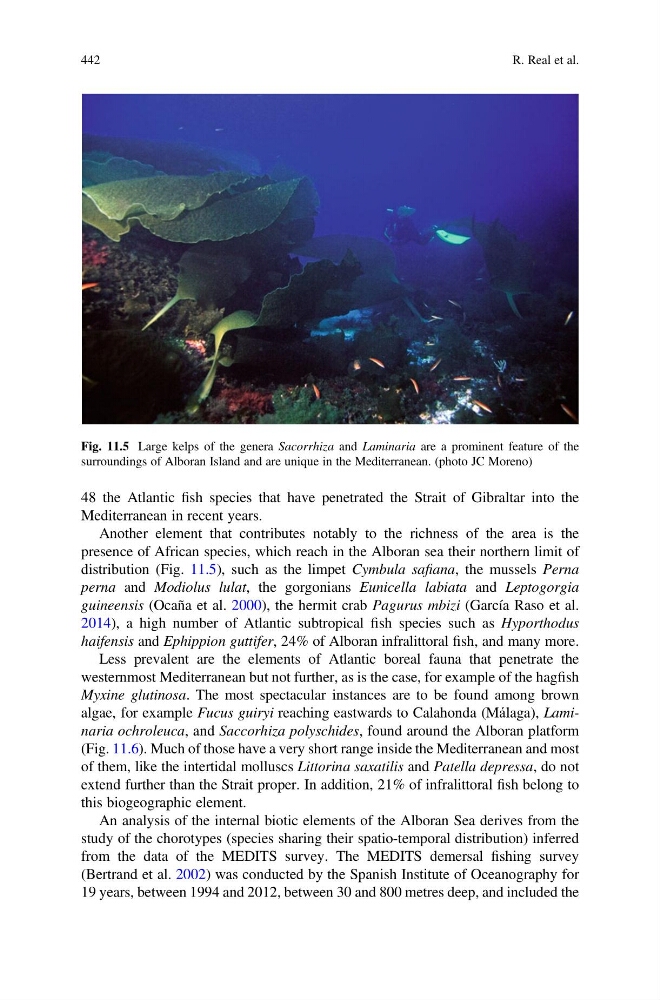
Another element that contributes notably to the richness of the area is the
presence of African species, which reach in the Alboran sea their northern limit of
distribution (Fig. 11.5), such as the limpet Cymbula safiana, the mussels Perna
perna and Modiolus lulat, the gorgonians Eunicella labiata and Leptogorgia
guineensis (Ocaña et al. 2000), the hermit crab Pagurus mbizi (García Raso et al.
2014), a high number of Atlantic subtropical fish species such as Hyporthodus
haifensis and Ephippion guttifer, 24% of Alboran infralittoral fish, and many more.
Less prevalent are the elements of Atlantic boreal fauna that penetrate the
westernmost Mediterranean but not further, as is the case, for example of the hagfish
Myxine glutinosa. The most spectacular instances are to be found among brown
algae, for example Fucus guiryi reaching eastwards to Calahonda (Málaga), Laminaria ochroleuca, and Saccorhiza polyschides, found around the Alboran platform
(Fig. 11.6). Much of those have a very short range inside the Mediterranean and most
of them, like the intertidal molluscs Littorina saxatilis and Patella depressa, do not
extend further than the Strait proper. In addition, 21% of infralittoral fish belong to
this biogeographic element.
An analysis of the internal biotic elements of the Alboran Sea derives from the
study of the chorotypes (species sharing their spatio-temporal distribution) inferred
from the data of the MEDITS survey. The MEDITS demersal fishing survey
(Bertrand et al. 2002) was conducted by the Spanish Institute of Oceanography for
19 years, between 1994 and 2012, between 30 and 800 metres deep, and included the
Fig. 11.5 Large kelps of the genera Sacorrhiza and Laminaria are a prominent feature of the
surroundings of Alboran Island and are unique in the Mediterranean. (photo JC Moreno)
442
R. Real et al.
Mediterranean in recent years.
Another element that contributes notably to the richness of the area is the
presence of African species, which reach in the Alboran sea their northern limit of
distribution (Fig. 11.5), such as the limpet Cymbula safiana, the mussels Perna
perna and Modiolus lulat, the gorgonians Eunicella labiata and Leptogorgia
guineensis (Ocaña et al. 2000), the hermit crab Pagurus mbizi (García Raso et al.
2014), a high number of Atlantic subtropical fish species such as Hyporthodus
haifensis and Ephippion guttifer, 24% of Alboran infralittoral fish, and many more.
Less prevalent are the elements of Atlantic boreal fauna that penetrate the
westernmost Mediterranean but not further, as is the case, for example of the hagfish
Myxine glutinosa. The most spectacular instances are to be found among brown
algae, for example Fucus guiryi reaching eastwards to Calahonda (Málaga), Laminaria ochroleuca, and Saccorhiza polyschides, found around the Alboran platform
(Fig. 11.6). Much of those have a very short range inside the Mediterranean and most
of them, like the intertidal molluscs Littorina saxatilis and Patella depressa, do not
extend further than the Strait proper. In addition, 21% of infralittoral fish belong to
this biogeographic element.
An analysis of the internal biotic elements of the Alboran Sea derives from the
study of the chorotypes (species sharing their spatio-temporal distribution) inferred
from the data of the MEDITS survey. The MEDITS demersal fishing survey
(Bertrand et al. 2002) was conducted by the Spanish Institute of Oceanography for
19 years, between 1994 and 2012, between 30 and 800 metres deep, and included the
Fig. 11.5 Large kelps of the genera Sacorrhiza and Laminaria are a prominent feature of the
surroundings of Alboran Island and are unique in the Mediterranean. (photo JC Moreno)
442
R. Real et al.