

Alboran Sea together with other Spanish Mediterranean waters. Depth was the most
influential factor to explain the distribution patterns of these fish species in the
Alboran Sea. For example, a chorotype was composed of shallow species (71.2 m
average depth), including Arnoglossus thori, Diplodus vulgaris, Pagrus pagrus,
Scorpaena notata, Serranus cabrilla, Spondyliosoma cantharus, and Trigloporus
lastoviza. These species live near the coasts and on the whole continental platform.
They share rocky but also sandy and muddy habitats. There are years in which
populations of these species are absent, or are less frequent in large areas, including
the Alboran Sea. A second chorotype, however, was composed of Gadiculus
argenteus, Gaidropsarus biscayensis, Helicolenus dactylopterus, Lepidopus
caudatus, Lophius budegassa, Micromesistius poutassou, Phycis blennoides,
Scyliorhinus canicula and Symphurus nigrescens, and occurs mostly at the limits
between the continental shelf and the slope (300 m).
In recent years, a process of tropicalization of the ichthyofauna is evidenced by
the northward range expansion of southern species which are either reported for the
first time in the Mediterranean, as is the case of Acanthurus monrovie (Langeneck
et al. 2015) and Cantigaster capistratus (Galeote 2001; Brito et al. 2007), or increase
their number, as occurs with Katsuwomus pelamis (Saber et al. 2015) or Thunnus
obesus (J.C. Báez, personal observation). This process could be due to a combination of increasing sea surface temperature and anthropogenic effects.
11.5 Species Richness
The Alboran Sea stands out for the richness of its biota, in part because of its location
at the crossroads of the already mentioned Lusitanian, Mauritanian and Mediterranean marine biogeographical regions. This makes the area a place of confluence,
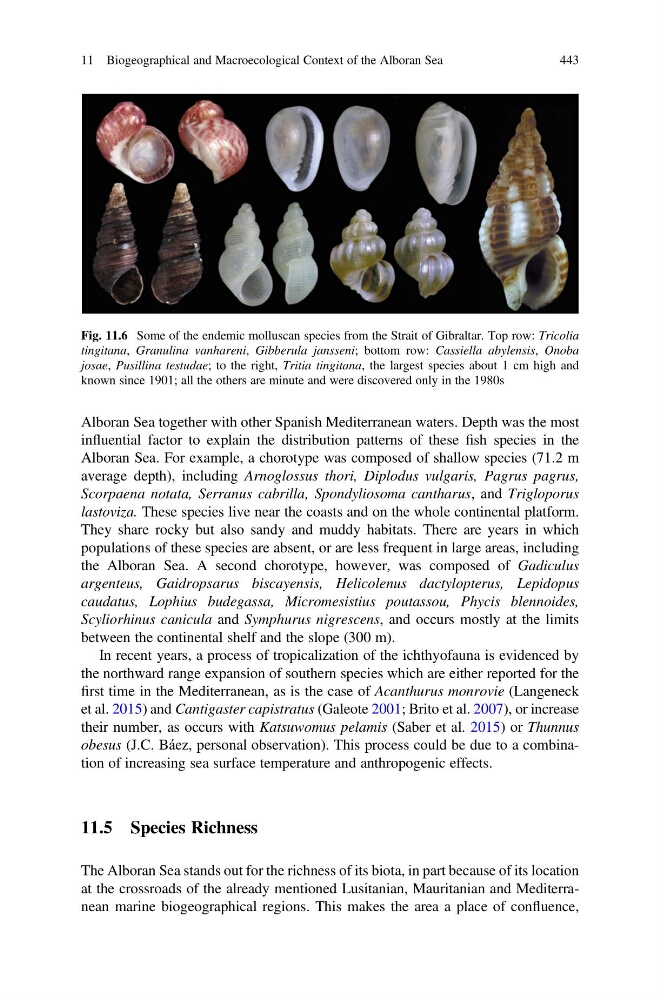
Fig. 11.6 Some of the endemic molluscan species from the Strait of Gibraltar. Top row: Tricolia
tingitana, Granulina vanhareni, Gibberula jansseni; bottom row: Cassiella abylensis, Onoba
josae, Pusillina testudae; to the right, Tritia tingitana, the largest species about 1 cm high and
known since 1901; all the others are minute and were discovered only in the 1980s
11 Biogeographical and Macroecological Context of the Alboran Sea
443
influential factor to explain the distribution patterns of these fish species in the
Alboran Sea. For example, a chorotype was composed of shallow species (71.2 m
average depth), including Arnoglossus thori, Diplodus vulgaris, Pagrus pagrus,
Scorpaena notata, Serranus cabrilla, Spondyliosoma cantharus, and Trigloporus
lastoviza. These species live near the coasts and on the whole continental platform.
They share rocky but also sandy and muddy habitats. There are years in which
populations of these species are absent, or are less frequent in large areas, including
the Alboran Sea. A second chorotype, however, was composed of Gadiculus
argenteus, Gaidropsarus biscayensis, Helicolenus dactylopterus, Lepidopus
caudatus, Lophius budegassa, Micromesistius poutassou, Phycis blennoides,
Scyliorhinus canicula and Symphurus nigrescens, and occurs mostly at the limits
between the continental shelf and the slope (300 m).
In recent years, a process of tropicalization of the ichthyofauna is evidenced by
the northward range expansion of southern species which are either reported for the
first time in the Mediterranean, as is the case of Acanthurus monrovie (Langeneck
et al. 2015) and Cantigaster capistratus (Galeote 2001; Brito et al. 2007), or increase
their number, as occurs with Katsuwomus pelamis (Saber et al. 2015) or Thunnus
obesus (J.C. Báez, personal observation). This process could be due to a combination of increasing sea surface temperature and anthropogenic effects.
11.5 Species Richness
The Alboran Sea stands out for the richness of its biota, in part because of its location
at the crossroads of the already mentioned Lusitanian, Mauritanian and Mediterranean marine biogeographical regions. This makes the area a place of confluence,
Fig. 11.6 Some of the endemic molluscan species from the Strait of Gibraltar. Top row: Tricolia
tingitana, Granulina vanhareni, Gibberula jansseni; bottom row: Cassiella abylensis, Onoba
josae, Pusillina testudae; to the right, Tritia tingitana, the largest species about 1 cm high and
known since 1901; all the others are minute and were discovered only in the 1980s
11 Biogeographical and Macroecological Context of the Alboran Sea
443