

its last important populations in Calahonda (Málaga). Ten infra-littoral fish species
(Raja asterias, Syngnathus abaster, Gobius strictus, Pomatoschistus kneri,
P. quagga, Pseudaphya ferreri, Blennius incognitus, Symphodus rostratus,
Opeatogenys gracilis, and Arnoglossus kessleri) are endemic to the Mediterranean
(Reina Hervás and Serrano 1987a, b; Reina Hervás and Serrano 1993). The Alboran
Sea also hosts most of the populations of the Patella ferruginea, catalogued “in
danger of extinction”. This and other Mediterranean species (e.g. the intertidal
gastropod Phorcus richardi) reach the Strait of Gibraltar but do not penetrate further
into the Atlantic. However, the Alboran Sea is characterized by a low presence of
Mediterranean endemics, probably due to the effect of the incoming Atlantic body of
water, which forms a permanent gyre clockwise in Alboran that is separated from the
rest of the western Mediterranean basin by the well-marked hydrographic front
between Oran and Almeria. The Alboran Sea is also the core distribution area of
the Mediterranean orange coral Astroides calycularis, which has a limited geographical distribution in the straits of Sicily and Messina, the Gulf of Naples and Malta,
but mainly occurs in the Alboran Sea, from the Strait of Gibraltar to Cabo de Palos
on the European coast and from Morocco to Tunisia on the African coast. Probably
as a result of the currents that disperse the larvae from the Alboran Sea, there are also
specimens in Cape Espartel (Morocco) and Cádiz (Spain) (Terrón-Sigler et al. 2015).
The most common pattern among species living in the Alboran sea is that of an
Atlanto-Mediterranean range spanning both the Mediterranean (or most of it) and, in
the Atlantic, the Ibero-Moroccan area or further. Nearly half of the molluscan
species recorded by Urra et al. (2017) in the Calahonda Special Area of Conservation
(Málaga) have this kind of distribution, as it is also the case of infralittoral fish, with
30% of them being Atlanto-Mediterranean and an additional 18% more strictly
Ibero-Moroccan (Reina Hervás and Serrano 1987a, b, Reina Hervás and Serrano
1993). A majority of Cnidarians from the coast of Granada assessed by Ocaña et al.
(2000) are also Atlanto-Mediterranean, as are other fish species such as Galeus
atlanticus or Squalus megalops. During the last 30 years, there has been a growing
presence of Atlantic species, mainly fish, on the coasts of the Alboran Sea. These
presences would be favoured by an increase in the flow of water through the Strait
and hydroclimatic modifications of the area. Psomadakis et al. (2012) quantified in
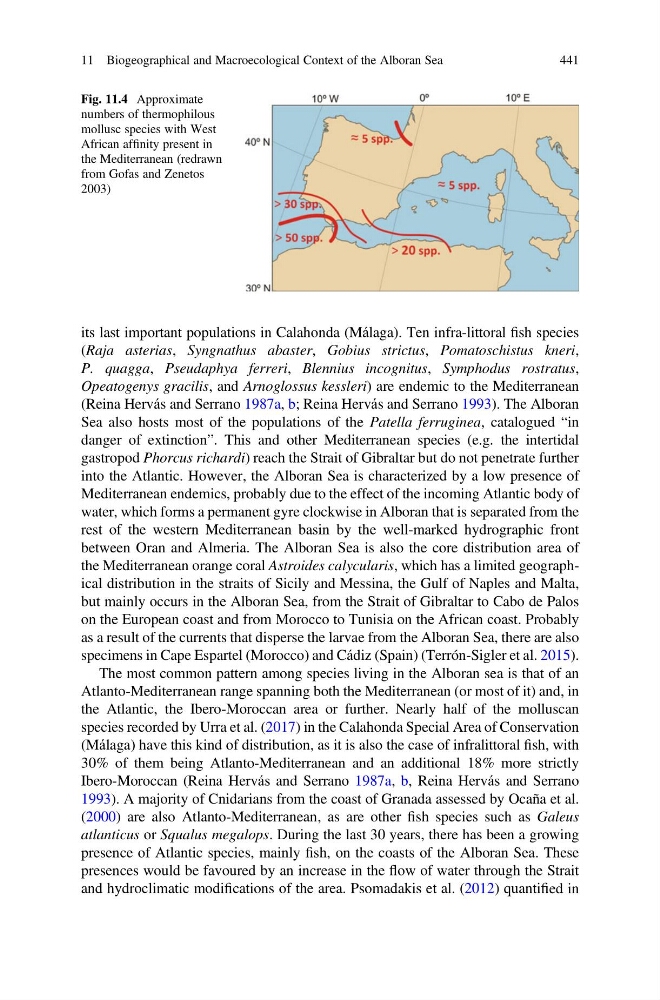
Fig. 11.4 Approximate
numbers of thermophilous
mollusc species with West
African affinity present in
the Mediterranean (redrawn
from Gofas and Zenetos
2003)
11 Biogeographical and Macroecological Context of the Alboran Sea
441
(Raja asterias, Syngnathus abaster, Gobius strictus, Pomatoschistus kneri,
P. quagga, Pseudaphya ferreri, Blennius incognitus, Symphodus rostratus,
Opeatogenys gracilis, and Arnoglossus kessleri) are endemic to the Mediterranean
(Reina Hervás and Serrano 1987a, b; Reina Hervás and Serrano 1993). The Alboran
Sea also hosts most of the populations of the Patella ferruginea, catalogued “in
danger of extinction”. This and other Mediterranean species (e.g. the intertidal
gastropod Phorcus richardi) reach the Strait of Gibraltar but do not penetrate further
into the Atlantic. However, the Alboran Sea is characterized by a low presence of
Mediterranean endemics, probably due to the effect of the incoming Atlantic body of
water, which forms a permanent gyre clockwise in Alboran that is separated from the
rest of the western Mediterranean basin by the well-marked hydrographic front
between Oran and Almeria. The Alboran Sea is also the core distribution area of
the Mediterranean orange coral Astroides calycularis, which has a limited geographical distribution in the straits of Sicily and Messina, the Gulf of Naples and Malta,
but mainly occurs in the Alboran Sea, from the Strait of Gibraltar to Cabo de Palos
on the European coast and from Morocco to Tunisia on the African coast. Probably
as a result of the currents that disperse the larvae from the Alboran Sea, there are also
specimens in Cape Espartel (Morocco) and Cádiz (Spain) (Terrón-Sigler et al. 2015).
The most common pattern among species living in the Alboran sea is that of an
Atlanto-Mediterranean range spanning both the Mediterranean (or most of it) and, in
the Atlantic, the Ibero-Moroccan area or further. Nearly half of the molluscan
species recorded by Urra et al. (2017) in the Calahonda Special Area of Conservation
(Málaga) have this kind of distribution, as it is also the case of infralittoral fish, with
30% of them being Atlanto-Mediterranean and an additional 18% more strictly
Ibero-Moroccan (Reina Hervás and Serrano 1987a, b, Reina Hervás and Serrano
1993). A majority of Cnidarians from the coast of Granada assessed by Ocaña et al.
(2000) are also Atlanto-Mediterranean, as are other fish species such as Galeus
atlanticus or Squalus megalops. During the last 30 years, there has been a growing
presence of Atlantic species, mainly fish, on the coasts of the Alboran Sea. These
presences would be favoured by an increase in the flow of water through the Strait
and hydroclimatic modifications of the area. Psomadakis et al. (2012) quantified in
Fig. 11.4 Approximate
numbers of thermophilous
mollusc species with West
African affinity present in
the Mediterranean (redrawn
from Gofas and Zenetos
2003)
11 Biogeographical and Macroecological Context of the Alboran Sea
441