

high commercial value such as the spiny lobster Palinurus elephas, the European
lobster Homarus gammarus, the Mediterranean slipper lobster Scyllarides latus, the
spider crab Maja squinado, the knobbed triton Charonia lampas or the date mussel
Lithophaga lithophaga. Among fishes, Anthias anthias is among the commonest
species and forms swarms next to some overhangs of the rocky bottom. Groupers
such as Epinephelus marginatus and the cuckoo wrasse Labrus mixtus are also
characteristic of this habitat.
At deeper areas and down to 200 m depth or more, coralligenous communities
turn to a “Roche du Large” community (sensu Pérès and Picard 1964) with a
different faunal composition. The community on the Alboran platform is dominated
by the gorgonians Viminella flagellum, Acanthogorgia hirsuta, Acanthogorgia
armata and especially Callogorgia verticillata, a typical species of the bathyal
level that can develop dense “gorgonian gardens” (Gofas et al. 2014a). Other typical
species include small-size gorgonians (e.g. Bebryce mollis) and scleractinians
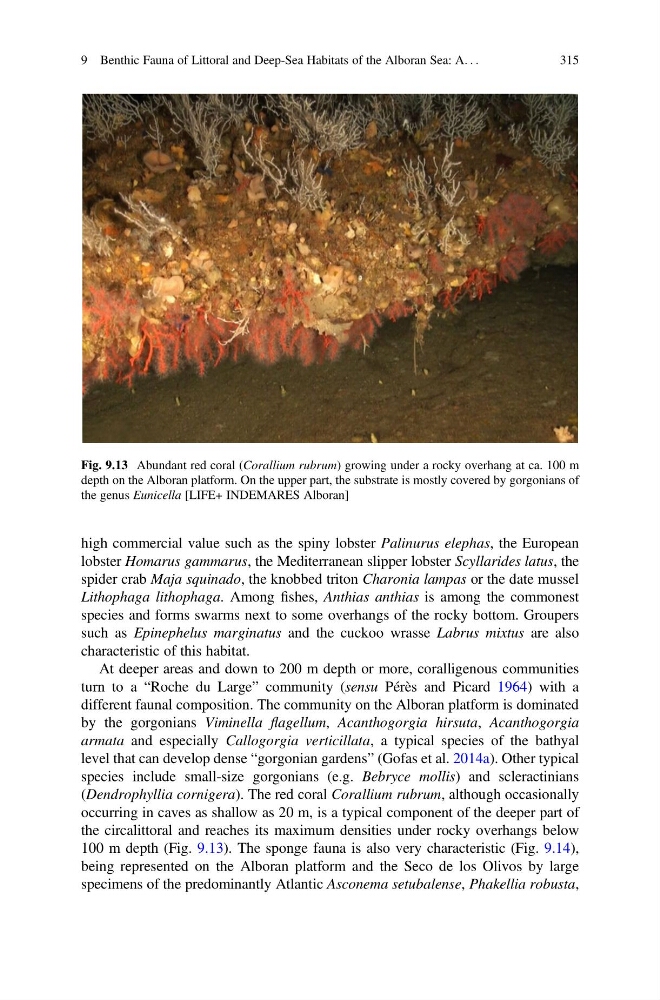
(Dendrophyllia cornigera). The red coral Corallium rubrum, although occasionally
occurring in caves as shallow as 20 m, is a typical component of the deeper part of
the circalittoral and reaches its maximum densities under rocky overhangs below
100 m depth (Fig. 9.13). The sponge fauna is also very characteristic (Fig. 9.14),
being represented on the Alboran platform and the Seco de los Olivos by large
specimens of the predominantly Atlantic Asconema setubalense, Phakellia robusta,
Fig. 9.13 Abundant red coral (Corallium rubrum) growing under a rocky overhang at ca. 100 m
depth on the Alboran platform. On the upper part, the substrate is mostly covered by gorgonians of
the genus Eunicella [LIFE+ INDEMARES Alboran]
9 Benthic Fauna of Littoral and Deep-Sea Habitats of the Alboran Sea: A. . .
315
lobster Homarus gammarus, the Mediterranean slipper lobster Scyllarides latus, the
spider crab Maja squinado, the knobbed triton Charonia lampas or the date mussel
Lithophaga lithophaga. Among fishes, Anthias anthias is among the commonest
species and forms swarms next to some overhangs of the rocky bottom. Groupers
such as Epinephelus marginatus and the cuckoo wrasse Labrus mixtus are also
characteristic of this habitat.
At deeper areas and down to 200 m depth or more, coralligenous communities
turn to a “Roche du Large” community (sensu Pérès and Picard 1964) with a
different faunal composition. The community on the Alboran platform is dominated
by the gorgonians Viminella flagellum, Acanthogorgia hirsuta, Acanthogorgia
armata and especially Callogorgia verticillata, a typical species of the bathyal
level that can develop dense “gorgonian gardens” (Gofas et al. 2014a). Other typical
species include small-size gorgonians (e.g. Bebryce mollis) and scleractinians
(Dendrophyllia cornigera). The red coral Corallium rubrum, although occasionally
occurring in caves as shallow as 20 m, is a typical component of the deeper part of
the circalittoral and reaches its maximum densities under rocky overhangs below
100 m depth (Fig. 9.13). The sponge fauna is also very characteristic (Fig. 9.14),
being represented on the Alboran platform and the Seco de los Olivos by large
specimens of the predominantly Atlantic Asconema setubalense, Phakellia robusta,
Fig. 9.13 Abundant red coral (Corallium rubrum) growing under a rocky overhang at ca. 100 m
depth on the Alboran platform. On the upper part, the substrate is mostly covered by gorgonians of
the genus Eunicella [LIFE+ INDEMARES Alboran]
9 Benthic Fauna of Littoral and Deep-Sea Habitats of the Alboran Sea: A. . .
315