

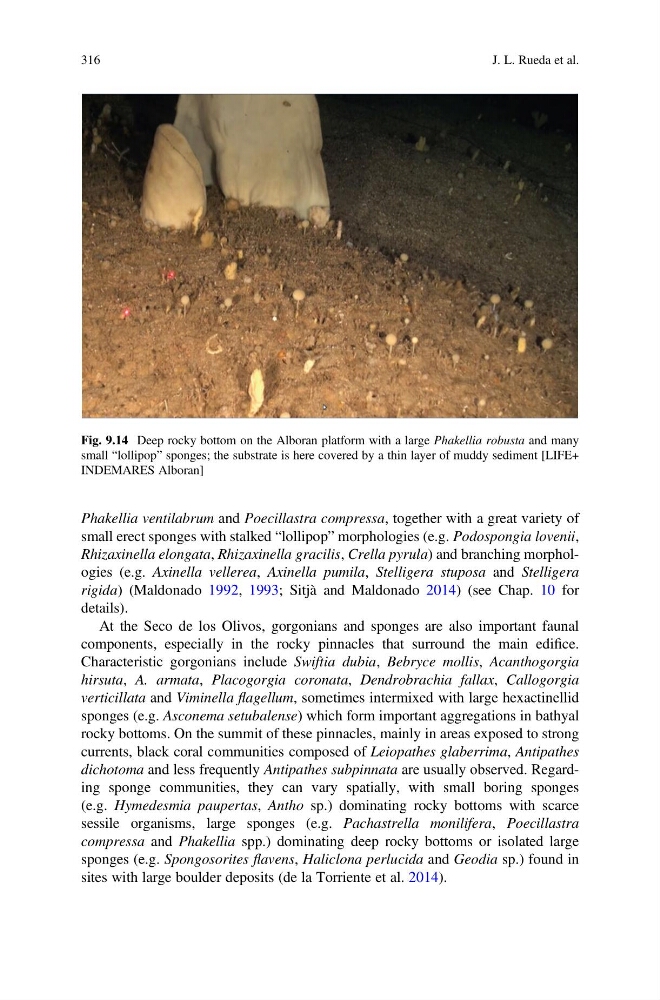
Phakellia ventilabrum and Poecillastra compressa, together with a great variety of
small erect sponges with stalked “lollipop” morphologies (e.g. Podospongia lovenii,
Rhizaxinella elongata, Rhizaxinella gracilis, Crella pyrula) and branching morphologies (e.g. Axinella vellerea, Axinella pumila, Stelligera stuposa and Stelligera
rigida) (Maldonado 1992, 1993; Sitjà and Maldonado 2014) (see Chap. 10 for
details).
At the Seco de los Olivos, gorgonians and sponges are also important faunal
components, especially in the rocky pinnacles that surround the main edifice.
Characteristic gorgonians include Swiftia dubia, Bebryce mollis, Acanthogorgia
hirsuta, A. armata, Placogorgia coronata, Dendrobrachia fallax, Callogorgia
verticillata and Viminella flagellum, sometimes intermixed with large hexactinellid
sponges (e.g. Asconema setubalense) which form important aggregations in bathyal
rocky bottoms. On the summit of these pinnacles, mainly in areas exposed to strong
currents, black coral communities composed of Leiopathes glaberrima, Antipathes
dichotoma and less frequently Antipathes subpinnata are usually observed. Regarding sponge communities, they can vary spatially, with small boring sponges
(e.g. Hymedesmia paupertas, Antho sp.) dominating rocky bottoms with scarce
sessile organisms, large sponges (e.g. Pachastrella monilifera, Poecillastra
compressa and Phakellia spp.) dominating deep rocky bottoms or isolated large
sponges (e.g. Spongosorites flavens, Haliclona perlucida and Geodia sp.) found in
sites with large boulder deposits (de la Torriente et al. 2014).
Fig. 9.14 Deep rocky bottom on the Alboran platform with a large Phakellia robusta and many
small “lollipop” sponges; the substrate is here covered by a thin layer of muddy sediment [LIFE+
INDEMARES Alboran]
316
J. L. Rueda et al.
small erect sponges with stalked “lollipop” morphologies (e.g. Podospongia lovenii,
Rhizaxinella elongata, Rhizaxinella gracilis, Crella pyrula) and branching morphologies (e.g. Axinella vellerea, Axinella pumila, Stelligera stuposa and Stelligera
rigida) (Maldonado 1992, 1993; Sitjà and Maldonado 2014) (see Chap. 10 for
details).
At the Seco de los Olivos, gorgonians and sponges are also important faunal
components, especially in the rocky pinnacles that surround the main edifice.
Characteristic gorgonians include Swiftia dubia, Bebryce mollis, Acanthogorgia
hirsuta, A. armata, Placogorgia coronata, Dendrobrachia fallax, Callogorgia
verticillata and Viminella flagellum, sometimes intermixed with large hexactinellid
sponges (e.g. Asconema setubalense) which form important aggregations in bathyal
rocky bottoms. On the summit of these pinnacles, mainly in areas exposed to strong
currents, black coral communities composed of Leiopathes glaberrima, Antipathes
dichotoma and less frequently Antipathes subpinnata are usually observed. Regarding sponge communities, they can vary spatially, with small boring sponges
(e.g. Hymedesmia paupertas, Antho sp.) dominating rocky bottoms with scarce
sessile organisms, large sponges (e.g. Pachastrella monilifera, Poecillastra
compressa and Phakellia spp.) dominating deep rocky bottoms or isolated large
sponges (e.g. Spongosorites flavens, Haliclona perlucida and Geodia sp.) found in
sites with large boulder deposits (de la Torriente et al. 2014).
Fig. 9.14 Deep rocky bottom on the Alboran platform with a large Phakellia robusta and many
small “lollipop” sponges; the substrate is here covered by a thin layer of muddy sediment [LIFE+
INDEMARES Alboran]
316
J. L. Rueda et al.