

66
2 – Methods and techniques
where t c is the cationic transport number in the MX compound, F is the
Faraday constant, ρ is the density of MX, M is the molar mass of MX, S is the
surface area of the anode, Δx is the displacement of the anode-MX interface,
I is the dc current passing through the anode, and τ is the electrolysis time.
Consider the displacement of a cylindrical cell with constant cross section s
and whose anodic interface has been displaced a distance Δx. This displacement is due to the passage of a current I for a time τ.
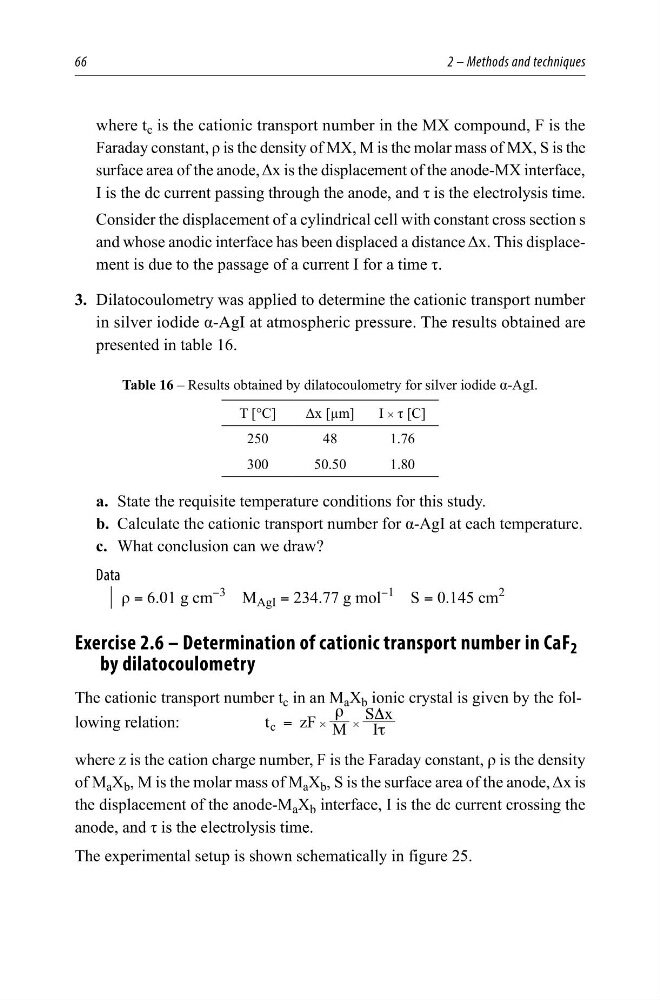
3. Dilatocoulometry was applied to determine the cationic transport number
in silver iodide α-AgI at atmospheric pressure. The results obtained are
presented in table 16.
Table 16 – Results obtained by dilatocoulometry for silver iodide α-AgI.
T [°C]
Δx [µm]
I # τ [C]
250
48
1.76
300
50.50
1.80
a. State the requisite temperature conditions for this study.
b. Calculate the cationic transport number for α-AgI at each temperature.
c. What conclusion can we draw?
Data
ρ = 6.01 g cm
−3
M AgI = 234.77 g mol
−1
S = 0.145 cm
2
Exercise 2.6 – Determination of cationic transport number in CaF 2
by dilatocoulometry
The cationic transport number t c in an M a X b ionic crystal is given by the following relation:
t
zF M
I
S x
c
ρ
τ
Δ
=
#
#
where z is the cation charge number, F is the Faraday constant, ρ is the density
of M a X b , M is the molar mass of M a X b , S is the surface area of the anode, Δx is
the displacement of the anode-M a X b interface, I is the dc current crossing the
anode, and τ is the electrolysis time.
The experimental setup is shown schematically in figure 25.
2 – Methods and techniques
where t c is the cationic transport number in the MX compound, F is the
Faraday constant, ρ is the density of MX, M is the molar mass of MX, S is the
surface area of the anode, Δx is the displacement of the anode-MX interface,
I is the dc current passing through the anode, and τ is the electrolysis time.
Consider the displacement of a cylindrical cell with constant cross section s
and whose anodic interface has been displaced a distance Δx. This displacement is due to the passage of a current I for a time τ.
3. Dilatocoulometry was applied to determine the cationic transport number
in silver iodide α-AgI at atmospheric pressure. The results obtained are
presented in table 16.
Table 16 – Results obtained by dilatocoulometry for silver iodide α-AgI.
T [°C]
Δx [µm]
I # τ [C]
250
48
1.76
300
50.50
1.80
a. State the requisite temperature conditions for this study.
b. Calculate the cationic transport number for α-AgI at each temperature.
c. What conclusion can we draw?
Data
ρ = 6.01 g cm
−3
M AgI = 234.77 g mol
−1
S = 0.145 cm
2
Exercise 2.6 – Determination of cationic transport number in CaF 2
by dilatocoulometry
The cationic transport number t c in an M a X b ionic crystal is given by the following relation:
t
zF M
I
S x
c
ρ
τ
Δ
=
#
#
where z is the cation charge number, F is the Faraday constant, ρ is the density
of M a X b , M is the molar mass of M a X b , S is the surface area of the anode, Δx is
the displacement of the anode-M a X b interface, I is the dc current crossing the
anode, and τ is the electrolysis time.
The experimental setup is shown schematically in figure 25.