

Exercises
63
The oxygen activity a O
RE
2
at the reference electrode is fixed by the equilibrium
between the two copper oxides
2CuO(s) m Cu 2 O(s) + 2
1 O 2 (g)
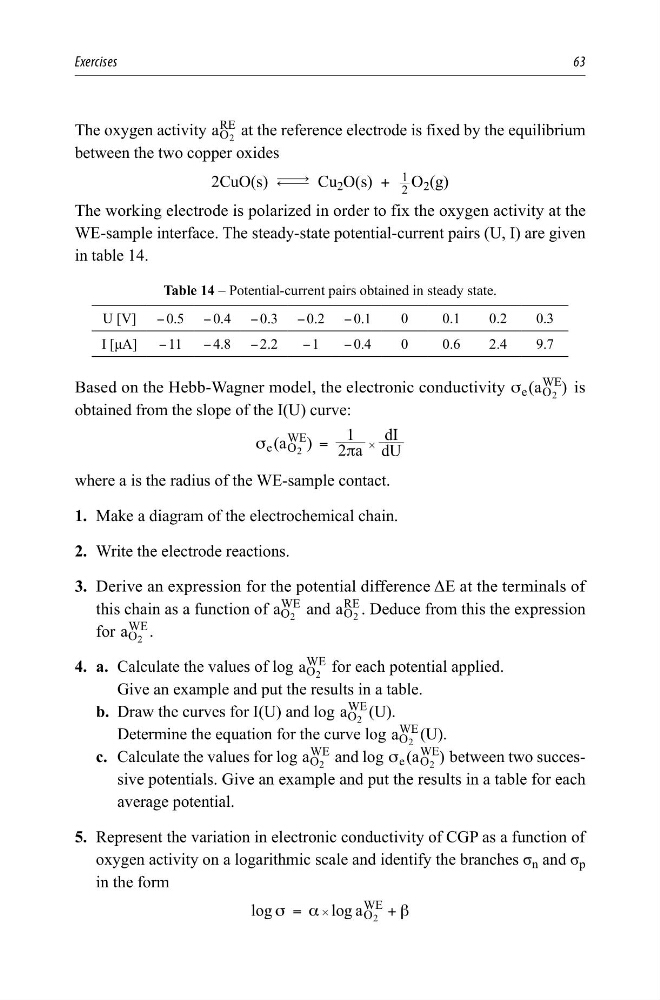
The working electrode is polarized in order to fix the oxygen activity at the
WE-sample interface. The steady-state potential-current pairs (U, I) are given
in table 14.
Table 14 – Potential-current pairs obtained in steady state.
U [V] − 0.5 − 0.4 − 0.3 − 0.2 − 0.1
0
0.1
0.2
0.3
I [μA]
− 11
− 4.8 − 2.2
− 1
− 0.4
0
0.6
2.4
9.7
Based on the Hebb-Wagner model, the electronic conductivity (a )
e O
WE
2
σ
is
obtained from the slope of the I(U) curve:
(a )
2 a
1
dU
dI
e O
WE
2
σ
π
=
#
where a is the radius of the WE-sample contact.
1. Make a diagram of the electrochemical chain.
2. Write the electrode reactions.
3. Derive an expression for the potential difference ΔE at the terminals of
this chain as a function of a O
WE
2
and a O
RE
2
. Deduce from this the expression
for a O
WE
2
.
4. a. Calculate the values of log a O
WE
2
for each potential applied.
Give an example and put the results in a table.
b. Draw the curves for I(U) and log a O
WE
2
(U).
Determine the equation for the curve log a O
WE
2
(U).
c. Calculate the values for log a O
WE
2
and log (a )
e O
WE
2
σ
between two successive potentials. Give an example and put the results in a table for each
average potential.
5. Represent the variation in electronic conductivity of CGP as a function of
oxygen activity on a logarithmic scale and identify the branches σ n and σ p
in the form
log
l og a O
WE
2
σ α
β
=
+
#
63
The oxygen activity a O
RE
2
at the reference electrode is fixed by the equilibrium
between the two copper oxides
2CuO(s) m Cu 2 O(s) + 2
1 O 2 (g)
The working electrode is polarized in order to fix the oxygen activity at the
WE-sample interface. The steady-state potential-current pairs (U, I) are given
in table 14.
Table 14 – Potential-current pairs obtained in steady state.
U [V] − 0.5 − 0.4 − 0.3 − 0.2 − 0.1
0
0.1
0.2
0.3
I [μA]
− 11
− 4.8 − 2.2
− 1
− 0.4
0
0.6
2.4
9.7
Based on the Hebb-Wagner model, the electronic conductivity (a )
e O
WE
2
σ
is
obtained from the slope of the I(U) curve:
(a )
2 a
1
dU
dI
e O
WE
2
σ
π
=
#
where a is the radius of the WE-sample contact.
1. Make a diagram of the electrochemical chain.
2. Write the electrode reactions.
3. Derive an expression for the potential difference ΔE at the terminals of
this chain as a function of a O
WE
2
and a O
RE
2
. Deduce from this the expression
for a O
WE
2
.
4. a. Calculate the values of log a O
WE
2
for each potential applied.
Give an example and put the results in a table.
b. Draw the curves for I(U) and log a O
WE
2
(U).
Determine the equation for the curve log a O
WE
2
(U).
c. Calculate the values for log a O
WE
2
and log (a )
e O
WE
2
σ
between two successive potentials. Give an example and put the results in a table for each
average potential.
5. Represent the variation in electronic conductivity of CGP as a function of
oxygen activity on a logarithmic scale and identify the branches σ n and σ p
in the form
log
l og a O
WE
2
σ α
β
=
+
#