

Solutions to exercises
41
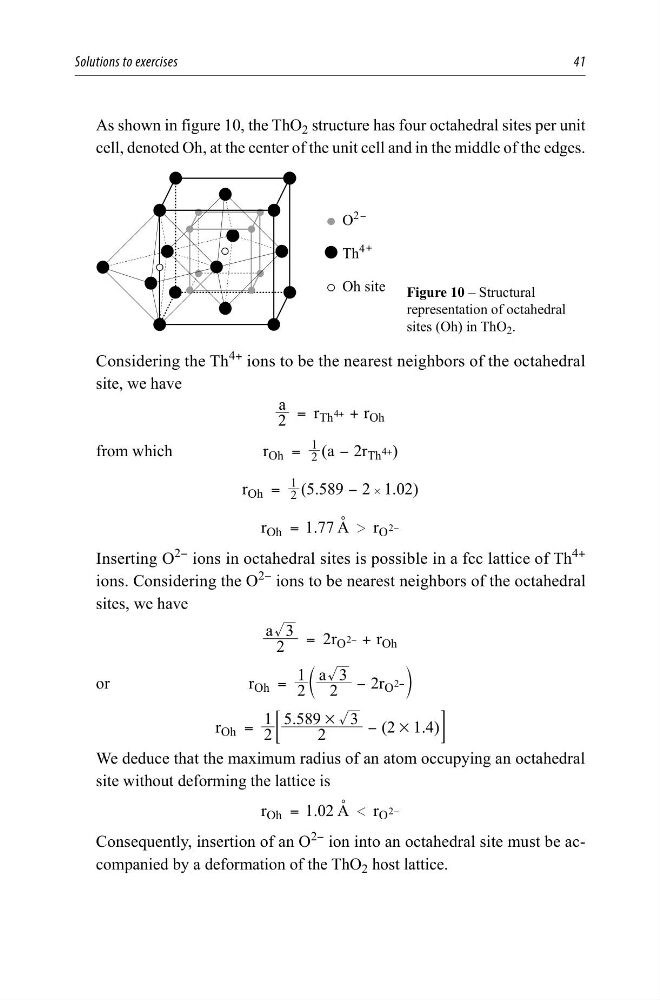
As shown in figure 10, the ThO 2 structure has four octahedral sites per unit
cell, denoted Oh, at the center of the unit cell and in the middle of the edges.
Figure 10 – Structural
representation of octahedral
sites (Oh) in ThO 2 .
Considering the Th
4+
ions to be the nearest neighbors of the octahedral
site, we have
a
r
r
2
Th
Oh
4
=
+
+
from which
(
)
r
a
r
2
Oh
Th
2
1
4
=
−
+
( .
. )
r
5589 2 1 02
Oh
2
1
#
=
−
.
r
A r
1 77
Oh
O 2
=
2
−
c
Inserting O
2−
ions in octahedral sites is possible in a fcc lattice of Th
4+
ions. Considering the O
2−
ions to be nearest neighbors of the octahedral
sites, we have
a
r
r
2
3
2 O
O h
2
=
+
−
or
r
a
r
2
1 2
3
2
Oh
O 2
=
−
−
c
m
.
(
. )
r
2
1
2
5 589
3
2 1 4
Oh
#
#
=
−
;
E
We deduce that the maximum radius of an atom occupying an octahedral
site without deforming the lattice is
.
r
A r
1 02
Oh
O 2
=
1
−
c
Consequently, insertion of an O
2−
ion into an octahedral site must be accompanied by a deformation of the ThO 2 host lattice.
2
<
7K
2KVLWH
41
As shown in figure 10, the ThO 2 structure has four octahedral sites per unit
cell, denoted Oh, at the center of the unit cell and in the middle of the edges.
Figure 10 – Structural
representation of octahedral
sites (Oh) in ThO 2 .
Considering the Th
4+
ions to be the nearest neighbors of the octahedral
site, we have
a
r
r
2
Th
Oh
4
=
+
+
from which
(
)
r
a
r
2
Oh
Th
2
1
4
=
−
+
( .
. )
r
5589 2 1 02
Oh
2
1
#
=
−
.
r
A r
1 77
Oh
O 2
=
2
−
c
Inserting O
2−
ions in octahedral sites is possible in a fcc lattice of Th
4+
ions. Considering the O
2−
ions to be nearest neighbors of the octahedral
sites, we have
a
r
r
2
3
2 O
O h
2
=
+
−
or
r
a
r
2
1 2
3
2
Oh
O 2
=
−
−
c
m
.
(
. )
r
2
1
2
5 589
3
2 1 4
Oh
#
#
=
−
;
E
We deduce that the maximum radius of an atom occupying an octahedral
site without deforming the lattice is
.
r
A r
1 02
Oh
O 2
=
1
−
c
Consequently, insertion of an O
2−
ion into an octahedral site must be accompanied by a deformation of the ThO 2 host lattice.
2
<
7K
2KVLWH