

40
1 – Description of ionic crystals
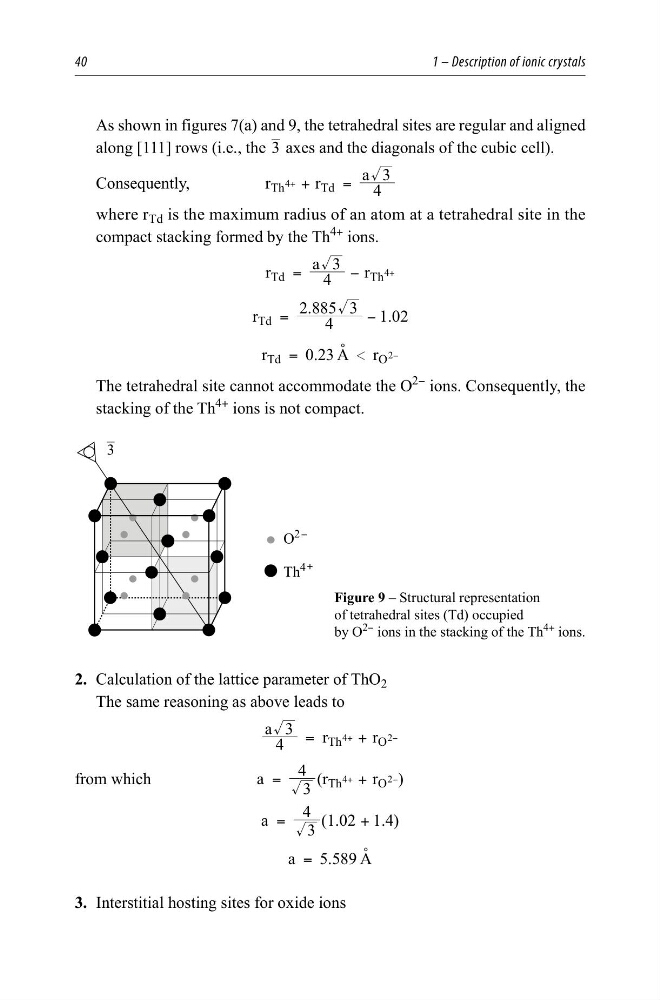
As shown in figures 7(a) and 9, the tetrahedral sites are regular and aligned
along [111] rows (i.e., the 3 axes and the diagonals of the cubic cell).
Consequently,
r
r
a 4
3
Th
Td
4 +
=
+
where r Td is the maximum radius of an atom at a tetrahedral site in the
compact stacking formed by the Th
4+
ions.
r
a
r
4
3
Td
Th 4
=
−
+
.
.
r
4
2 885 3
1 02
Td =
−
.
r
A r
0 23
Td
O 2
=
1
−
c
The tetrahedral site cannot accommodate the O
2−
ions. Consequently, the
stacking of the Th
4+
ions is not compact.
Figure 9 – Structural representation
of tetrahedral sites (Td) occupied
by O
2−
ions in the stacking of the Th
4+
ions.
2. Calculation of the lattice parameter of ThO 2
The same reasoning as above leads to
a
r
r
4
3
Th
O
4
2
=
+
+
−
from which
(
)
a
r
r
3
4 Th
O
4
2
=
+
+
−
( .
. )
a
3
4
1 02 1 4
=
+
.
a
A
5 589
=
c
3. Interstitial hosting sites for oxide ions
±
2
<
7K
1 – Description of ionic crystals
As shown in figures 7(a) and 9, the tetrahedral sites are regular and aligned
along [111] rows (i.e., the 3 axes and the diagonals of the cubic cell).
Consequently,
r
r
a 4
3
Th
Td
4 +
=
+
where r Td is the maximum radius of an atom at a tetrahedral site in the
compact stacking formed by the Th
4+
ions.
r
a
r
4
3
Td
Th 4
=
−
+
.
.
r
4
2 885 3
1 02
Td =
−
.
r
A r
0 23
Td
O 2
=
1
−
c
The tetrahedral site cannot accommodate the O
2−
ions. Consequently, the
stacking of the Th
4+
ions is not compact.
Figure 9 – Structural representation
of tetrahedral sites (Td) occupied
by O
2−
ions in the stacking of the Th
4+
ions.
2. Calculation of the lattice parameter of ThO 2
The same reasoning as above leads to
a
r
r
4
3
Th
O
4
2
=
+
+
−
from which
(
)
a
r
r
3
4 Th
O
4
2
=
+
+
−
( .
. )
a
3
4
1 02 1 4
=
+
.
a
A
5 589
=
c
3. Interstitial hosting sites for oxide ions
±
2
<
7K