

12
1 – Description of ionic crystals
2 electronic disorder
0 m e ′ + h
•
with K e = np
2 equilibrium with the environment
X
#
X m 2
1
X 2 + e ′ + V
•
X
with K g = n [V
•
X ] P
½
X 2
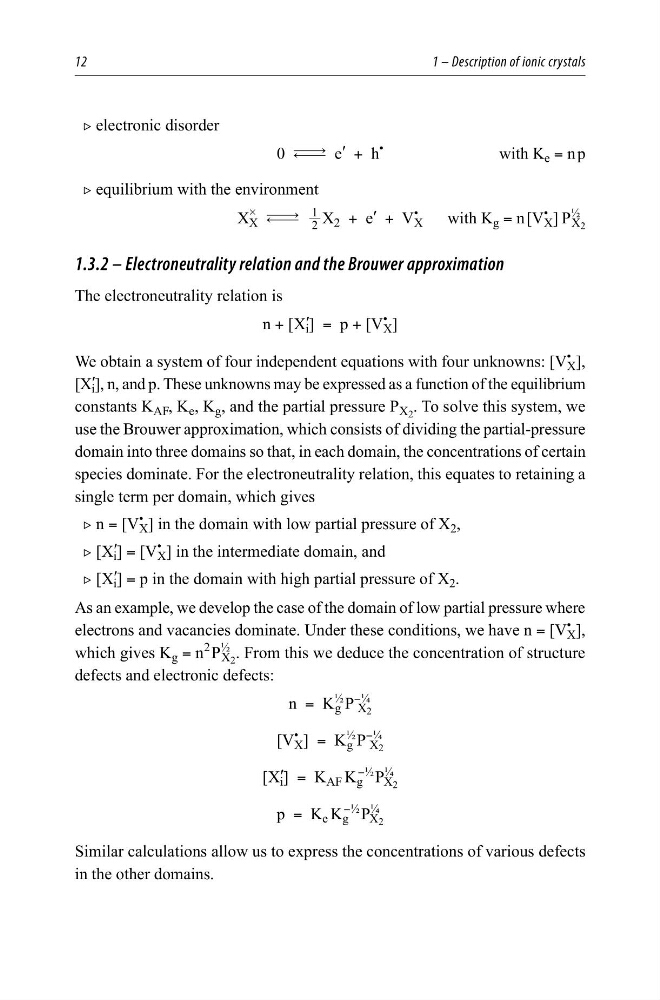
1.3.2 – Electroneutrality relation and the Brouwer approximation
The electroneutrality relation is
n + [X ′
i ] = p + [V
•
X ]
We obtain a system of four independent equations with four unknowns: [V
•
X ],
[X ′
i ], n, and p. These unknowns may be expressed as a function of the equilibrium
constants K AF , K e , K g , and the partial pressure P X 2 . To solve this system, we
use the Brouwer approximation, which consists of dividing the partial-pressure
domain into three domains so that, in each domain, the concentrations of certain
species dominate. For the electroneutrality relation, this equates to retaining a
single term per domain, which gives
2 n = [V
•
X ] in the domain with low partial pressure of X 2 ,
2 [X ′
i ] = [V
•
X ] in the intermediate domain, and
2 [X ′
i ] = p in the domain with high partial pressure of X 2 .
As an example, we develop the case of the domain of low partial pressure where
electrons and vacancies dominate. Under these conditions, we have n = [V
•
X ],
which gives K g = n
2
P
½
X 2 . From this we deduce the concentration of structure
defects and electronic defects:
n = K
½
g P
−¼
X 2
[V
•
X ] = K
½
g P
−¼
X 2
[X ′
i ] = K AF K g
−½
P
¼
X 2
p = K e K g
−½
P
¼
X 2
Similar calculations allow us to express the concentrations of various defects
in the other domains.
1 – Description of ionic crystals
2 electronic disorder
0 m e ′ + h
•
with K e = np
2 equilibrium with the environment
X
#
X m 2
1
X 2 + e ′ + V
•
X
with K g = n [V
•
X ] P
½
X 2
1.3.2 – Electroneutrality relation and the Brouwer approximation
The electroneutrality relation is
n + [X ′
i ] = p + [V
•
X ]
We obtain a system of four independent equations with four unknowns: [V
•
X ],
[X ′
i ], n, and p. These unknowns may be expressed as a function of the equilibrium
constants K AF , K e , K g , and the partial pressure P X 2 . To solve this system, we
use the Brouwer approximation, which consists of dividing the partial-pressure
domain into three domains so that, in each domain, the concentrations of certain
species dominate. For the electroneutrality relation, this equates to retaining a
single term per domain, which gives
2 n = [V
•
X ] in the domain with low partial pressure of X 2 ,
2 [X ′
i ] = [V
•
X ] in the intermediate domain, and
2 [X ′
i ] = p in the domain with high partial pressure of X 2 .
As an example, we develop the case of the domain of low partial pressure where
electrons and vacancies dominate. Under these conditions, we have n = [V
•
X ],
which gives K g = n
2
P
½
X 2 . From this we deduce the concentration of structure
defects and electronic defects:
n = K
½
g P
−¼
X 2
[V
•
X ] = K
½
g P
−¼
X 2
[X ′
i ] = K AF K g
−½
P
¼
X 2
p = K e K g
−½
P
¼
X 2
Similar calculations allow us to express the concentrations of various defects
in the other domains.