

252
5 – Applications
c. 2 Use of the equation
°
ln
E
E
F
RT x
x
x
z F
E
x
x
int
Li
m
m
=
−
− −
Based on the theoretical model, for x = 2
1
°
E
E
F
z
E
2
int
1 2
=
+
The equation can be reformulated as follows:
.
(
) .
ln
E
E
x
x
x
2 215
96 480 3 6
2 57 10
1
2
int
Li
2
#
#
=
−
−
−
−
2 A least squares fit to the experimental points leads to a result for E int
that agrees better with the experimental points
.
E
k J mol
6 11
int
1
=
−
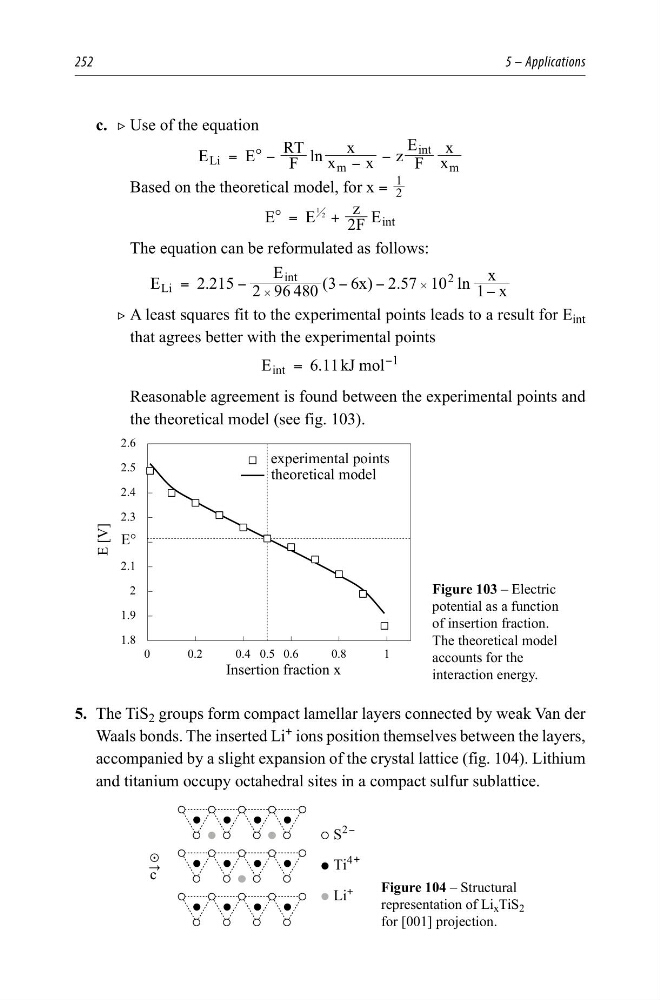
Reasonable agreement is found between the experimental points and
the theoretical model (see fig. 103).
Figure 103 – Electric
potential as a function
of insertion fraction.
The theoretical model
accounts for the
interaction energy.
5. The TiS 2 groups form compact lamellar layers connected by weak Van der
Waals bonds. The inserted Li
+
ions position themselves between the layers,
accompanied by a slight expansion of the crystal lattice (fig. 104). Lithium
and titanium occupy octahedral sites in a compact sulfur sublattice.
Figure 104 – Structural
representation of Li x TiS 2
for [001] projection.
H[SHULPHQWDOSRLQWV
WKHRUHWLFDOPRGHO
,QVHUWLRQIUDFWLRQ[
(>9@
(
9
7L
6
<
/L
ĺ F
5 – Applications
c. 2 Use of the equation
°
ln
E
E
F
RT x
x
x
z F
E
x
x
int
Li
m
m
=
−
− −
Based on the theoretical model, for x = 2
1
°
E
E
F
z
E
2
int
1 2
=
+
The equation can be reformulated as follows:
.
(
) .
ln
E
E
x
x
x
2 215
96 480 3 6
2 57 10
1
2
int
Li
2
#
#
=
−
−
−
−
2 A least squares fit to the experimental points leads to a result for E int
that agrees better with the experimental points
.
E
k J mol
6 11
int
1
=
−
Reasonable agreement is found between the experimental points and
the theoretical model (see fig. 103).
Figure 103 – Electric
potential as a function
of insertion fraction.
The theoretical model
accounts for the
interaction energy.
5. The TiS 2 groups form compact lamellar layers connected by weak Van der
Waals bonds. The inserted Li
+
ions position themselves between the layers,
accompanied by a slight expansion of the crystal lattice (fig. 104). Lithium
and titanium occupy octahedral sites in a compact sulfur sublattice.
Figure 104 – Structural
representation of Li x TiS 2
for [001] projection.
H[SHULPHQWDOSRLQWV
WKHRUHWLFDOPRGHO
,QVHUWLRQIUDFWLRQ[
(>9@
(
9
7L
6
<
/L
ĺ F