

Solutions to exercises
253
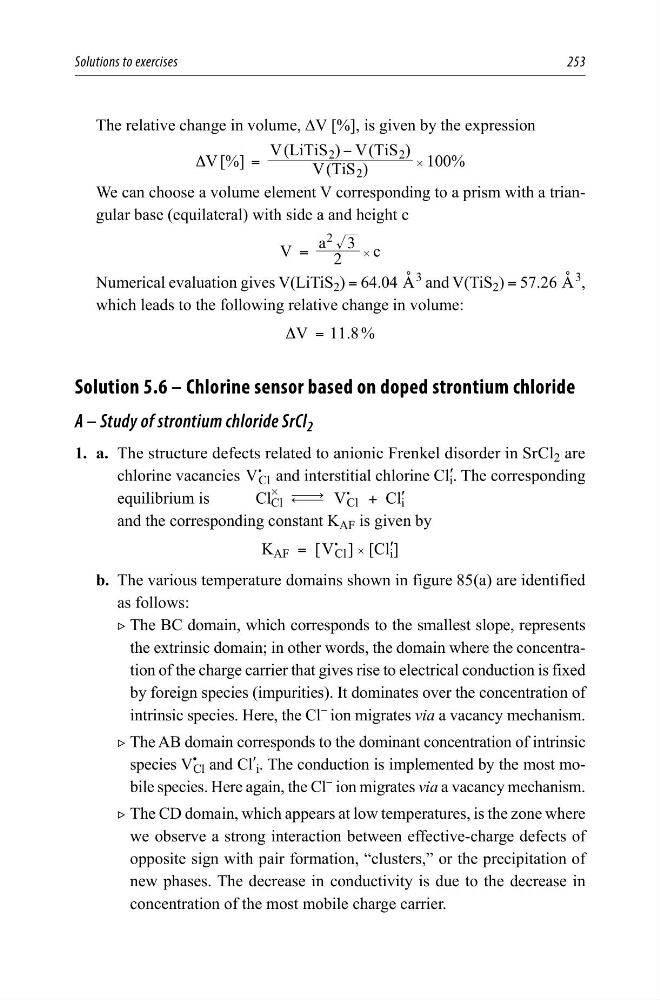
The relative change in volume, ∆V [%], is given by the expression
V [%]
V(TiS )
V(LiTiS ) V(TiS ) 100%
2
2
2
Δ
=
−
#
We can choose a volume element V corresponding to a prism with a triangular base (equilateral) with side a and height c
V
2
a 3
c
2
=
#
Numerical evaluation gives V(LiTiS 2 ) = 64.04 A c 3 and V(TiS 2 ) = 57.26 A c 3 ,
which leads to the following relative change in volume:
V 11.8 %
Δ =
Solution 5.6 – Chlorine sensor based on doped strontium chloride
A – Study of strontium chloride SrCl 2
1. a. The structure defects related to anionic Frenkel disorder in SrCl 2 are
chlorine vacancies V Cl
:
and interstitial chlorine Cl ′
i . The corresponding
equilibrium is
Cl
#
Cl m V Cl
:
+ Cl ′
i
and the corresponding constant K AF is given by
K AF = [V Cl
:
] # [Cl ′
i ]
b. The various temperature domains shown in figure 85(a) are identified
as follows:
2 The BC domain, which corresponds to the smallest slope, represents
the extrinsic domain; in other words, the domain where the concentration of the charge carrier that gives rise to electrical conduction is fixed
by foreign species (impurities). It dominates over the concentration of
intrinsic species. Here, the Cl
−
ion migrates via a vacancy mechanism.
2 The AB domain corresponds to the dominant concentration of intrinsic
species V
•
Cl and Cl ′ i . The conduction is implemented by the most mobile species. Here again, the Cl
−
ion migrates via a vacancy mechanism.
2 The CD domain, which appears at low temperatures, is the zone where
we observe a strong interaction between effective-charge defects of
opposite sign with pair formation, “clusters,” or the precipitation of
new phases. The decrease in conductivity is due to the decrease in
concentration of the most mobile charge carrier.
253
The relative change in volume, ∆V [%], is given by the expression
V [%]
V(TiS )
V(LiTiS ) V(TiS ) 100%
2
2
2
Δ
=
−
#
We can choose a volume element V corresponding to a prism with a triangular base (equilateral) with side a and height c
V
2
a 3
c
2
=
#
Numerical evaluation gives V(LiTiS 2 ) = 64.04 A c 3 and V(TiS 2 ) = 57.26 A c 3 ,
which leads to the following relative change in volume:
V 11.8 %
Δ =
Solution 5.6 – Chlorine sensor based on doped strontium chloride
A – Study of strontium chloride SrCl 2
1. a. The structure defects related to anionic Frenkel disorder in SrCl 2 are
chlorine vacancies V Cl
:
and interstitial chlorine Cl ′
i . The corresponding
equilibrium is
Cl
#
Cl m V Cl
:
+ Cl ′
i
and the corresponding constant K AF is given by
K AF = [V Cl
:
] # [Cl ′
i ]
b. The various temperature domains shown in figure 85(a) are identified
as follows:
2 The BC domain, which corresponds to the smallest slope, represents
the extrinsic domain; in other words, the domain where the concentration of the charge carrier that gives rise to electrical conduction is fixed
by foreign species (impurities). It dominates over the concentration of
intrinsic species. Here, the Cl
−
ion migrates via a vacancy mechanism.
2 The AB domain corresponds to the dominant concentration of intrinsic
species V
•
Cl and Cl ′ i . The conduction is implemented by the most mobile species. Here again, the Cl
−
ion migrates via a vacancy mechanism.
2 The CD domain, which appears at low temperatures, is the zone where
we observe a strong interaction between effective-charge defects of
opposite sign with pair formation, “clusters,” or the precipitation of
new phases. The decrease in conductivity is due to the decrease in
concentration of the most mobile charge carrier.