

Solutions to exercises
251
b. In the cathode composed of Li x TiS 2 , we have xLi
+
, xTi
3+
, and (1 − x)Ti
4+
.
The formula may be written in the form Li
+
x Ti
3+
x Ti
4+
1−x S 2 .
2 This equation may be obtained under the following conditions:
• the integrity of the TiS 2 structure is conserved while the Li is being
inserted, which means that the number of ionic sites remains constant;
• we assume as a first approximation that the unoccupied sites are
equivalent and that their energy is independent of the insertion fraction;
• we consider that the fill factor of the TiS 2 electronic band remains
relatively constant, which implies a large number of electronic
states;
• this electronic band must be populated before insertion to ensure
permanent electronic conduction.
2 Based on the thermodynamic model, for x = 2
1
E
½ = E °
from which we get
E ° = 2.215 V
Consequently, the equation is
.
.
ln
E
x
x
2 215 2 57 10
1
Li
2
#
=
−
−
−
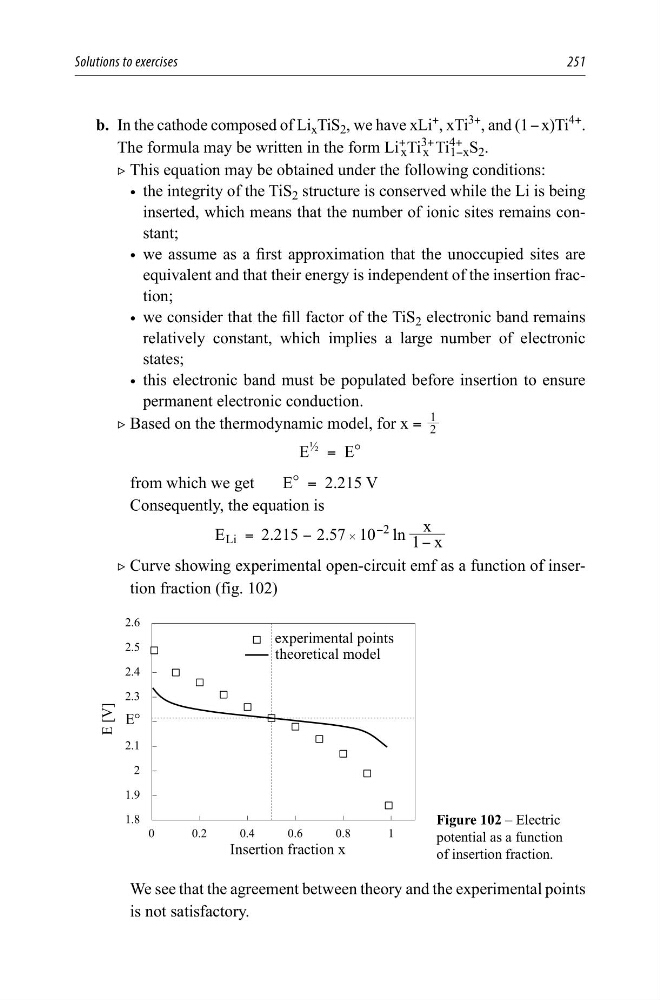
2 Curve showing experimental open-circuit emf as a function of insertion fraction (fig. 102)
Figure 102 – Electric
potential as a function
of insertion fraction.
We see that the agreement between theory and the experimental points
is not satisfactory.
(>9@
(
H[SHULPHQWDOSRLQWV
WKHRUHWLFDOPRGHO
,QVHUWLRQIUDFWLRQ[
251
b. In the cathode composed of Li x TiS 2 , we have xLi
+
, xTi
3+
, and (1 − x)Ti
4+
.
The formula may be written in the form Li
+
x Ti
3+
x Ti
4+
1−x S 2 .
2 This equation may be obtained under the following conditions:
• the integrity of the TiS 2 structure is conserved while the Li is being
inserted, which means that the number of ionic sites remains constant;
• we assume as a first approximation that the unoccupied sites are
equivalent and that their energy is independent of the insertion fraction;
• we consider that the fill factor of the TiS 2 electronic band remains
relatively constant, which implies a large number of electronic
states;
• this electronic band must be populated before insertion to ensure
permanent electronic conduction.
2 Based on the thermodynamic model, for x = 2
1
E
½ = E °
from which we get
E ° = 2.215 V
Consequently, the equation is
.
.
ln
E
x
x
2 215 2 57 10
1
Li
2
#
=
−
−
−
2 Curve showing experimental open-circuit emf as a function of insertion fraction (fig. 102)
Figure 102 – Electric
potential as a function
of insertion fraction.
We see that the agreement between theory and the experimental points
is not satisfactory.
(>9@
(
H[SHULPHQWDOSRLQWV
WKHRUHWLFDOPRGHO
,QVHUWLRQIUDFWLRQ[