

250
5 – Applications
2 at 1 100 °C
.
K
96 480
135 46
V
2
Cu
=
l
We obtain
.
K
455 10
V
C
1000
9
°
Cu
#
=
−
l
and
.
K
145 10
V
C
1100
8
°
Cu
#
=
−
l
b. 2 at 1 000 °C
.
K
96 480
85 14
O
2
i
=
l
2 at 1 100 °C
.
K
96 480
247 01
O
2
i
=
l
We obtain
.
K
915 10
O
C
1000
9
°
i
#
=
−
l
and
.
K
265 10
O
C
1100
8
°
i
#
=
−
l
Solution 5.5 – TiS 2 : insertion material
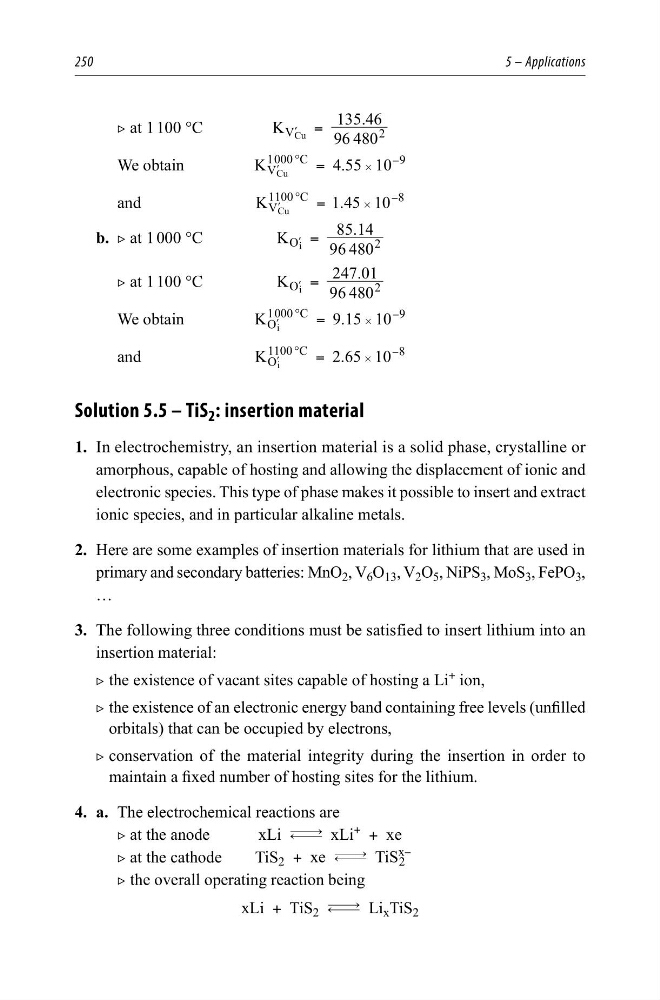
1. In electrochemistry, an insertion material is a solid phase, crystalline or
amorphous, capable of hosting and allowing the displacement of ionic and
electronic species. This type of phase makes it possible to insert and extract
ionic species, and in particular alkaline metals.
2. Here are some examples of insertion materials for lithium that are used in
primary and secondary batteries: MnO 2 , V 6 O 13 , V 2 O 5 , NiPS 3 , MoS 3 , FePO 3 ,
…
3. The following three conditions must be satisfied to insert lithium into an
insertion material:
2 the existence of vacant sites capable of hosting a Li
+
ion,
2 the existence of an electronic energy band containing free levels (unfilled
orbitals) that can be occupied by electrons,
2 conservation of the material integrity during the insertion in order to
maintain a fixed number of hosting sites for the lithium.
4. a. The electrochemical reactions are
2 at the anode
xLi m xLi
+ + xe
2 at the cathode
TiS 2 + xe m TiS
x−
2
2 the overall operating reaction being
xLi + TiS 2 m Li x TiS 2
5 – Applications
2 at 1 100 °C
.
K
96 480
135 46
V
2
Cu
=
l
We obtain
.
K
455 10
V
C
1000
9
°
Cu
#
=
−
l
and
.
K
145 10
V
C
1100
8
°
Cu
#
=
−
l
b. 2 at 1 000 °C
.
K
96 480
85 14
O
2
i
=
l
2 at 1 100 °C
.
K
96 480
247 01
O
2
i
=
l
We obtain
.
K
915 10
O
C
1000
9
°
i
#
=
−
l
and
.
K
265 10
O
C
1100
8
°
i
#
=
−
l
Solution 5.5 – TiS 2 : insertion material
1. In electrochemistry, an insertion material is a solid phase, crystalline or
amorphous, capable of hosting and allowing the displacement of ionic and
electronic species. This type of phase makes it possible to insert and extract
ionic species, and in particular alkaline metals.
2. Here are some examples of insertion materials for lithium that are used in
primary and secondary batteries: MnO 2 , V 6 O 13 , V 2 O 5 , NiPS 3 , MoS 3 , FePO 3 ,
…
3. The following three conditions must be satisfied to insert lithium into an
insertion material:
2 the existence of vacant sites capable of hosting a Li
+
ion,
2 the existence of an electronic energy band containing free levels (unfilled
orbitals) that can be occupied by electrons,
2 conservation of the material integrity during the insertion in order to
maintain a fixed number of hosting sites for the lithium.
4. a. The electrochemical reactions are
2 at the anode
xLi m xLi
+ + xe
2 at the cathode
TiS 2 + xe m TiS
x−
2
2 the overall operating reaction being
xLi + TiS 2 m Li x TiS 2