

Solutions to exercises
249
with i = V ′
Cu or O ′
i we finally obtain
k
P
k
P
V
O
O
O
Cu
2
i
2
1 4
1 2
σ =
+
#
#
l
l
`
`
j
j
This expression is the theoretical equation for Cu 2 O conductivity as a function
of oxygen partial pressure based on the defect model established in question 1.
3. a. Fitting this theoretical equation by least squares to the experimental
points allows us to determine the parameters in the expression above
for conductivity. We obtain
2 at 1 000 °C
42.39 P
85.14 P
O
O
2
2
1 4
1 2
σ =
+
#
#
`
`
j
j
2 at 1 100 °C
135.46 P
247.01 P
O
O
2
2
1 4
1 2
σ =
+
#
#
`
`
j
j
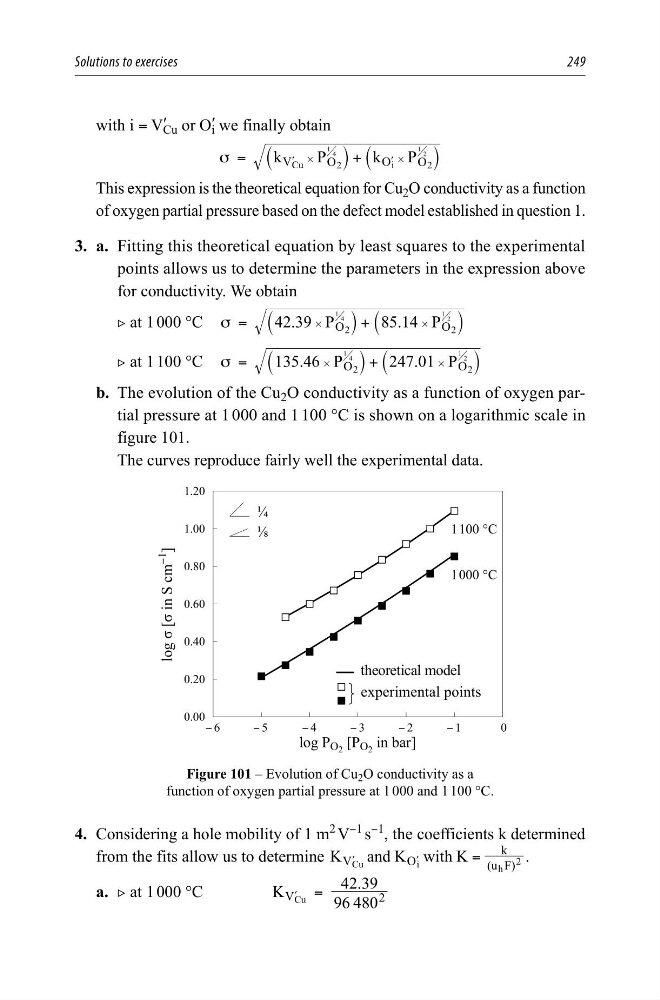
b. The evolution of the Cu 2 O conductivity as a function of oxygen partial pressure at 1 000 and 1 100 °C is shown on a logarithmic scale in
figure 101.
The curves reproduce fairly well the experimental data.
H[SHULPHQWDOSRLQWV
ORJ3 2 >3 2 LQEDU@
ORJı>ıLQ6FP
<
@
WKHRUHWLFDOPRGHO
&
&
ǩ
ó
<
<
<
<
<
<
Figure 101 – Evolution of Cu 2 O conductivity as a
function of oxygen partial pressure at 1 000 and 1 100 °C.
4. Considering a hole mobility of 1 m
2
V
−1
s
−1
, the coefficients k determined
from the fits allow us to determine
.
K
and K with K ( )
V
O
u F
k
Cu
i
h
2
=
l
l
a. 2 at 1 000 °C
.
K
96 480
42 39
V
2
Cu
=
l
249
with i = V ′
Cu or O ′
i we finally obtain
k
P
k
P
V
O
O
O
Cu
2
i
2
1 4
1 2
σ =
+
#
#
l
l
`
`
j
j
This expression is the theoretical equation for Cu 2 O conductivity as a function
of oxygen partial pressure based on the defect model established in question 1.
3. a. Fitting this theoretical equation by least squares to the experimental
points allows us to determine the parameters in the expression above
for conductivity. We obtain
2 at 1 000 °C
42.39 P
85.14 P
O
O
2
2
1 4
1 2
σ =
+
#
#
`
`
j
j
2 at 1 100 °C
135.46 P
247.01 P
O
O
2
2
1 4
1 2
σ =
+
#
#
`
`
j
j
b. The evolution of the Cu 2 O conductivity as a function of oxygen partial pressure at 1 000 and 1 100 °C is shown on a logarithmic scale in
figure 101.
The curves reproduce fairly well the experimental data.
H[SHULPHQWDOSRLQWV
ORJ3 2 >3 2 LQEDU@
ORJı>ıLQ6FP
<
@
WKHRUHWLFDOPRGHO
&
&
ǩ
ó
<
<
<
<
<
<
Figure 101 – Evolution of Cu 2 O conductivity as a
function of oxygen partial pressure at 1 000 and 1 100 °C.
4. Considering a hole mobility of 1 m
2
V
−1
s
−1
, the coefficients k determined
from the fits allow us to determine
.
K
and K with K ( )
V
O
u F
k
Cu
i
h
2
=
l
l
a. 2 at 1 000 °C
.
K
96 480
42 39
V
2
Cu
=
l