

230
5 – Applications
4. State the main advantages and disadvantages of solid-electrolyte coulometric
gas sensors.
Exercise 5.13 – Nitrogen oxide sensor
We consider a nitrogen oxide sensor made of a nernstian potentiometric cell.
A – Type (I) cell involving sodium ionic conducting electrolyte
(NASICON or Na-β-alumina)
To measure NO 2 concentration, chain (Ia) was proposed
Na / NASICON / NaNO 3 / Au,NO 2 ,O 2
(Ia)
(reference)
(Na
+
)
(porous layer) (measurement)
The following electrode reaction is considered:
Na
+ + NO 2 + 2
1
O 2 + e $ NaNO 3
1. Establish the expression for the emf of the cell (Ia) as a function of
a. NO 2 partial pressure,
b. NO 2 molar fraction for the case where total pressure is 1 bar.
We assume that all thermodynamic equilibria are in place.
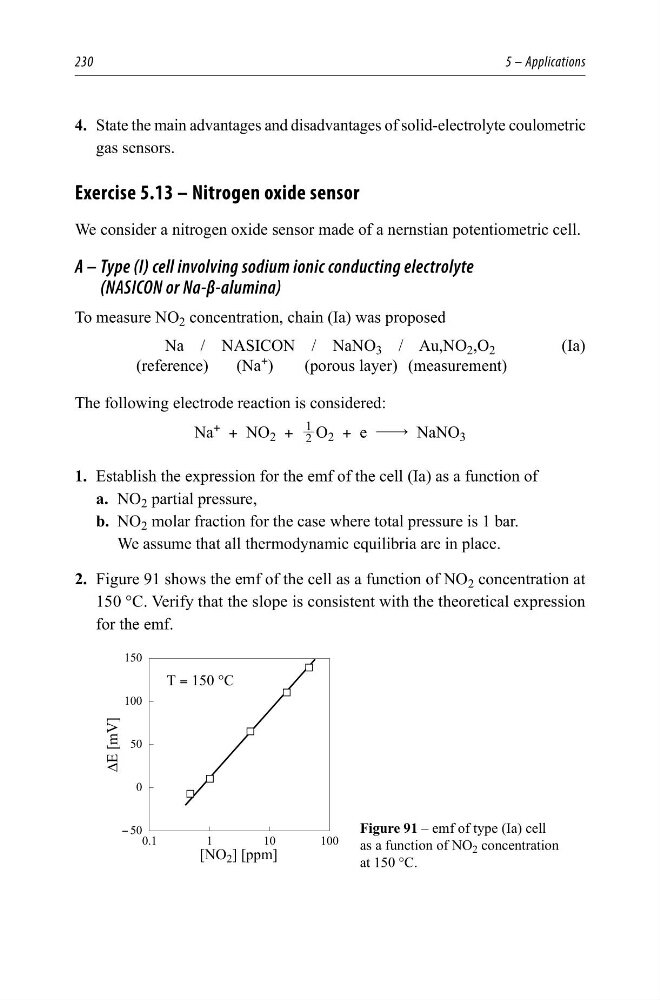
2. Figure 91 shows the emf of the cell as a function of NO 2 concentration at
150 °C. Verify that the slope is consistent with the theoretical expression
for the emf.
Figure 91 – emf of type (Ia) cell
as a function of NO 2 concentration
at 150 °C.
<
¨(>P9@
>12 @>SSP@
7&
5 – Applications
4. State the main advantages and disadvantages of solid-electrolyte coulometric
gas sensors.
Exercise 5.13 – Nitrogen oxide sensor
We consider a nitrogen oxide sensor made of a nernstian potentiometric cell.
A – Type (I) cell involving sodium ionic conducting electrolyte
(NASICON or Na-β-alumina)
To measure NO 2 concentration, chain (Ia) was proposed
Na / NASICON / NaNO 3 / Au,NO 2 ,O 2
(Ia)
(reference)
(Na
+
)
(porous layer) (measurement)
The following electrode reaction is considered:
Na
+ + NO 2 + 2
1
O 2 + e $ NaNO 3
1. Establish the expression for the emf of the cell (Ia) as a function of
a. NO 2 partial pressure,
b. NO 2 molar fraction for the case where total pressure is 1 bar.
We assume that all thermodynamic equilibria are in place.
2. Figure 91 shows the emf of the cell as a function of NO 2 concentration at
150 °C. Verify that the slope is consistent with the theoretical expression
for the emf.
Figure 91 – emf of type (Ia) cell
as a function of NO 2 concentration
at 150 °C.
<
¨(>P9@
>12 @>SSP@
7&