

Exercises
231
3. Calculate the standard free enthalpy of the proposed electrode reaction
within the framework of an analysis of air polluted by NO 2 at 150 °C.
Data
P O 2 = 0.21 bar
4. To analyze NO, which is a major nitrogen compound in exhaust gas, we
propose using a layer of sodium nitrite NaNO 2 with the following electrochemical chain:
Na / NASICON / NaNO 2 / Au,NO,O 2
(Ib)
(reference)
(Na
+
)
(porous layer) (measurement)
Give the expression for the emf of the cell (Ib) as a function of NO partial
pressure.
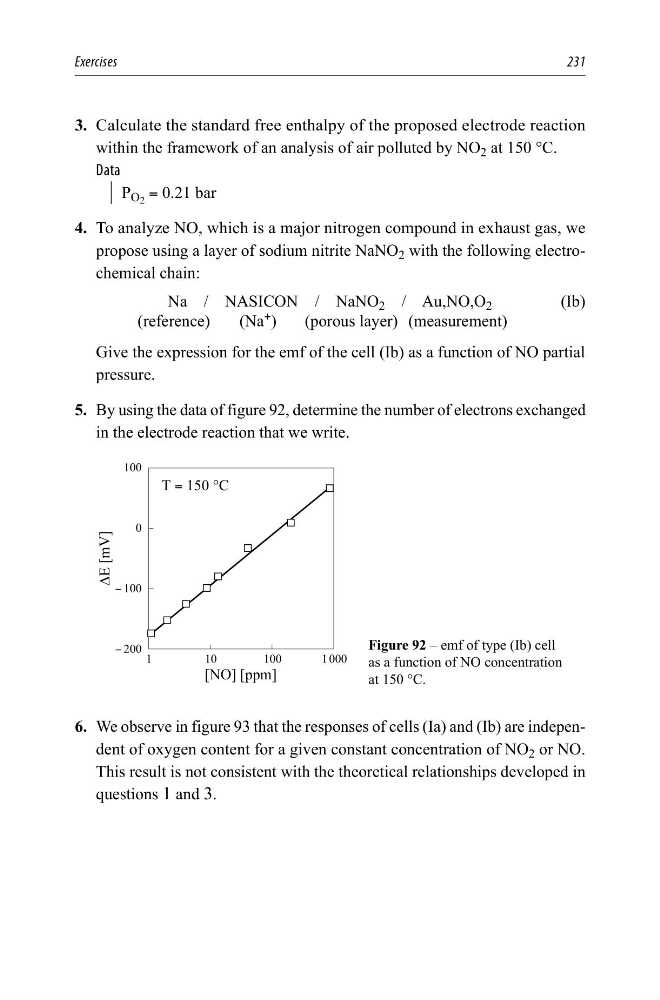
5. By using the data of figure 92, determine the number of electrons exchanged
in the electrode reaction that we write.
Figure 92 – emf of type (Ib) cell
as a function of NO concentration
at 150 °C.
6. We observe in figure 93 that the responses of cells (Ia) and (Ib) are independent of oxygen content for a given constant concentration of NO 2 or NO.
This result is not consistent with the theoretical relationships developed in
questions 1 and 3.
7&
<
<
¨(>P9@
>12@>SSP@
231
3. Calculate the standard free enthalpy of the proposed electrode reaction
within the framework of an analysis of air polluted by NO 2 at 150 °C.
Data
P O 2 = 0.21 bar
4. To analyze NO, which is a major nitrogen compound in exhaust gas, we
propose using a layer of sodium nitrite NaNO 2 with the following electrochemical chain:
Na / NASICON / NaNO 2 / Au,NO,O 2
(Ib)
(reference)
(Na
+
)
(porous layer) (measurement)
Give the expression for the emf of the cell (Ib) as a function of NO partial
pressure.
5. By using the data of figure 92, determine the number of electrons exchanged
in the electrode reaction that we write.
Figure 92 – emf of type (Ib) cell
as a function of NO concentration
at 150 °C.
6. We observe in figure 93 that the responses of cells (Ia) and (Ib) are independent of oxygen content for a given constant concentration of NO 2 or NO.
This result is not consistent with the theoretical relationships developed in
questions 1 and 3.
7&
<
<
¨(>P9@
>12@>SSP@