

Exercises
221
where P 1 and P 2 denote the partial pressure of chlorine at electrodes (1) and (2),
respectively.
1. Write the electrochemical reaction at the electrodes.
2. With the help of the electrochemical potentials of the species involved,
derive the expression relating the emf at the chain terminals to the chlorine
partial pressure and to the temperature.
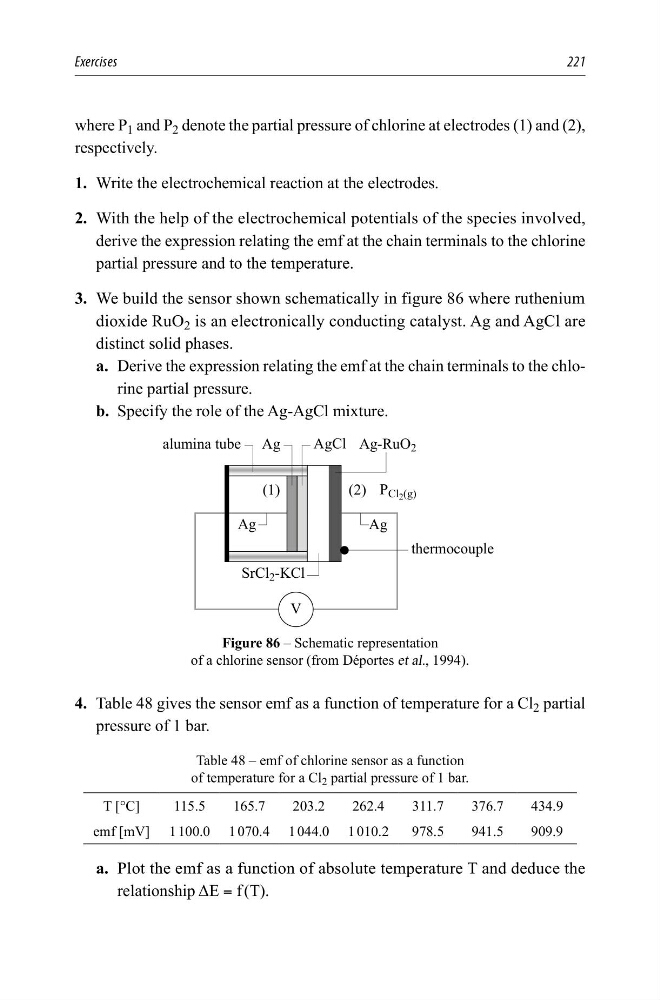
3. We build the sensor shown schematically in figure 86 where ruthenium
dioxide RuO 2 is an electronically conducting catalyst. Ag and AgCl are
distinct solid phases.
a. Derive the expression relating the emf at the chain terminals to the chlorine partial pressure.
b. Specify the role of the Ag-AgCl mixture.
$J
$J5X2
6U&O .&O
$J
$J&O
DOXPLQDWXEH
WKHUPRFRXSOH
3 &O J
9
$J
Figure 86 – Schematic representation
of a chlorine sensor (from Déportes et al., 1994).
4. Table 48 gives the sensor emf as a function of temperature for a Cl 2 partial
pressure of 1 bar.
Table 48 – emf of chlorine sensor as a function
of temperature for a Cl 2 partial pressure of 1 bar.
T [°C]
115.5
165.7
203.2
262.4
311.7
376.7
434.9
emf [mV] 1 100.0 1 070.4 1 044.0 1 010.2
978.5
941.5
909.9
a. Plot the emf as a function of absolute temperature T and deduce the
relationship ΔE = f (T).
221
where P 1 and P 2 denote the partial pressure of chlorine at electrodes (1) and (2),
respectively.
1. Write the electrochemical reaction at the electrodes.
2. With the help of the electrochemical potentials of the species involved,
derive the expression relating the emf at the chain terminals to the chlorine
partial pressure and to the temperature.
3. We build the sensor shown schematically in figure 86 where ruthenium
dioxide RuO 2 is an electronically conducting catalyst. Ag and AgCl are
distinct solid phases.
a. Derive the expression relating the emf at the chain terminals to the chlorine partial pressure.
b. Specify the role of the Ag-AgCl mixture.
$J
$J5X2
6U&O .&O
$J
$J&O
DOXPLQDWXEH
WKHUPRFRXSOH
3 &O J
9
$J
Figure 86 – Schematic representation
of a chlorine sensor (from Déportes et al., 1994).
4. Table 48 gives the sensor emf as a function of temperature for a Cl 2 partial
pressure of 1 bar.
Table 48 – emf of chlorine sensor as a function
of temperature for a Cl 2 partial pressure of 1 bar.
T [°C]
115.5
165.7
203.2
262.4
311.7
376.7
434.9
emf [mV] 1 100.0 1 070.4 1 044.0 1 010.2
978.5
941.5
909.9
a. Plot the emf as a function of absolute temperature T and deduce the
relationship ΔE = f (T).