

220
5 – Applications
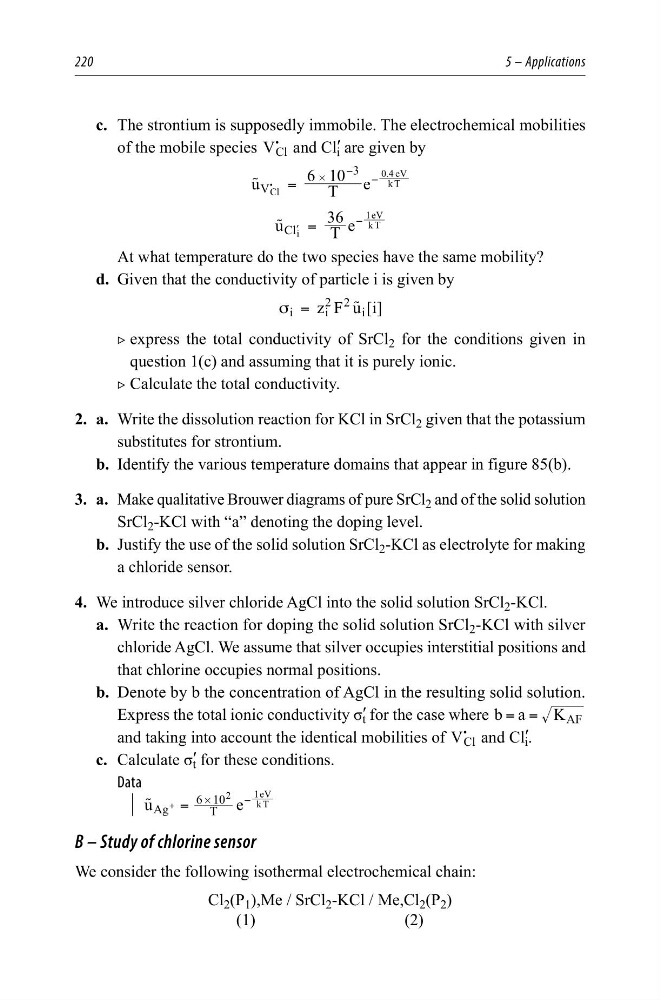
c. The strontium is supposedly immobile. The electrochemical mobilities
of the mobile species V Cl
:
and Cl ′
i are given by
u
T
e
6 10
V
3
.
Cl
k T
eV
0 4
#
=
− −
:
u
u
T e
36
Cl i
k T
eV
1
=
−
l
u
At what temperature do the two species have the same mobility?
d. Given that the conductivity of particle i is given by
z F u [i]
i
i
2 2 i
σ =
u
2 express the total conductivity of SrCl 2 for the conditions given in
question 1(c) and assuming that it is purely ionic.
2 Calculate the total conductivity.
2. a. Write the dissolution reaction for KCl in SrCl 2 given that the potassium
substitutes for strontium.
b. Identify the various temperature domains that appear in figure 85(b).
3. a. Make qualitative Brouwer diagrams of pure SrCl 2 and of the solid solution
SrCl 2 -KCl with “a” denoting the doping level.
b. Justify the use of the solid solution SrCl 2 -KCl as electrolyte for making
a chloride sensor.
4. We introduce silver chloride AgCl into the solid solution SrCl 2 -KCl.
a. Write the reaction for doping the solid solution SrCl 2 -KCl with silver
chloride AgCl. We assume that silver occupies interstitial positions and
that chlorine occupies normal positions.
b. Denote by b the concentration of AgCl in the resulting solid solution.
Express the total ionic conductivity σ ′
t for the case where b a
K AF
= =
and taking into account the identical mobilities of V Cl
:
and Cl ′
i .
c. Calculate σ ′
t for these conditions.
Data
u
e
Ag
T
6 10
k T
eV
2
1
=
#
−
+
u
B – Study of chlorine sensor
We consider the following isothermal electrochemical chain:
Cl 2 (P 1 ),Me / SrCl 2 -KCl / Me,Cl 2 (P 2 )
(1)
(2)
5 – Applications
c. The strontium is supposedly immobile. The electrochemical mobilities
of the mobile species V Cl
:
and Cl ′
i are given by
u
T
e
6 10
V
3
.
Cl
k T
eV
0 4
#
=
− −
:
u
u
T e
36
Cl i
k T
eV
1
=
−
l
u
At what temperature do the two species have the same mobility?
d. Given that the conductivity of particle i is given by
z F u [i]
i
i
2 2 i
σ =
u
2 express the total conductivity of SrCl 2 for the conditions given in
question 1(c) and assuming that it is purely ionic.
2 Calculate the total conductivity.
2. a. Write the dissolution reaction for KCl in SrCl 2 given that the potassium
substitutes for strontium.
b. Identify the various temperature domains that appear in figure 85(b).
3. a. Make qualitative Brouwer diagrams of pure SrCl 2 and of the solid solution
SrCl 2 -KCl with “a” denoting the doping level.
b. Justify the use of the solid solution SrCl 2 -KCl as electrolyte for making
a chloride sensor.
4. We introduce silver chloride AgCl into the solid solution SrCl 2 -KCl.
a. Write the reaction for doping the solid solution SrCl 2 -KCl with silver
chloride AgCl. We assume that silver occupies interstitial positions and
that chlorine occupies normal positions.
b. Denote by b the concentration of AgCl in the resulting solid solution.
Express the total ionic conductivity σ ′
t for the case where b a
K AF
= =
and taking into account the identical mobilities of V Cl
:
and Cl ′
i .
c. Calculate σ ′
t for these conditions.
Data
u
e
Ag
T
6 10
k T
eV
2
1
=
#
−
+
u
B – Study of chlorine sensor
We consider the following isothermal electrochemical chain:
Cl 2 (P 1 ),Me / SrCl 2 -KCl / Me,Cl 2 (P 2 )
(1)
(2)