

Course notes
209
L Theoretical capacity and nominal capacity
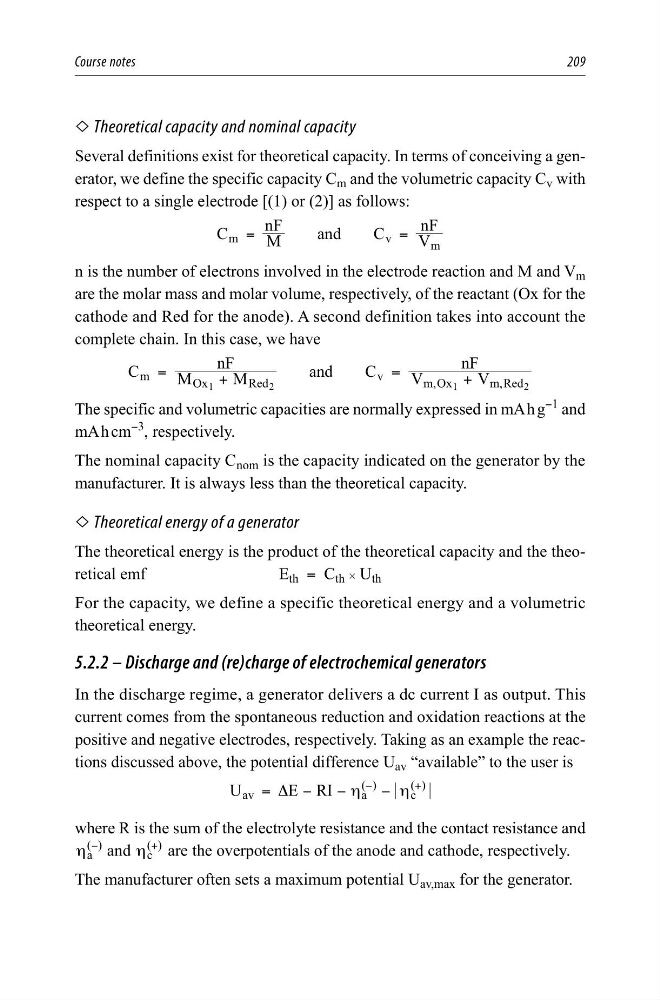
Several definitions exist for theoretical capacity. In terms of conceiving a generator, we define the specific capacity C m and the volumetric capacity C v with
respect to a single electrode [(1) or (2)] as follows:
C
M
nF
and
C
V
nF
m
v
m
=
=
n is the number of electrons involved in the electrode reaction and M and V m
are the molar mass and molar volume, respectively, of the reactant (Ox for the
cathode and Red for the anode). A second definition takes into account the
complete chain. In this case, we have
C
M
M
nF
and
C
V
V
nF
,
,
m
Ox
Red
v
m Ox
mRed
1
2
1
2
=
+
=
+
The specific and volumetric capacities are normally expressed in mA h g
−1
and
mA h cm
−3
, respectively.
The nominal capacity C nom is the capacity indicated on the generator by the
manufacturer. It is always less than the theoretical capacity.
L Theoretical energy of a generator
The theoretical energy is the product of the theoretical capacity and the theoretical emf
E th = C th # U th
For the capacity, we define a specific theoretical energy and a volumetric
theoretical energy.
5.2.2 – Discharge and (re)charge of electrochemical generators
In the discharge regime, a generator delivers a dc current I as output. This
current comes from the spontaneous reduction and oxidation reactions at the
positive and negative electrodes, respectively. Taking as an example the reactions discussed above, the potential difference U av “available” to the user is
U
E RI
av
a
( )
c
( )
η
η
Δ
=
−
−
−
−
+
where R is the sum of the electrolyte resistance and the contact resistance and
and
a
( )
c
( )
η
η
−
+
are the overpotentials of the anode and cathode, respectively.
The manufacturer often sets a maximum potential U av,max for the generator.
209
L Theoretical capacity and nominal capacity
Several definitions exist for theoretical capacity. In terms of conceiving a generator, we define the specific capacity C m and the volumetric capacity C v with
respect to a single electrode [(1) or (2)] as follows:
C
M
nF
and
C
V
nF
m
v
m
=
=
n is the number of electrons involved in the electrode reaction and M and V m
are the molar mass and molar volume, respectively, of the reactant (Ox for the
cathode and Red for the anode). A second definition takes into account the
complete chain. In this case, we have
C
M
M
nF
and
C
V
V
nF
,
,
m
Ox
Red
v
m Ox
mRed
1
2
1
2
=
+
=
+
The specific and volumetric capacities are normally expressed in mA h g
−1
and
mA h cm
−3
, respectively.
The nominal capacity C nom is the capacity indicated on the generator by the
manufacturer. It is always less than the theoretical capacity.
L Theoretical energy of a generator
The theoretical energy is the product of the theoretical capacity and the theoretical emf
E th = C th # U th
For the capacity, we define a specific theoretical energy and a volumetric
theoretical energy.
5.2.2 – Discharge and (re)charge of electrochemical generators
In the discharge regime, a generator delivers a dc current I as output. This
current comes from the spontaneous reduction and oxidation reactions at the
positive and negative electrodes, respectively. Taking as an example the reactions discussed above, the potential difference U av “available” to the user is
U
E RI
av
a
( )
c
( )
η
η
Δ
=
−
−
−
−
+
where R is the sum of the electrolyte resistance and the contact resistance and
and
a
( )
c
( )
η
η
−
+
are the overpotentials of the anode and cathode, respectively.
The manufacturer often sets a maximum potential U av,max for the generator.