

208
5 – Applications
5.1.4 – Coulometric sensor
The working principle of a coulometric sensor is based on the complete consumption by electrolysis of the species being analyzed. The amount of substance
due to this species is directly related to the amount of charge Q = ∫ Idt that passes
through the electrode. This type of sensor requires calibration beforehand and
cannot make continuous measurements.
5.1.5 – Conductometric sensor for gas analysis
The conductometric sensor for gas analysis normally relies upon an ionic
non-stoichiometric solid. Its working principle is based on the electronic conductivity of the solid as a function of the composition of the surrounding gas.
For example, to measure the amount of oxygen in a mix of gases, we can use
SnO 2 , BaTiO 3 , or solid solutions based on TiO 2 , such as TiO 2 -CoO-BaO.
5.2 – Electrochemical generators
5.2.1 – Definition and characteristics
L Electrochemical generator: Definition, capacity, and theoretical energy
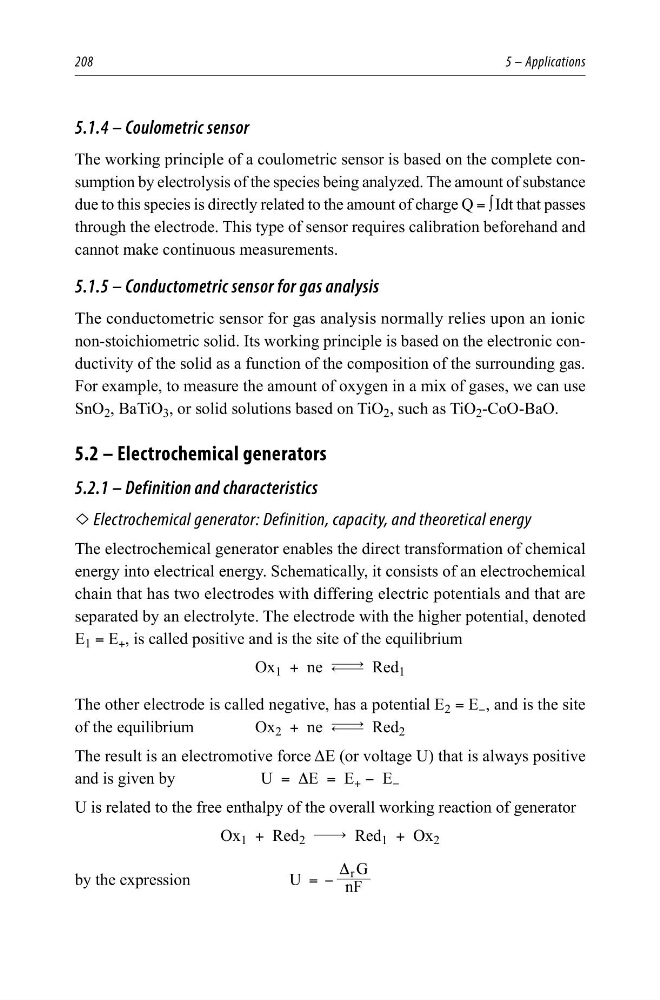
The electrochemical generator enables the direct transformation of chemical
energy into electrical energy. Schematically, it consists of an electrochemical
chain that has two electrodes with differing electric potentials and that are
separated by an electrolyte. The electrode with the higher potential, denoted
E 1 = E + , is called positive and is the site of the equilibrium
Ox 1 + ne m Red 1
The other electrode is called negative, has a potential E 2 = E − , and is the site
of the equilibrium
Ox 2 + ne m Red 2
The result is an electromotive force ΔE (or voltage U) that is always positive
and is given by
U = ΔE = E + − E −
U is related to the free enthalpy of the overall working reaction of generator
Ox 1 + Red 2 $ Red 1 + Ox 2
by the expression
U
nF
G
r
Δ
= −
5 – Applications
5.1.4 – Coulometric sensor
The working principle of a coulometric sensor is based on the complete consumption by electrolysis of the species being analyzed. The amount of substance
due to this species is directly related to the amount of charge Q = ∫ Idt that passes
through the electrode. This type of sensor requires calibration beforehand and
cannot make continuous measurements.
5.1.5 – Conductometric sensor for gas analysis
The conductometric sensor for gas analysis normally relies upon an ionic
non-stoichiometric solid. Its working principle is based on the electronic conductivity of the solid as a function of the composition of the surrounding gas.
For example, to measure the amount of oxygen in a mix of gases, we can use
SnO 2 , BaTiO 3 , or solid solutions based on TiO 2 , such as TiO 2 -CoO-BaO.
5.2 – Electrochemical generators
5.2.1 – Definition and characteristics
L Electrochemical generator: Definition, capacity, and theoretical energy
The electrochemical generator enables the direct transformation of chemical
energy into electrical energy. Schematically, it consists of an electrochemical
chain that has two electrodes with differing electric potentials and that are
separated by an electrolyte. The electrode with the higher potential, denoted
E 1 = E + , is called positive and is the site of the equilibrium
Ox 1 + ne m Red 1
The other electrode is called negative, has a potential E 2 = E − , and is the site
of the equilibrium
Ox 2 + ne m Red 2
The result is an electromotive force ΔE (or voltage U) that is always positive
and is given by
U = ΔE = E + − E −
U is related to the free enthalpy of the overall working reaction of generator
Ox 1 + Red 2 $ Red 1 + Ox 2
by the expression
U
nF
G
r
Δ
= −