

Course notes
207
E
4F
RT
ln P
P
O
(Ref)
O
(Mes)
2
2
Δ = −
5.1.3 – Amperometric sensor
The working principle of this sensor is based on exploiting the diffusion-limited
current of the electroactive species (Ox or Red) at an electrode / solid electrolyte interface. This current is proportional to the concentration or the molar
fraction of the species being analyzed (see Chapter 4, Thermodynamics and
electrochemical kinetics). In practice, a diffusion barrier (small holes or porous
layer) is created in the device, which limits the diffusion of active species. The
sensor is often calibrated beforehand.
In what follows, we use the example of a gas sensor designed to detect the
concentration of species X 2 as it undergoes the reduction reaction
2
1
X 2 + e m X
−
SE
SE: solid electrolyte
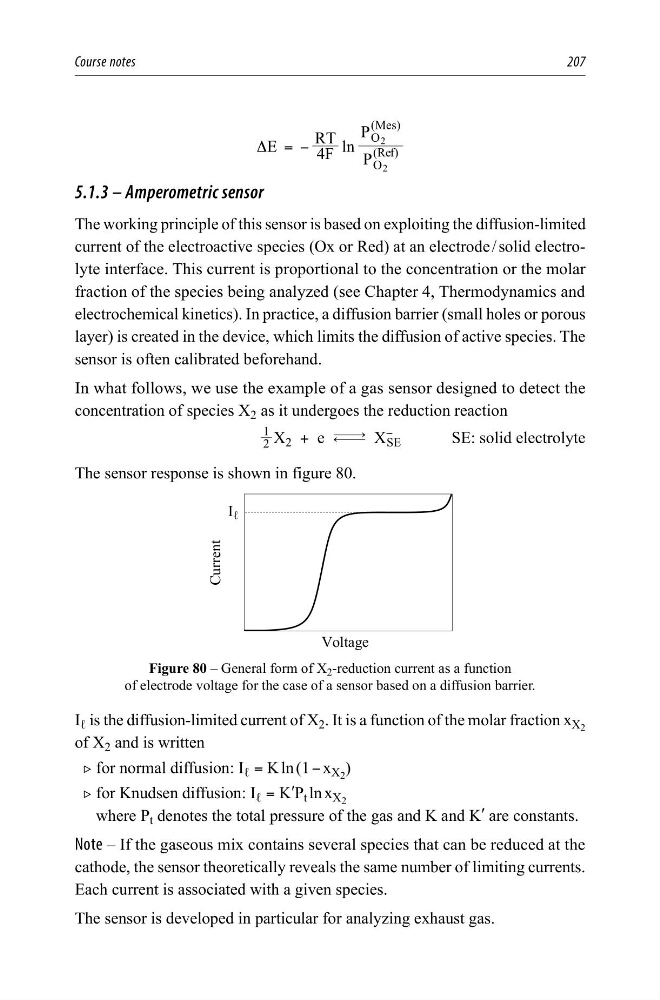
The sensor response is shown in figure 80.
, Ɛ
&XUUHQW
9ROWDJH
Figure 80 – General form of X 2 -reduction current as a function
of electrode voltage for the case of a sensor based on a diffusion barrier.
I ℓ is the diffusion-limited current of X 2 . It is a function of the molar fraction x X 2
of X 2 and is written
2 for normal diffusion: I ℓ = K ln (1 − x X 2 )
2 for Knudsen diffusion: I ℓ = K ′ P t ln x X 2
where P t denotes the total pressure of the gas and K and K ′ are constants.
Note – If the gaseous mix contains several species that can be reduced at the
cathode, the sensor theoretically reveals the same number of limiting currents.
Each current is associated with a given species.
The sensor is developed in particular for analyzing exhaust gas.
207
E
4F
RT
ln P
P
O
(Ref)
O
(Mes)
2
2
Δ = −
5.1.3 – Amperometric sensor
The working principle of this sensor is based on exploiting the diffusion-limited
current of the electroactive species (Ox or Red) at an electrode / solid electrolyte interface. This current is proportional to the concentration or the molar
fraction of the species being analyzed (see Chapter 4, Thermodynamics and
electrochemical kinetics). In practice, a diffusion barrier (small holes or porous
layer) is created in the device, which limits the diffusion of active species. The
sensor is often calibrated beforehand.
In what follows, we use the example of a gas sensor designed to detect the
concentration of species X 2 as it undergoes the reduction reaction
2
1
X 2 + e m X
−
SE
SE: solid electrolyte
The sensor response is shown in figure 80.
, Ɛ
&XUUHQW
9ROWDJH
Figure 80 – General form of X 2 -reduction current as a function
of electrode voltage for the case of a sensor based on a diffusion barrier.
I ℓ is the diffusion-limited current of X 2 . It is a function of the molar fraction x X 2
of X 2 and is written
2 for normal diffusion: I ℓ = K ln (1 − x X 2 )
2 for Knudsen diffusion: I ℓ = K ′ P t ln x X 2
where P t denotes the total pressure of the gas and K and K ′ are constants.
Note – If the gaseous mix contains several species that can be reduced at the
cathode, the sensor theoretically reveals the same number of limiting currents.
Each current is associated with a given species.
The sensor is developed in particular for analyzing exhaust gas.