

206
5 – Applications
In what follows, we restrict ourselves to developing the principles that govern
the operation of potentiometric, amperometric, conductimetric and coulometric
gas sensors.
5.1.2 – Potentiometric sensor for gas analysis
The principle is based on exploiting the equilibria at the gas / electrode / solid
electrolyte interfaces. The sensor invokes an electrochemical chain with two
electrodes separated by a solid electrolyte. The first electrode is in contact
with the gaseous species to be analyzed and the second serves as a reference
electrode. The sensor works by measuring the apparent open-circuit potential
difference ΔE between the chain terminals. ΔE is a function of temperature and
of the partial pressure of the gaseous species to be analyzed within the mix
of gases. An oxygen (O 2 ) sensor is taken as an example in what follows. The
electrochemical chain considered is
P
(1)
O 2 ,Me / solid electrolyte (SE) / Me,P
(2)
O 2
(1)
(2)
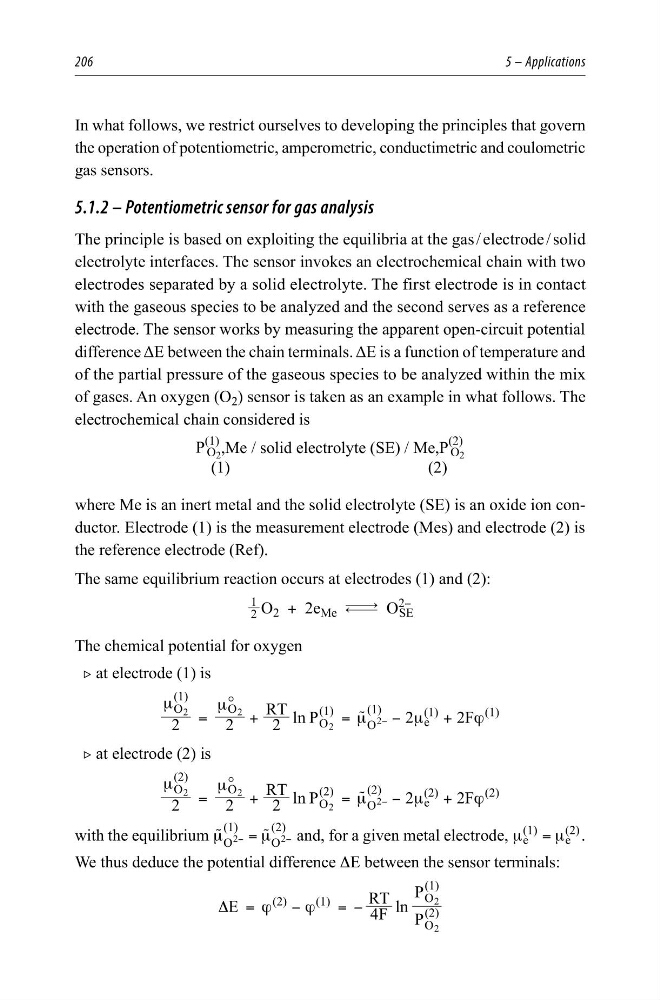
where Me is an inert metal and the solid electrolyte (SE) is an oxide ion conductor. Electrode (1) is the measurement electrode (Mes) and electrode (2) is
the reference electrode (Ref).
The same equilibrium reaction occurs at electrodes (1) and (2):
2
1
O 2 + 2e Me m O
2−
SE
The chemical potential for oxygen
2 at electrode (1) is
2
2
2
RT
ln P
2
2F
O
(1)
O
O
(1)
O
(1)
e
(1)
(1)
2
2
2
2
μ
μ
μ
μ
ϕ
=
+
=
−
+
−
°
u
2 at electrode (2) is
2
2
2
RT
ln P
2
2F
O
(2)
O
O
(2)
O
(2)
e
(2)
(2)
2
2
2
2
μ
μ
μ
μ
ϕ
=
+
=
−
+
−
°
u
with the equilibrium O
(1)
O
(2)
2
2
μ
μ
=
−
−
u
u
and, for a given metal electrode, e
(1)
e
(2)
μ
μ
=
.
We thus deduce the potential difference ΔE between the sensor terminals:
E
4F
RT
ln P
P
(2)
(1)
O
(2)
O
(1)
2
2
ϕ
ϕ
Δ =
−
= −
5 – Applications
In what follows, we restrict ourselves to developing the principles that govern
the operation of potentiometric, amperometric, conductimetric and coulometric
gas sensors.
5.1.2 – Potentiometric sensor for gas analysis
The principle is based on exploiting the equilibria at the gas / electrode / solid
electrolyte interfaces. The sensor invokes an electrochemical chain with two
electrodes separated by a solid electrolyte. The first electrode is in contact
with the gaseous species to be analyzed and the second serves as a reference
electrode. The sensor works by measuring the apparent open-circuit potential
difference ΔE between the chain terminals. ΔE is a function of temperature and
of the partial pressure of the gaseous species to be analyzed within the mix
of gases. An oxygen (O 2 ) sensor is taken as an example in what follows. The
electrochemical chain considered is
P
(1)
O 2 ,Me / solid electrolyte (SE) / Me,P
(2)
O 2
(1)
(2)
where Me is an inert metal and the solid electrolyte (SE) is an oxide ion conductor. Electrode (1) is the measurement electrode (Mes) and electrode (2) is
the reference electrode (Ref).
The same equilibrium reaction occurs at electrodes (1) and (2):
2
1
O 2 + 2e Me m O
2−
SE
The chemical potential for oxygen
2 at electrode (1) is
2
2
2
RT
ln P
2
2F
O
(1)
O
O
(1)
O
(1)
e
(1)
(1)
2
2
2
2
μ
μ
μ
μ
ϕ
=
+
=
−
+
−
°
u
2 at electrode (2) is
2
2
2
RT
ln P
2
2F
O
(2)
O
O
(2)
O
(2)
e
(2)
(2)
2
2
2
2
μ
μ
μ
μ
ϕ
=
+
=
−
+
−
°
u
with the equilibrium O
(1)
O
(2)
2
2
μ
μ
=
−
−
u
u
and, for a given metal electrode, e
(1)
e
(2)
μ
μ
=
.
We thus deduce the potential difference ΔE between the sensor terminals:
E
4F
RT
ln P
P
(2)
(1)
O
(2)
O
(1)
2
2
ϕ
ϕ
Δ =
−
= −