

180
4 – Electrode reactions
a. show that we obtain the solution
X
X
2FS j D
I
i
0
ω
=
+
b. deduce the expression for the overpotential η.
4. Starting from the derivative of the overpotential with respect to I near the
origin (I ≈ 0), or by doing a polynomial approximation
a. Show explicitly that the impedance obtained is a Warburg impedance.
Data
(
)
j
j
1
2
1
1 2
=
−
−
b. For a symmetric cell containing two identical oxygen-diffusion-limited
electrodes deposited on each side of a sintered solid, draw the general
form of the impedance diagram in both the Nyquist and Bode representations. Represent and explain the different elementary contributions of
the response of the electrochemical cell.
c. How does a point of fixed frequency evolve as a function of oxygen
pressure in the gas surrounding the electrode material?
Exercise 4.2 – Study of oxygen-electrode reaction
We use impedance spectroscopy to study the electrochemical behavior of the
lanthanum cobaltite La 0.7 Sr 0.3 CoO 3−δ . Circular electrodes are deposited in a
symmetric configuration on an yttria-stabilized zirconia (YSZ) electrode by
radiofrequency sputtering. They have a diameter d = 20 mm and a thickness
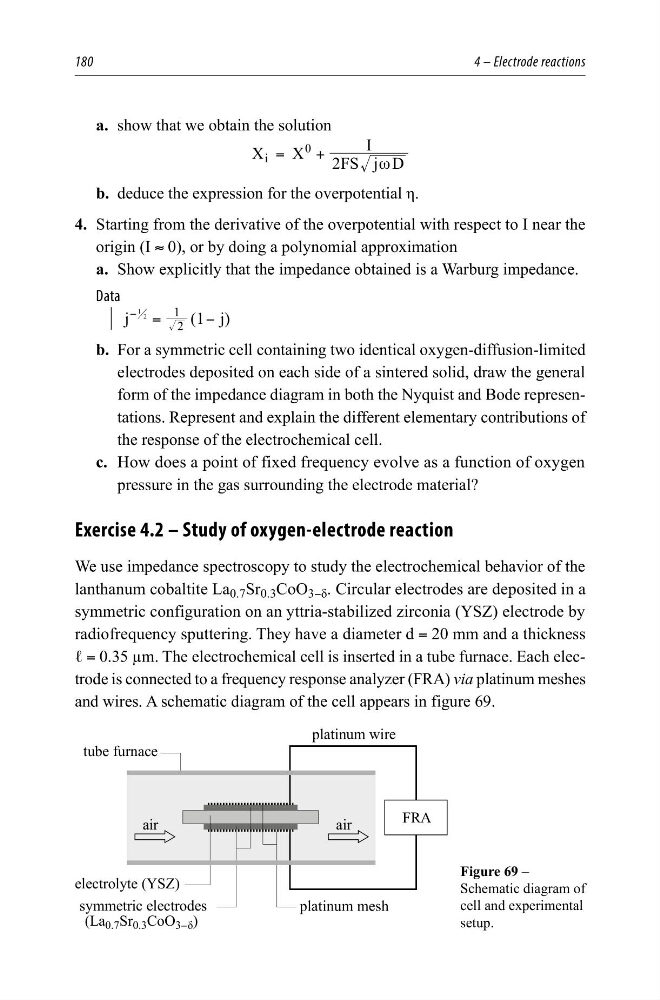
ℓ = 0.35 µm. The electrochemical cell is inserted in a tube furnace. Each electrode is connected to a frequency response analyzer (FRA) via platinum meshes
and wires. A schematic diagram of the cell appears in figure 69.
)5$
DLU
DLU
HOHFWURO\WH<6=
V\PPHWULFHOHFWURGHV
/D 6U &R2 < į
SODWLQXPPHVK
WXEHIXUQDFH
SODWLQXPZLUH
Figure 69 –
Schematic diagram of
cell and experimental
setup.
4 – Electrode reactions
a. show that we obtain the solution
X
X
2FS j D
I
i
0
ω
=
+
b. deduce the expression for the overpotential η.
4. Starting from the derivative of the overpotential with respect to I near the
origin (I ≈ 0), or by doing a polynomial approximation
a. Show explicitly that the impedance obtained is a Warburg impedance.
Data
(
)
j
j
1
2
1
1 2
=
−
−
b. For a symmetric cell containing two identical oxygen-diffusion-limited
electrodes deposited on each side of a sintered solid, draw the general
form of the impedance diagram in both the Nyquist and Bode representations. Represent and explain the different elementary contributions of
the response of the electrochemical cell.
c. How does a point of fixed frequency evolve as a function of oxygen
pressure in the gas surrounding the electrode material?
Exercise 4.2 – Study of oxygen-electrode reaction
We use impedance spectroscopy to study the electrochemical behavior of the
lanthanum cobaltite La 0.7 Sr 0.3 CoO 3−δ . Circular electrodes are deposited in a
symmetric configuration on an yttria-stabilized zirconia (YSZ) electrode by
radiofrequency sputtering. They have a diameter d = 20 mm and a thickness
ℓ = 0.35 µm. The electrochemical cell is inserted in a tube furnace. Each electrode is connected to a frequency response analyzer (FRA) via platinum meshes
and wires. A schematic diagram of the cell appears in figure 69.
)5$
DLU
DLU
HOHFWURO\WH<6=
V\PPHWULFHOHFWURGHV
/D 6U &R2 < į
SODWLQXPPHVK
WXEHIXUQDFH
SODWLQXPZLUH
Figure 69 –
Schematic diagram of
cell and experimental
setup.