

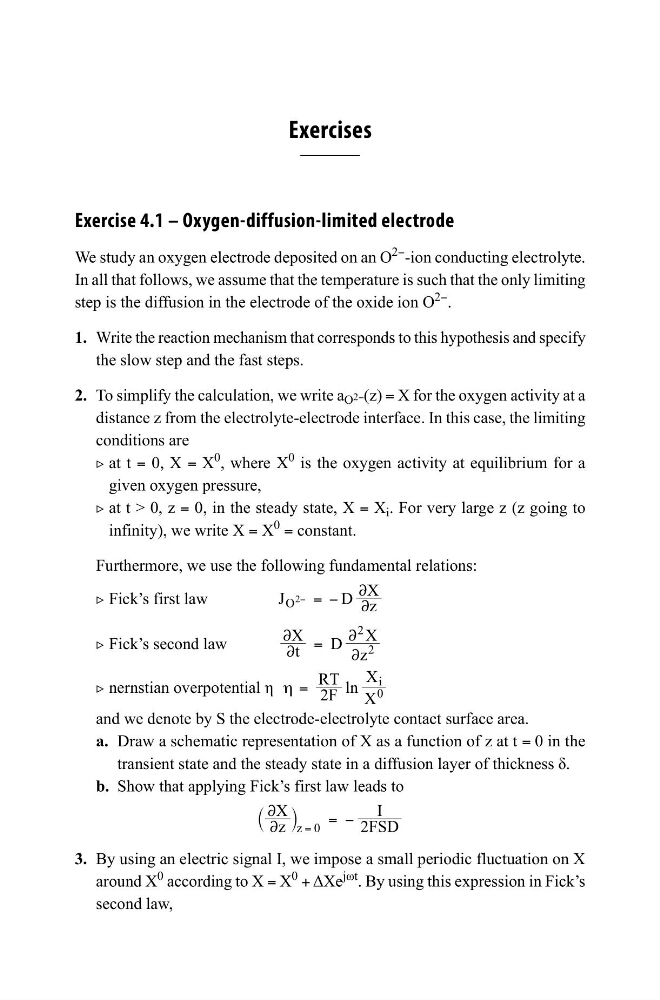
Exercises
Exercise 4.1 – Oxygen-diffusion-limited electrode
We study an oxygen electrode deposited on an O
2−
-ion conducting electrolyte.
In all that follows, we assume that the temperature is such that the only limiting
step is the diffusion in the electrode of the oxide ion O
2−
.
1. Write the reaction mechanism that corresponds to this hypothesis and specify
the slow step and the fast steps.
2. To simplify the calculation, we write a O 2−(z) = X for the oxygen activity at a
distance z from the electrolyte-electrode interface. In this case, the limiting
conditions are
2 at t = 0, X = X
0
, where X
0
is the oxygen activity at equilibrium for a
given oxygen pressure,
2 at t > 0, z = 0, in the steady state, X = X i . For very large z (z going to
infinity), we write X = X
0 = constant.
Furthermore, we use the following fundamental relations:
2 Fick’s first law
J
D z
X
O 2
2
2
= −
−
2 Fick’s second law
t
X
D z
X
2
2
2
2
2
2
=
2 nernstian overpotential η
2F
RT
ln X
X
0
i
η =
and we denote by S the electrode-electrolyte contact surface area.
a. Draw a schematic representation of X as a function of z at t = 0 in the
transient state and the steady state in a diffusion layer of thickness δ.
b. Show that applying Fick’s first law leads to
z
X
FSD
I
2
z 0
2
2
= −
=
`
j
3. By using an electric signal I, we impose a small periodic fluctuation on X
around X
0
according to X = X
0 + ΔXe
jωt
. By using this expression in Fick’s
second law,
Exercise 4.1 – Oxygen-diffusion-limited electrode
We study an oxygen electrode deposited on an O
2−
-ion conducting electrolyte.
In all that follows, we assume that the temperature is such that the only limiting
step is the diffusion in the electrode of the oxide ion O
2−
.
1. Write the reaction mechanism that corresponds to this hypothesis and specify
the slow step and the fast steps.
2. To simplify the calculation, we write a O 2−(z) = X for the oxygen activity at a
distance z from the electrolyte-electrode interface. In this case, the limiting
conditions are
2 at t = 0, X = X
0
, where X
0
is the oxygen activity at equilibrium for a
given oxygen pressure,
2 at t > 0, z = 0, in the steady state, X = X i . For very large z (z going to
infinity), we write X = X
0 = constant.
Furthermore, we use the following fundamental relations:
2 Fick’s first law
J
D z
X
O 2
2
2
= −
−
2 Fick’s second law
t
X
D z
X
2
2
2
2
2
2
=
2 nernstian overpotential η
2F
RT
ln X
X
0
i
η =
and we denote by S the electrode-electrolyte contact surface area.
a. Draw a schematic representation of X as a function of z at t = 0 in the
transient state and the steady state in a diffusion layer of thickness δ.
b. Show that applying Fick’s first law leads to
z
X
FSD
I
2
z 0
2
2
= −
=
`
j
3. By using an electric signal I, we impose a small periodic fluctuation on X
around X
0
according to X = X
0 + ΔXe
jωt
. By using this expression in Fick’s
second law,