

178
4 – Electrode reactions
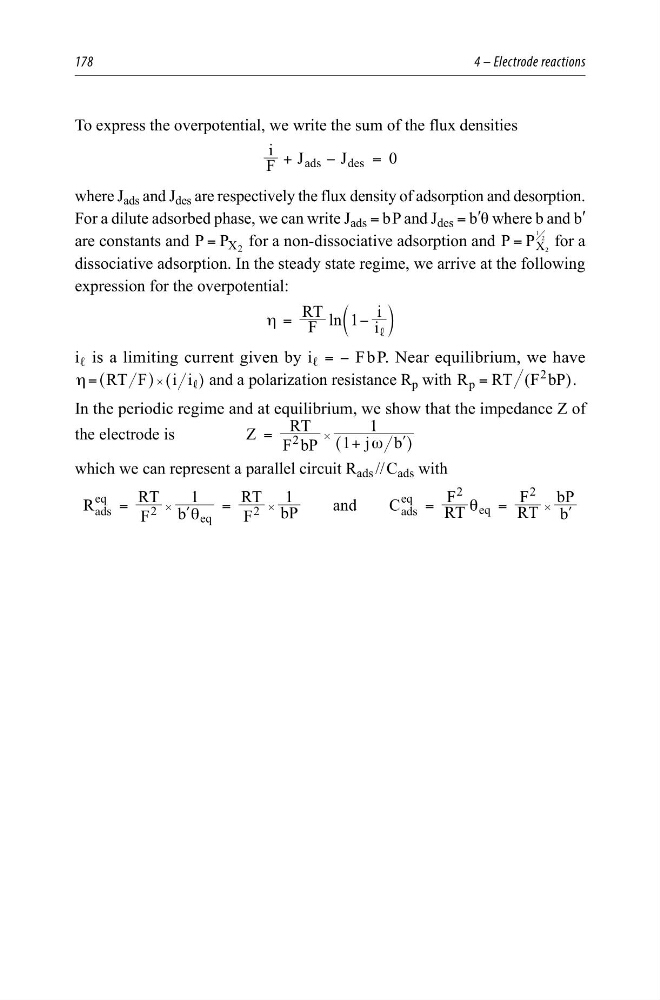
To express the overpotential, we write the sum of the flux densities
F
i
J
J
0
ads
des
+
−
=
where J ads and J des are respectively the flux density of adsorption and desorption.
For a dilute adsorbed phase, we can write J ads = bP and J des = b ′ θ where b and b ′
are constants and P P X 2
=
for a non-dissociative adsorption and P P X 2
1 2
=
for a
dissociative adsorption. In the steady state regime, we arrive at the following
expression for the overpotential:
F
RT
ln 1 i
i
η =
−
,
c
m
i ℓ is a limiting current given by i ℓ = − F b P. Near equilibrium, we have
RT F
i i
η =
,
#
^
^
h
h and a polarization resistance R p with
(
).
R RT F bP
p
2
=
In the periodic regime and at equilibrium, we show that the impedance Z of
the electrode is
Z
F bP
RT
1 j b
1
2
ω
=
+
#
l
^
h
which we can represent a parallel circuit R ads // C ads with
R
F
RT
b
1
F
RT bP
1
and
C
RT
F
RT
F
b
bP
ads
eq
2
eq
2
ads
eq
2
eq
2
θ
θ
=
=
=
=
#
#
#
l
l
4 – Electrode reactions
To express the overpotential, we write the sum of the flux densities
F
i
J
J
0
ads
des
+
−
=
where J ads and J des are respectively the flux density of adsorption and desorption.
For a dilute adsorbed phase, we can write J ads = bP and J des = b ′ θ where b and b ′
are constants and P P X 2
=
for a non-dissociative adsorption and P P X 2
1 2
=
for a
dissociative adsorption. In the steady state regime, we arrive at the following
expression for the overpotential:
F
RT
ln 1 i
i
η =
−
,
c
m
i ℓ is a limiting current given by i ℓ = − F b P. Near equilibrium, we have
RT F
i i
η =
,
#
^
^
h
h and a polarization resistance R p with
(
).
R RT F bP
p
2
=
In the periodic regime and at equilibrium, we show that the impedance Z of
the electrode is
Z
F bP
RT
1 j b
1
2
ω
=
+
#
l
^
h
which we can represent a parallel circuit R ads // C ads with
R
F
RT
b
1
F
RT bP
1
and
C
RT
F
RT
F
b
bP
ads
eq
2
eq
2
ads
eq
2
eq
2
θ
θ
=
=
=
=
#
#
#
l
l