

Course notes
177
where R d denotes the diffusion resistance, which varies with overpotential. At
equilibrium, the expression for R d is
R
n F
RT [Ox] D
d
eq
2 2
Ox
Ox
#
δ
=
ϕ
Note – In the case of a gas, [Ox] φ is a function of the partial pressure of the gas.
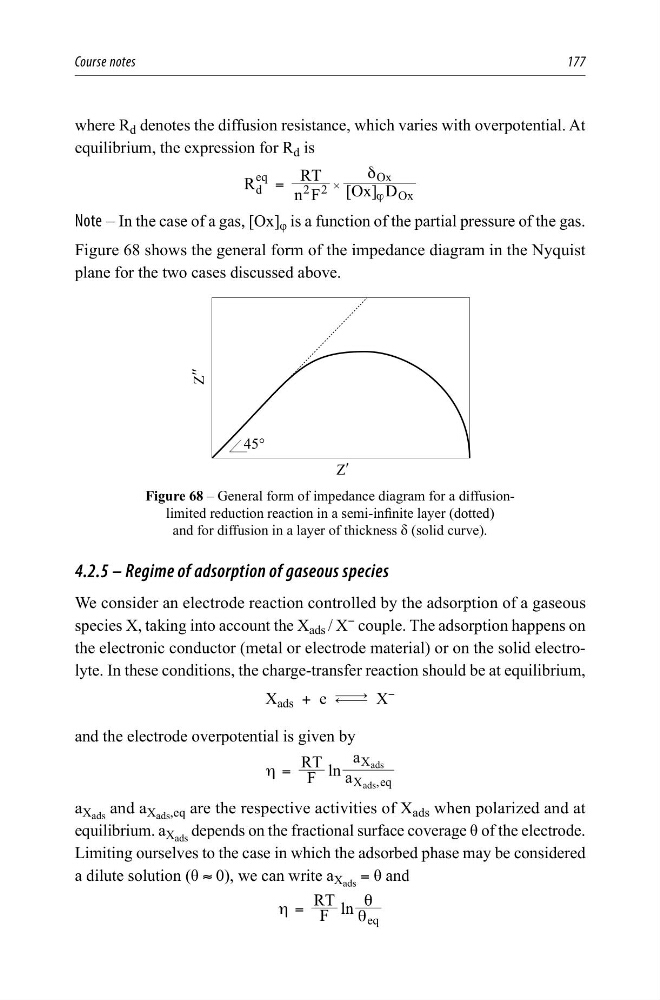
Figure 68 shows the general form of the impedance diagram in the Nyquist
plane for the two cases discussed above.
=ƍ
= ƍƍ
Figure 68 – General form of impedance diagram for a diffusionlimited reduction reaction in a semi-infinite layer (dotted)
and for diffusion in a layer of thickness δ (solid curve).
4.2.5 – Regime of adsorption of gaseous species
We consider an electrode reaction controlled by the adsorption of a gaseous
species X, taking into account the X ads / X
−
couple. The adsorption happens on
the electronic conductor (metal or electrode material) or on the solid electrolyte. In these conditions, the charge-transfer reaction should be at equilibrium,
X ads + e m X
−
and the electrode overpotential is given by
F
RT
ln a
a
X ,eq
X
ads
ads
η =
a X ads and a X ads ,eq are the respective activities of X ads when polarized and at
equilibrium. a X ads depends on the fractional surface coverage θ of the electrode.
Limiting ourselves to the case in which the adsorbed phase may be considered
a dilute solution (θ ≈ 0), we can write a X ads = θ and
F
RT
ln eq
η
θ
θ
=
177
where R d denotes the diffusion resistance, which varies with overpotential. At
equilibrium, the expression for R d is
R
n F
RT [Ox] D
d
eq
2 2
Ox
Ox
#
δ
=
ϕ
Note – In the case of a gas, [Ox] φ is a function of the partial pressure of the gas.
Figure 68 shows the general form of the impedance diagram in the Nyquist
plane for the two cases discussed above.
=ƍ
= ƍƍ
Figure 68 – General form of impedance diagram for a diffusionlimited reduction reaction in a semi-infinite layer (dotted)
and for diffusion in a layer of thickness δ (solid curve).
4.2.5 – Regime of adsorption of gaseous species
We consider an electrode reaction controlled by the adsorption of a gaseous
species X, taking into account the X ads / X
−
couple. The adsorption happens on
the electronic conductor (metal or electrode material) or on the solid electrolyte. In these conditions, the charge-transfer reaction should be at equilibrium,
X ads + e m X
−
and the electrode overpotential is given by
F
RT
ln a
a
X ,eq
X
ads
ads
η =
a X ads and a X ads ,eq are the respective activities of X ads when polarized and at
equilibrium. a X ads depends on the fractional surface coverage θ of the electrode.
Limiting ourselves to the case in which the adsorbed phase may be considered
a dilute solution (θ ≈ 0), we can write a X ads = θ and
F
RT
ln eq
η
θ
θ
=