

176
4 – Electrode reactions
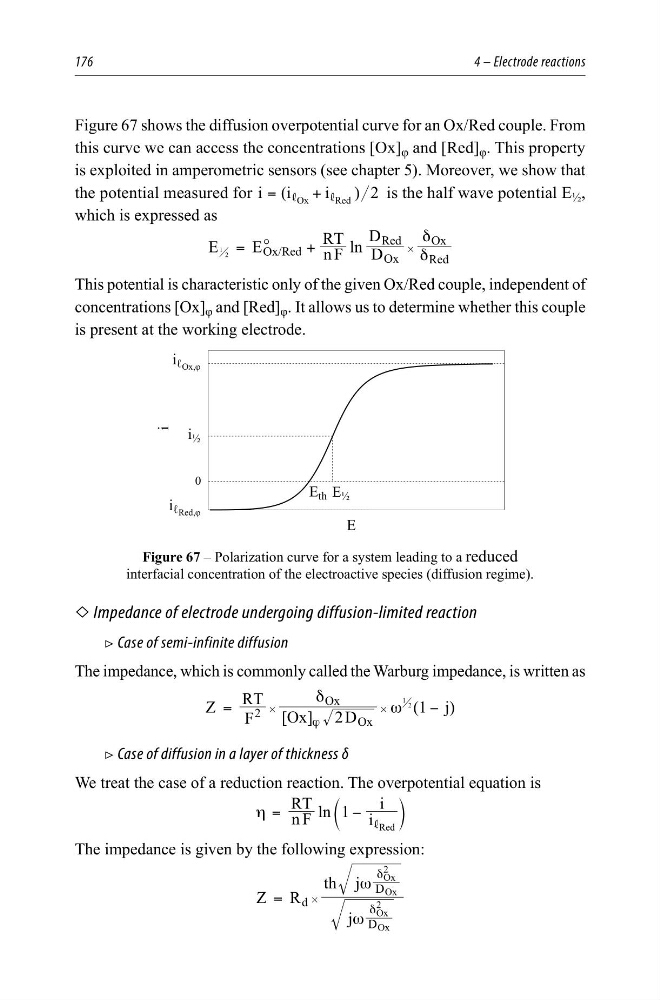
Figure 67 shows the diffusion overpotential curve for an Ox/Red couple. From
this curve we can access the concentrations [Ox] φ and [Red] φ . This property
is exploited in amperometric sensors (see chapter 5). Moreover, we show that
the potential measured for
(
)
i i
i
2
Ox
Red
=
+
,
,
is the half wave potential E ½ ,
which is expressed as
E
E
n F
RT
ln D
D
Ox/Red
Ox
Red
Red
Ox
1 2
δ
δ
=
+
#
°
This potential is characteristic only of the given Ox/Red couple, independent of
concentrations [Ox] φ and [Red] φ . It allows us to determine whether this couple
is present at the working electrode.
L
(
L Ɛ 2[ij
L Ɛ 5HGij
( WK ( ò
L ò
Figure 67 – Polarization curve for a system leading to a reduced
interfacial concentration of the electroactive species (diffusion regime).
L Impedance of electrode undergoing diffusion-limited reaction
2 Case of semi-infinite diffusion
The impedance, which is commonly called the Warburg impedance, is written as
Z
F
RT
[Ox] 2D
(1 j)
2
Ox
Ox
1 2
δ
ω
=
−
ϕ
#
#
2 Case of diffusion in a layer of thickness δ
We treat the case of a reduction reaction. The overpotential equation is
n F
RT
ln 1 i
i
Red
η =
−
,
c
m
The impedance is given by the following expression:
Z R
j
th j
d
D
D
Ox
Ox
2
Ox
Ox
2
ω
ω
=
δ
δ
#
4 – Electrode reactions
Figure 67 shows the diffusion overpotential curve for an Ox/Red couple. From
this curve we can access the concentrations [Ox] φ and [Red] φ . This property
is exploited in amperometric sensors (see chapter 5). Moreover, we show that
the potential measured for
(
)
i i
i
2
Ox
Red
=
+
,
,
is the half wave potential E ½ ,
which is expressed as
E
E
n F
RT
ln D
D
Ox/Red
Ox
Red
Red
Ox
1 2
δ
δ
=
+
#
°
This potential is characteristic only of the given Ox/Red couple, independent of
concentrations [Ox] φ and [Red] φ . It allows us to determine whether this couple
is present at the working electrode.
L
(
L Ɛ 2[ij
L Ɛ 5HGij
( WK ( ò
L ò
Figure 67 – Polarization curve for a system leading to a reduced
interfacial concentration of the electroactive species (diffusion regime).
L Impedance of electrode undergoing diffusion-limited reaction
2 Case of semi-infinite diffusion
The impedance, which is commonly called the Warburg impedance, is written as
Z
F
RT
[Ox] 2D
(1 j)
2
Ox
Ox
1 2
δ
ω
=
−
ϕ
#
#
2 Case of diffusion in a layer of thickness δ
We treat the case of a reduction reaction. The overpotential equation is
n F
RT
ln 1 i
i
Red
η =
−
,
c
m
The impedance is given by the following expression:
Z R
j
th j
d
D
D
Ox
Ox
2
Ox
Ox
2
ω
ω
=
δ
δ
#