

168
3 – Transport in ionic solids
ij
ij
3W,
ij
3W,,
ij
<6=
ij
<6=
PLFURHOHFWURGH
ij
3W
¨(
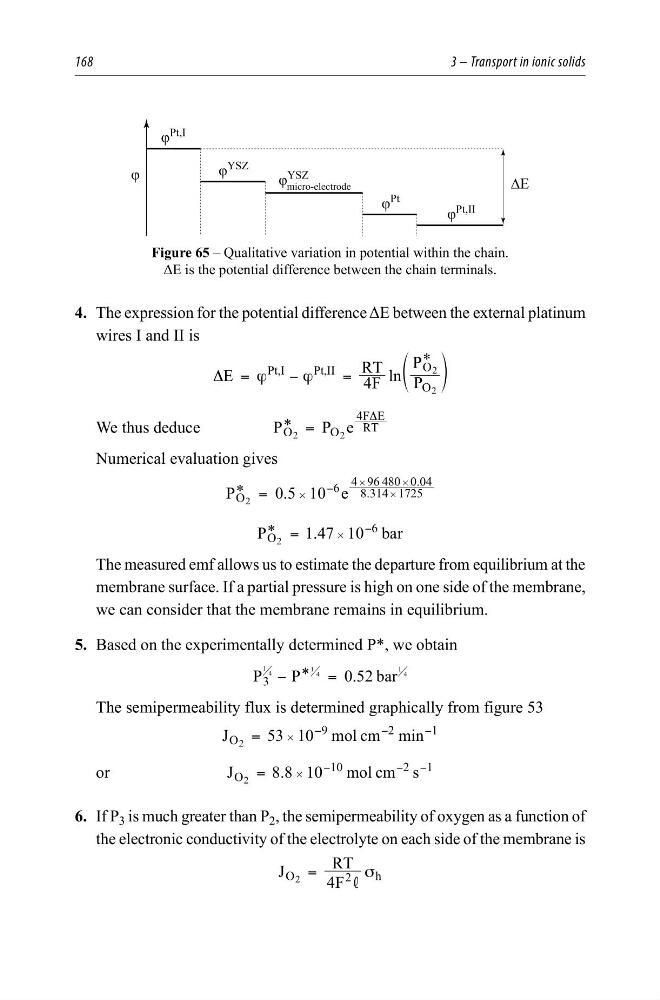
Figure 65 – Qualitative variation in potential within the chain.
ΔE is the potential difference between the chain terminals.
4. The expression for the potential difference ΔE between the external platinum
wires I and II is
E
4F
RT
ln P
P
Pt,I
Pt,II
O
O
2
2
ϕ
ϕ
Δ =
−
=
*
e
o
We thus deduce
P
P e
O
O
RT
4F E
2
2
=
Δ
*
Numerical evaluation gives
.
P
e
0 5 10
.
.
O
6
8 314 1725
4 96 480 0 04
2
#
=
#
#
#
−
*
.
P
b ar
1 47 10
O
6
2
#
=
−
*
The measured emf allows us to estimate the departure from equilibrium at the
membrane surface. If a partial pressure is high on one side of the membrane,
we can consider that the membrane remains in equilibrium.
5. Based on the experimentally determined P*, we obtain
.
P
P
bar
0 52
3
1 4
1 4
1 4
−
=
*
The semipermeability flux is determined graphically from figure 53
min
J
m ol cm
53 10
O
9
2
1
2
#
=
−
−
−
or
.
J
m ol cm s
8 8 10
O
10
2 1
2
#
=
−
− −
6. If P 3 is much greater than P 2 , the semipermeability of oxygen as a function of
the electronic conductivity of the electrolyte on each side of the membrane is
J
4F
RT
O
2
h
2
,
σ
=
3 – Transport in ionic solids
ij
ij
3W,
ij
3W,,
ij
<6=
ij
<6=
PLFURHOHFWURGH
ij
3W
¨(
Figure 65 – Qualitative variation in potential within the chain.
ΔE is the potential difference between the chain terminals.
4. The expression for the potential difference ΔE between the external platinum
wires I and II is
E
4F
RT
ln P
P
Pt,I
Pt,II
O
O
2
2
ϕ
ϕ
Δ =
−
=
*
e
o
We thus deduce
P
P e
O
O
RT
4F E
2
2
=
Δ
*
Numerical evaluation gives
.
P
e
0 5 10
.
.
O
6
8 314 1725
4 96 480 0 04
2
#
=
#
#
#
−
*
.
P
b ar
1 47 10
O
6
2
#
=
−
*
The measured emf allows us to estimate the departure from equilibrium at the
membrane surface. If a partial pressure is high on one side of the membrane,
we can consider that the membrane remains in equilibrium.
5. Based on the experimentally determined P*, we obtain
.
P
P
bar
0 52
3
1 4
1 4
1 4
−
=
*
The semipermeability flux is determined graphically from figure 53
min
J
m ol cm
53 10
O
9
2
1
2
#
=
−
−
−
or
.
J
m ol cm s
8 8 10
O
10
2 1
2
#
=
−
− −
6. If P 3 is much greater than P 2 , the semipermeability of oxygen as a function of
the electronic conductivity of the electrolyte on each side of the membrane is
J
4F
RT
O
2
h
2
,
σ
=