

Solutions to exercises
167
and
2
RT
ln P
2
2F
2F
O
e
Pt
Pt,II
O
MO
MO
2
2
μ
ϕ
μ
ϕ
+
−
=
−
−
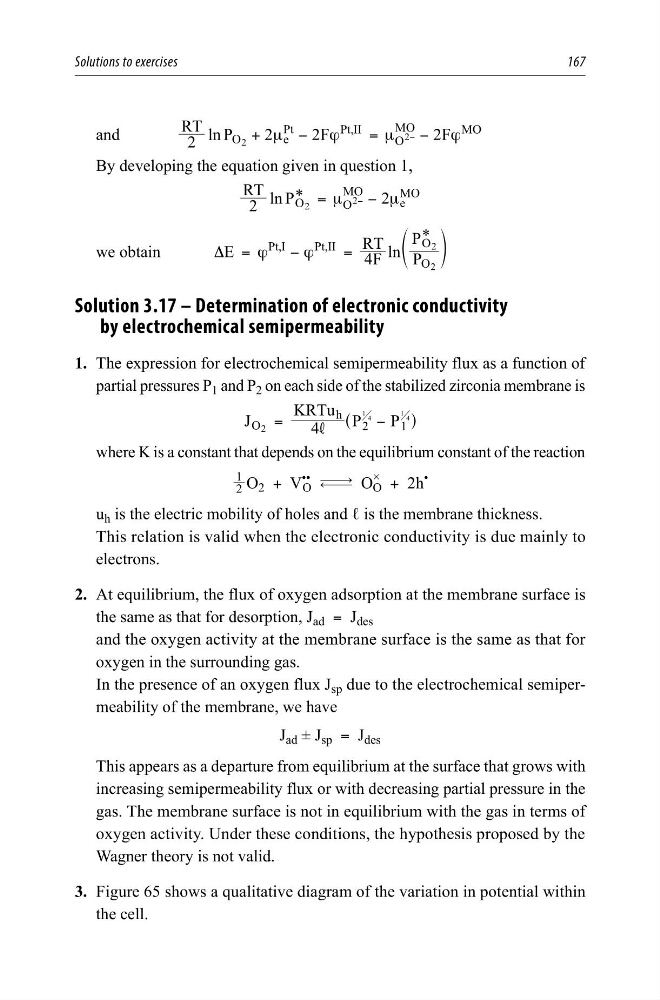
By developing the equation given in question 1,
2
RT
ln P
2
O
O
MO
e
MO
2
2
μ
μ
=
−
−
*
we obtain
E
4F
RT
ln P
P
Pt,I
Pt,II
O
O
2
2
ϕ
ϕ
Δ =
−
=
*
e
o
Solution 3.17 – Determination of electronic conductivity
by electrochemical semipermeability
1. The expression for electrochemical semipermeability flux as a function of
partial pressures P 1 and P 2 on each side of the stabilized zirconia membrane is
J
KRTu P
P
4
O
h
2
1
2
1 4
1 4
,
=
−
^
h
where K is a constant that depends on the equilibrium constant of the reaction
2
1
O 2 + V
••
O m O
#
O + 2h
•
u h is the electric mobility of holes and ℓ is the membrane thickness.
This relation is valid when the electronic conductivity is due mainly to
electrons.
2. At equilibrium, the flux of oxygen adsorption at the membrane surface is
the same as that for desorption, J ad = J des
and the oxygen activity at the membrane surface is the same as that for
oxygen in the surrounding gas.
In the presence of an oxygen flux J sp due to the electrochemical semipermeability of the membrane, we have
J ad ± J sp = J des
This appears as a departure from equilibrium at the surface that grows with
increasing semipermeability flux or with decreasing partial pressure in the
gas. The membrane surface is not in equilibrium with the gas in terms of
oxygen activity. Under these conditions, the hypothesis proposed by the
Wagner theory is not valid.
3. Figure 65 shows a qualitative diagram of the variation in potential within
the cell.
167
and
2
RT
ln P
2
2F
2F
O
e
Pt
Pt,II
O
MO
MO
2
2
μ
ϕ
μ
ϕ
+
−
=
−
−
By developing the equation given in question 1,
2
RT
ln P
2
O
O
MO
e
MO
2
2
μ
μ
=
−
−
*
we obtain
E
4F
RT
ln P
P
Pt,I
Pt,II
O
O
2
2
ϕ
ϕ
Δ =
−
=
*
e
o
Solution 3.17 – Determination of electronic conductivity
by electrochemical semipermeability
1. The expression for electrochemical semipermeability flux as a function of
partial pressures P 1 and P 2 on each side of the stabilized zirconia membrane is
J
KRTu P
P
4
O
h
2
1
2
1 4
1 4
,
=
−
^
h
where K is a constant that depends on the equilibrium constant of the reaction
2
1
O 2 + V
••
O m O
#
O + 2h
•
u h is the electric mobility of holes and ℓ is the membrane thickness.
This relation is valid when the electronic conductivity is due mainly to
electrons.
2. At equilibrium, the flux of oxygen adsorption at the membrane surface is
the same as that for desorption, J ad = J des
and the oxygen activity at the membrane surface is the same as that for
oxygen in the surrounding gas.
In the presence of an oxygen flux J sp due to the electrochemical semipermeability of the membrane, we have
J ad ± J sp = J des
This appears as a departure from equilibrium at the surface that grows with
increasing semipermeability flux or with decreasing partial pressure in the
gas. The membrane surface is not in equilibrium with the gas in terms of
oxygen activity. Under these conditions, the hypothesis proposed by the
Wagner theory is not valid.
3. Figure 65 shows a qualitative diagram of the variation in potential within
the cell.