

Solutions to exercises
157
A range therefore exists where the protonic conduction is constant independent of the oxygen partial pressure.
C – Determination electronic conduction part
1. a. Theoretical expression for emf ΔE as a function of hydrogen partial
pressure P H 2 ,c and of temperature
Both electrodes are at the following equilibrium:
H 2(g) m 2H
•
i + 2e ′
For electrode k, applying the Nernst equation gives
ln
E
E
F
RT P
H
2
,
k
k
H k
i k
2
•
2
=
+
°
6 @
Assuming that the activity of species H
•
i is the same at the two electrodeelectrolyte interfaces, the expression for the emf ΔE at the cell terminals is
E
2F
RT
ln P
P
H ,c
H ,1
2
2
Δ =
or
E
2F
RT
ln P H ,c
2
Δ = −
with P H 2 ,c expressed in bar.
b. This expression is valid under the following conditions:
2 the electronic conductivity of the electrolyte is negligible,
2 the protonic conductivity is non-negligible.
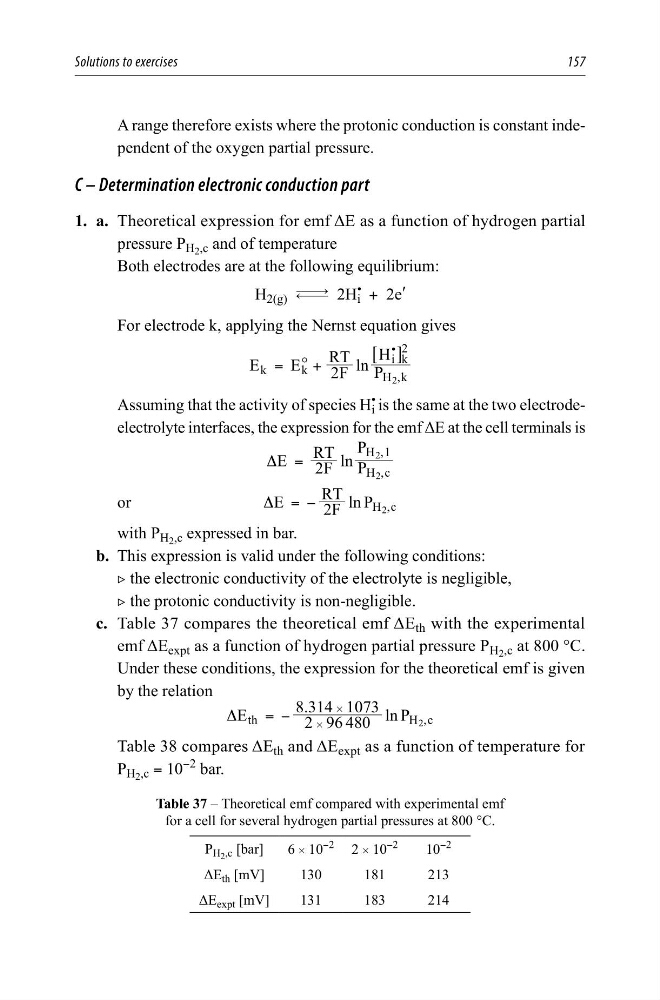
c. Table 37 compares the theoretical emf ΔE th with the experimental
emf ΔE expt as a function of hydrogen partial pressure P H 2 ,c at 800 °C.
Under these conditions, the expression for the theoretical emf is given
by the relation
E
2 96 480
8.314 1073
ln P
th
H ,c
2
Δ
= −
#
#
Table 38 compares ΔE th and ΔE expt as a function of temperature for
P H 2 ,c = 10
−2
bar.
Table 37 – Theoretical emf compared with experimental emf
for a cell for several hydrogen partial pressures at 800 °C.
P H 2 ,c [bar]
6 # 10
−2
2 # 10
−2
10
−2
ΔE th [mV]
130
181
213
ΔE expt [mV]
131
183
214
157
A range therefore exists where the protonic conduction is constant independent of the oxygen partial pressure.
C – Determination electronic conduction part
1. a. Theoretical expression for emf ΔE as a function of hydrogen partial
pressure P H 2 ,c and of temperature
Both electrodes are at the following equilibrium:
H 2(g) m 2H
•
i + 2e ′
For electrode k, applying the Nernst equation gives
ln
E
E
F
RT P
H
2
,
k
k
H k
i k
2
•
2
=
+
°
6 @
Assuming that the activity of species H
•
i is the same at the two electrodeelectrolyte interfaces, the expression for the emf ΔE at the cell terminals is
E
2F
RT
ln P
P
H ,c
H ,1
2
2
Δ =
or
E
2F
RT
ln P H ,c
2
Δ = −
with P H 2 ,c expressed in bar.
b. This expression is valid under the following conditions:
2 the electronic conductivity of the electrolyte is negligible,
2 the protonic conductivity is non-negligible.
c. Table 37 compares the theoretical emf ΔE th with the experimental
emf ΔE expt as a function of hydrogen partial pressure P H 2 ,c at 800 °C.
Under these conditions, the expression for the theoretical emf is given
by the relation
E
2 96 480
8.314 1073
ln P
th
H ,c
2
Δ
= −
#
#
Table 38 compares ΔE th and ΔE expt as a function of temperature for
P H 2 ,c = 10
−2
bar.
Table 37 – Theoretical emf compared with experimental emf
for a cell for several hydrogen partial pressures at 800 °C.
P H 2 ,c [bar]
6 # 10
−2
2 # 10
−2
10
−2
ΔE th [mV]
130
181
213
ΔE expt [mV]
131
183
214