

156
3 – Transport in ionic solids
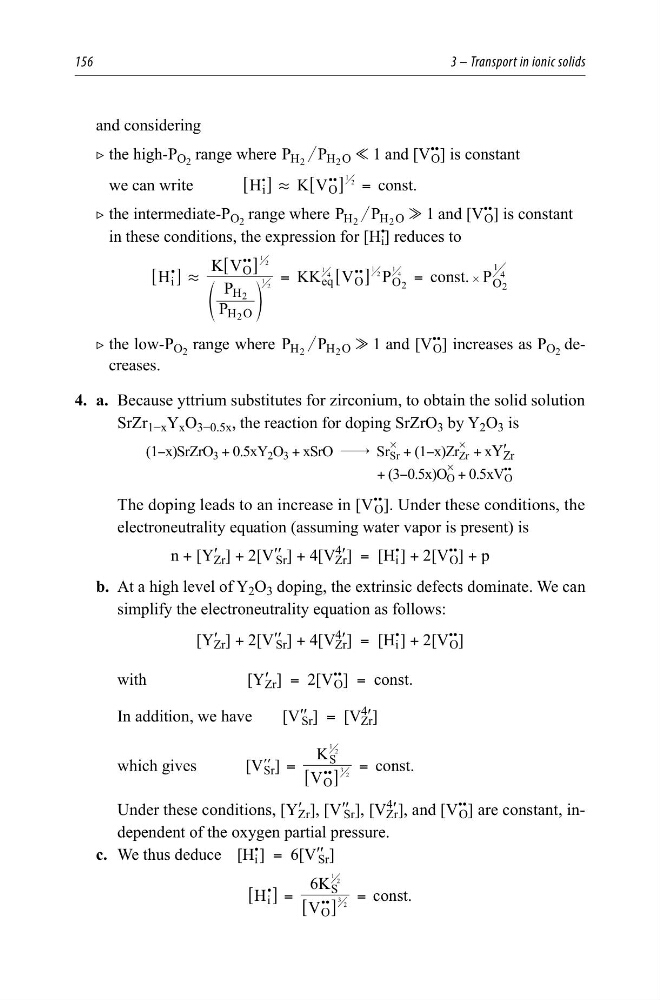
and considering
2 the high-P O 2 range where P
P
1
H
H O
2
2
% and [V
••
O ] is constant
we can write
.
H
K V
const
i
O
••
1 2
.
=
:
6
6
@
@
2 the intermediate-P O 2 range where P
P
1
H
H O
2
2
& and [V
••
O ] is constant
in these conditions, the expression for [H
•
i ] reduces to
.
H
P
P
K V
KK V
P
const P
i
H O
H
O
eq
O
O
O
•
••
••
2
2
2
2
1 4
1 2
1 2
1 4
1 2
1 4
.
=
=
#
e
o
6
6
6
@
@
@
2 the low-P O 2 range where P
P
1
H
H O
2
2
& and [V
••
O ] increases as P O 2 decreases.
4. a. Because yttrium substitutes for zirconium, to obtain the solid solution
SrZr 1−x Y x O 3−0.5x , the reaction for doping SrZrO 3 by Y 2 O 3 is
(1−x)SrZrO 3 + 0.5xY 2 O 3 + xSrO $ Sr
#
Sr + (1−x)Zr
#
Zr + xY ′
Zr
+ (3−0.5x)O
#
O + 0.5xV
••
O
The doping leads to an increase in [V
••
O ]. Under these conditions, the
electroneutrality equation (assuming water vapor is present) is
n + [Y ′
Zr ] + 2[V ′′ Sr ] + 4[V
4 ′
Zr ] = [H
•
i ] + 2[V
••
O ] + p
b. At a high level of Y 2 O 3 doping, the extrinsic defects dominate. We can
simplify the electroneutrality equation as follows:
[Y ′
Zr ] + 2[V ′′ Sr ] + 4[V
4 ′
Zr ] = [H
•
i ] + 2[V
••
O ]
with
[Y ′
Zr ] = 2[V
••
O ] = const.
In addition, we have
[V ′′ Sr ] = [V
4 ′
Zr ]
which gives
[ ]
.
V
V
K
const
Sr
O
S
••
3 2
1 2
=
=
ll
6 @
Under these conditions, [Y ′ Zr ], [V ′′ Sr ], [V
4 ′
Zr ], and [V
••
O ] are constant, independent of the oxygen partial pressure.
c. We thus deduce [H
•
i ] = 6[V ′′ Sr ]
.
H
V
K
const
6
i
O
S
•
••
3 2
1 2
=
=
6
6
@
@
3 – Transport in ionic solids
and considering
2 the high-P O 2 range where P
P
1
H
H O
2
2
% and [V
••
O ] is constant
we can write
.
H
K V
const
i
O
••
1 2
.
=
:
6
6
@
@
2 the intermediate-P O 2 range where P
P
1
H
H O
2
2
& and [V
••
O ] is constant
in these conditions, the expression for [H
•
i ] reduces to
.
H
P
P
K V
KK V
P
const P
i
H O
H
O
eq
O
O
O
•
••
••
2
2
2
2
1 4
1 2
1 2
1 4
1 2
1 4
.
=
=
#
e
o
6
6
6
@
@
@
2 the low-P O 2 range where P
P
1
H
H O
2
2
& and [V
••
O ] increases as P O 2 decreases.
4. a. Because yttrium substitutes for zirconium, to obtain the solid solution
SrZr 1−x Y x O 3−0.5x , the reaction for doping SrZrO 3 by Y 2 O 3 is
(1−x)SrZrO 3 + 0.5xY 2 O 3 + xSrO $ Sr
#
Sr + (1−x)Zr
#
Zr + xY ′
Zr
+ (3−0.5x)O
#
O + 0.5xV
••
O
The doping leads to an increase in [V
••
O ]. Under these conditions, the
electroneutrality equation (assuming water vapor is present) is
n + [Y ′
Zr ] + 2[V ′′ Sr ] + 4[V
4 ′
Zr ] = [H
•
i ] + 2[V
••
O ] + p
b. At a high level of Y 2 O 3 doping, the extrinsic defects dominate. We can
simplify the electroneutrality equation as follows:
[Y ′
Zr ] + 2[V ′′ Sr ] + 4[V
4 ′
Zr ] = [H
•
i ] + 2[V
••
O ]
with
[Y ′
Zr ] = 2[V
••
O ] = const.
In addition, we have
[V ′′ Sr ] = [V
4 ′
Zr ]
which gives
[ ]
.
V
V
K
const
Sr
O
S
••
3 2
1 2
=
=
ll
6 @
Under these conditions, [Y ′ Zr ], [V ′′ Sr ], [V
4 ′
Zr ], and [V
••
O ] are constant, independent of the oxygen partial pressure.
c. We thus deduce [H
•
i ] = 6[V ′′ Sr ]
.
H
V
K
const
6
i
O
S
•
••
3 2
1 2
=
=
6
6
@
@