

158
3 – Transport in ionic solids
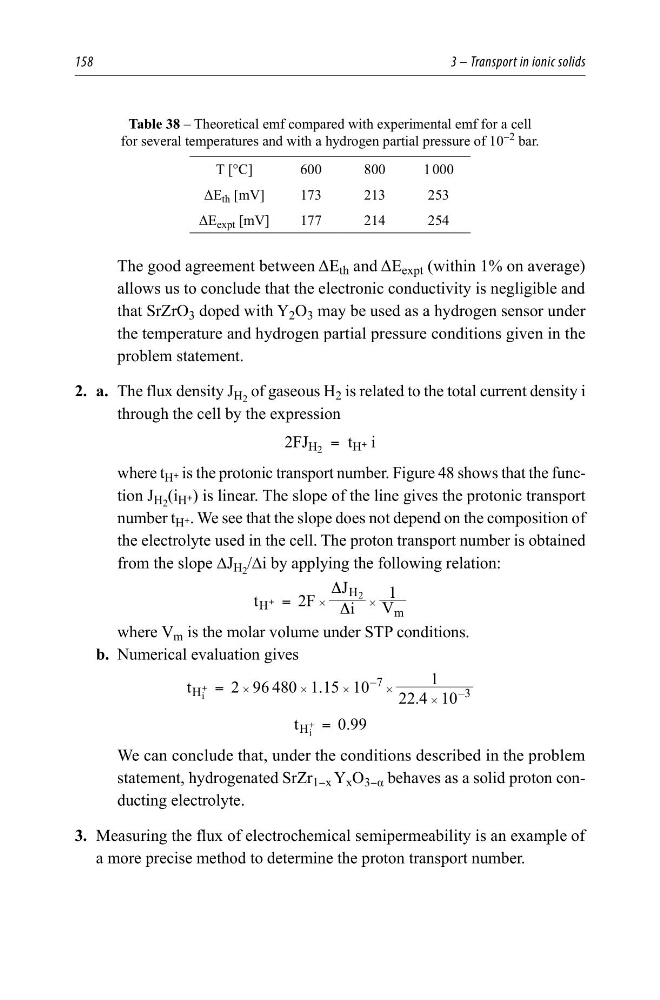
Table 38 – Theoretical emf compared with experimental emf for a cell
for several temperatures and with a hydrogen partial pressure of 10
−2
bar.
T [°C]
600
800
1 000
ΔE th [mV]
173
213
253
ΔE expt [mV]
177
214
254
The good agreement between ΔE th and ΔE expt (within 1% on average)
allows us to conclude that the electronic conductivity is negligible and
that SrZrO 3 doped with Y 2 O 3 may be used as a hydrogen sensor under
the temperature and hydrogen partial pressure conditions given in the
problem statement.
2. a. The flux density J H 2 of gaseous H 2 is related to the total current density i
through the cell by the expression
2FJ H 2 = t H + i
where t H + is the protonic transport number. Figure 48 shows that the function J H 2 (i H +) is linear. The slope of the line gives the protonic transport
number t H +. We see that the slope does not depend on the composition of
the electrolyte used in the cell. The proton transport number is obtained
from the slope ∆J H 2 /∆i by applying the following relation:
t
2F
i
J
V
1
H
H
m
2
Δ
Δ
=
#
#
+
where V m is the molar volume under STP conditions.
b. Numerical evaluation gives
t
2 96 480 1.15 10
22.4 10
1
H
–7
–3
i
#
#
= #
#
#
+
.
t
099
H i
=
+
We can conclude that, under the conditions described in the problem
statement, hydrogenated SrZr 1−x Y x O 3−α behaves as a solid proton conducting electrolyte.
3. Measuring the flux of electrochemical semipermeability is an example of
a more precise method to determine the proton transport number.
3 – Transport in ionic solids
Table 38 – Theoretical emf compared with experimental emf for a cell
for several temperatures and with a hydrogen partial pressure of 10
−2
bar.
T [°C]
600
800
1 000
ΔE th [mV]
173
213
253
ΔE expt [mV]
177
214
254
The good agreement between ΔE th and ΔE expt (within 1% on average)
allows us to conclude that the electronic conductivity is negligible and
that SrZrO 3 doped with Y 2 O 3 may be used as a hydrogen sensor under
the temperature and hydrogen partial pressure conditions given in the
problem statement.
2. a. The flux density J H 2 of gaseous H 2 is related to the total current density i
through the cell by the expression
2FJ H 2 = t H + i
where t H + is the protonic transport number. Figure 48 shows that the function J H 2 (i H +) is linear. The slope of the line gives the protonic transport
number t H +. We see that the slope does not depend on the composition of
the electrolyte used in the cell. The proton transport number is obtained
from the slope ∆J H 2 /∆i by applying the following relation:
t
2F
i
J
V
1
H
H
m
2
Δ
Δ
=
#
#
+
where V m is the molar volume under STP conditions.
b. Numerical evaluation gives
t
2 96 480 1.15 10
22.4 10
1
H
–7
–3
i
#
#
= #
#
#
+
.
t
099
H i
=
+
We can conclude that, under the conditions described in the problem
statement, hydrogenated SrZr 1−x Y x O 3−α behaves as a solid proton conducting electrolyte.
3. Measuring the flux of electrochemical semipermeability is an example of
a more precise method to determine the proton transport number.