

138
3 – Transport in ionic solids
t
D e
D e
RT
D e
Cl
RT
E
K
RT
E
Cl
RT
E
=
+
−
−
−
−
−
+
−
*
*
*
°
°
°
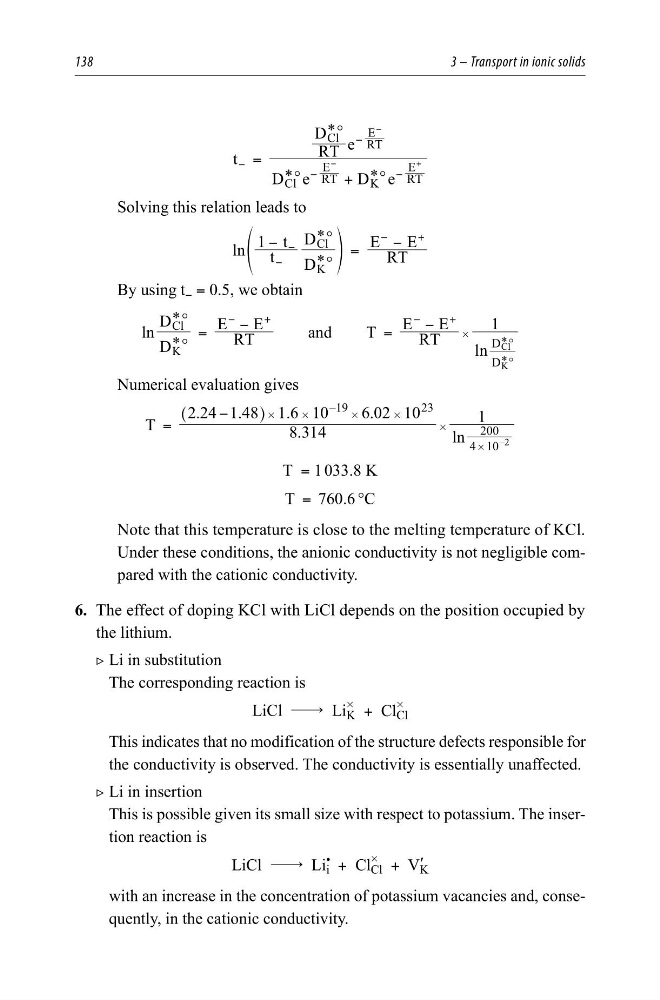
Solving this relation leads to
ln t
t
D
D
RT
E
E
1
K
Cl
−
=
−
−
−
−
+
*
*
°
°
f
p
By using t − = 0.5, we obtain
ln D
D
RT
E
E
K
Cl =
−
−
+
*
*
°
°
and
ln
T
RT
E
E
1
D
D
K
Cl
=
−
−
+
#
*
*
°
°
Numerical evaluation gives
.
.
.
.
.
ln
T
8 314
2 24 1 48 1 6 10
6 02 10
1
19
23
4 10
200
–
2
–
#
#
=
−
#
#
#
#
^
h
T = 1 033.8 K
.
T
C
760 6 °
=
Note that this temperature is close to the melting temperature of KCl.
Under these conditions, the anionic conductivity is not negligible compared with the cationic conductivity.
6. The effect of doping KCl with LiCl depends on the position occupied by
the lithium.
2 Li in substitution
The corresponding reaction is
LiCl $ Li
#
K + Cl
#
Cl
This indicates that no modification of the structure defects responsible for
the conductivity is observed. The conductivity is essentially unaffected.
2 Li in insertion
This is possible given its small size with respect to potassium. The insertion reaction is
LiCl $ Li
•
i + Cl
#
Cl + V ′
K
with an increase in the concentration of potassium vacancies and, consequently, in the cationic conductivity.
3 – Transport in ionic solids
t
D e
D e
RT
D e
Cl
RT
E
K
RT
E
Cl
RT
E
=
+
−
−
−
−
−
+
−
*
*
*
°
°
°
Solving this relation leads to
ln t
t
D
D
RT
E
E
1
K
Cl
−
=
−
−
−
−
+
*
*
°
°
f
p
By using t − = 0.5, we obtain
ln D
D
RT
E
E
K
Cl =
−
−
+
*
*
°
°
and
ln
T
RT
E
E
1
D
D
K
Cl
=
−
−
+
#
*
*
°
°
Numerical evaluation gives
.
.
.
.
.
ln
T
8 314
2 24 1 48 1 6 10
6 02 10
1
19
23
4 10
200
–
2
–
#
#
=
−
#
#
#
#
^
h
T = 1 033.8 K
.
T
C
760 6 °
=
Note that this temperature is close to the melting temperature of KCl.
Under these conditions, the anionic conductivity is not negligible compared with the cationic conductivity.
6. The effect of doping KCl with LiCl depends on the position occupied by
the lithium.
2 Li in substitution
The corresponding reaction is
LiCl $ Li
#
K + Cl
#
Cl
This indicates that no modification of the structure defects responsible for
the conductivity is observed. The conductivity is essentially unaffected.
2 Li in insertion
This is possible given its small size with respect to potassium. The insertion reaction is
LiCl $ Li
•
i + Cl
#
Cl + V ′
K
with an increase in the concentration of potassium vacancies and, consequently, in the cationic conductivity.