

Solutions to exercises
137
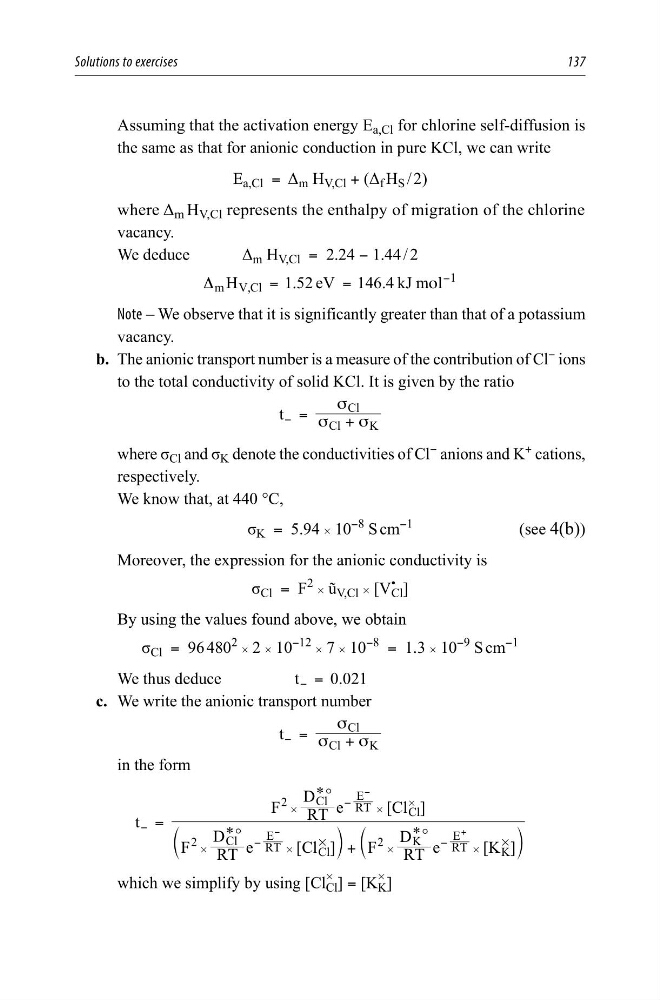
Assuming that the activation energy E a,Cl for chlorine self-diffusion is
the same as that for anionic conduction in pure KCl, we can write
E a,Cl = Δ m H V,Cl + (Δ f H S / 2)
where Δ m H V,Cl represents the enthalpy of migration of the chlorine
vacancy.
We deduce
Δ m H V,Cl = 2.24 − 1.44 / 2
H
1.52 eV 146.4 kJ m l
m V,Cl
1
ο
Δ
=
=
−
Note – We observe that it is significantly greater than that of a potassium
vacancy.
b. The anionic transport number is a measure of the contribution of Cl
−
ions
to the total conductivity of solid KCl. It is given by the ratio
t
Cl
K
Cl
σ
σ
σ
=
+
−
where σ Cl and σ K denote the conductivities of Cl
−
anions and K
+
cations,
respectively.
We know that, at 440 °C,
σ K = 5.94 # 10
−8
S cm
−1
(see 4(b))
Moreover, the expression for the anionic conductivity is
σ Cl = F
2 # ũ V,Cl # [V
•
Cl ]
By using the values found above, we obtain
σ Cl = 96 480
2 # 2 # 10
−12 # 7 # 10
−8 = 1.3 # 10
−9
S cm
−1
We thus deduce
.
t
0021
=
−
c. We write the anionic transport number
t
Cl
K
Cl
σ
σ
σ
=
+
−
in the form
[
]
[ ]
[
]
t
F
RT
D e
Cl
F
RT
D e
K
F
RT
D e
Cl
Cl
RT
E
Cl
K
RT
E
K
Cl
RT
E
Cl
2
2
2
=
+
#
#
−
−
−
−
#
#
#
#
#
#
#
−
+
−
*
*
*
°
°
°
c
c
m
m
which we simplify by using [Cl
#
Cl ] = [K
#
K ]
137
Assuming that the activation energy E a,Cl for chlorine self-diffusion is
the same as that for anionic conduction in pure KCl, we can write
E a,Cl = Δ m H V,Cl + (Δ f H S / 2)
where Δ m H V,Cl represents the enthalpy of migration of the chlorine
vacancy.
We deduce
Δ m H V,Cl = 2.24 − 1.44 / 2
H
1.52 eV 146.4 kJ m l
m V,Cl
1
ο
Δ
=
=
−
Note – We observe that it is significantly greater than that of a potassium
vacancy.
b. The anionic transport number is a measure of the contribution of Cl
−
ions
to the total conductivity of solid KCl. It is given by the ratio
t
Cl
K
Cl
σ
σ
σ
=
+
−
where σ Cl and σ K denote the conductivities of Cl
−
anions and K
+
cations,
respectively.
We know that, at 440 °C,
σ K = 5.94 # 10
−8
S cm
−1
(see 4(b))
Moreover, the expression for the anionic conductivity is
σ Cl = F
2 # ũ V,Cl # [V
•
Cl ]
By using the values found above, we obtain
σ Cl = 96 480
2 # 2 # 10
−12 # 7 # 10
−8 = 1.3 # 10
−9
S cm
−1
We thus deduce
.
t
0021
=
−
c. We write the anionic transport number
t
Cl
K
Cl
σ
σ
σ
=
+
−
in the form
[
]
[ ]
[
]
t
F
RT
D e
Cl
F
RT
D e
K
F
RT
D e
Cl
Cl
RT
E
Cl
K
RT
E
K
Cl
RT
E
Cl
2
2
2
=
+
#
#
−
−
−
−
#
#
#
#
#
#
#
−
+
−
*
*
*
°
°
°
c
c
m
m
which we simplify by using [Cl
#
Cl ] = [K
#
K ]