

136
3 – Transport in ionic solids
5.94 10 S cm
K
8
1
#
σ =
−
−
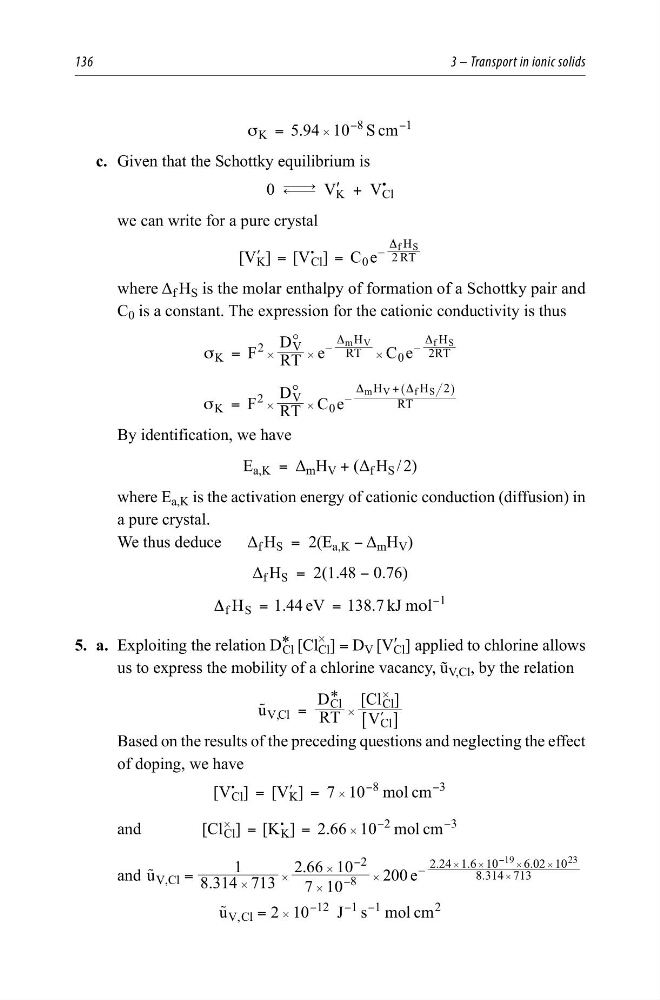
c. Given that the Schottky equilibrium is
0 m V ′
K + V
•
Cl
we can write for a pure crystal
[V ] [V ] C e
K
C l
0
– 2 RT
H
f S
=
=
:
Δ
l
where Δ f H S is the molar enthalpy of formation of a Schottky pair and
C 0 is a constant. The expression for the cationic conductivity is thus
F RT
D
e
C e
K
2
V
– RT
H
0
– 2RT
H
m V
f S
σ =
Δ
Δ
#
#
#
°
F RT
D
C e
K
2
V
0
–
RT
H
H 2
m V
f S
σ =
Δ
Δ
+
#
#
°
^
h
By identification, we have
E a,K = Δ m H V + (Δ f H S / 2)
where E a,K is the activation energy of cationic conduction (diffusion) in
a pure crystal.
We thus deduce
Δ f H S = 2(E a,K − Δ m H V )
Δ f H S = 2(1.48 − 0.76)
H
1.44 eV 138.7 kJ m l
f S
1
ο
Δ
=
=
−
5. a. Exploiting the relation D * Cl [Cl
#
Cl ] = D V [V ′
Cl ] applied to chlorine allows
us to express the mobility of a chlorine vacancy, ũ V,Cl , by the relation
[
]
u
RT
D
V
Cl
,
V Cl
Cl
Cl
Cl
#
=
#
*
l
u
6 @
Based on the results of the preceding questions and neglecting the effect
of doping, we have
[ ] [ ]
V
V
mol cm
7 10
Cl
K
8
3
#
=
=
:
−
−
l
and
[
] [ ]
.
Cl
K
m ol cm
2 66 10
Cl
K
2
3
#
=
=
:
−
−
#
and
.
.
u
e
8 314 713
1
7 10
2 66 10
200
,
.
.
.
.
V Cl
8
2
8 314 713
2 24 1 6 10
602 10
–
19
23
#
#
=
#
#
#
#
#
−
−
#
#
#
−
u
u
J s mol cm
2 10
,
V Cl
12
1 1
2
#
=
−
− −
u
3 – Transport in ionic solids
5.94 10 S cm
K
8
1
#
σ =
−
−
c. Given that the Schottky equilibrium is
0 m V ′
K + V
•
Cl
we can write for a pure crystal
[V ] [V ] C e
K
C l
0
– 2 RT
H
f S
=
=
:
Δ
l
where Δ f H S is the molar enthalpy of formation of a Schottky pair and
C 0 is a constant. The expression for the cationic conductivity is thus
F RT
D
e
C e
K
2
V
– RT
H
0
– 2RT
H
m V
f S
σ =
Δ
Δ
#
#
#
°
F RT
D
C e
K
2
V
0
–
RT
H
H 2
m V
f S
σ =
Δ
Δ
+
#
#
°
^
h
By identification, we have
E a,K = Δ m H V + (Δ f H S / 2)
where E a,K is the activation energy of cationic conduction (diffusion) in
a pure crystal.
We thus deduce
Δ f H S = 2(E a,K − Δ m H V )
Δ f H S = 2(1.48 − 0.76)
H
1.44 eV 138.7 kJ m l
f S
1
ο
Δ
=
=
−
5. a. Exploiting the relation D * Cl [Cl
#
Cl ] = D V [V ′
Cl ] applied to chlorine allows
us to express the mobility of a chlorine vacancy, ũ V,Cl , by the relation
[
]
u
RT
D
V
Cl
,
V Cl
Cl
Cl
Cl
#
=
#
*
l
u
6 @
Based on the results of the preceding questions and neglecting the effect
of doping, we have
[ ] [ ]
V
V
mol cm
7 10
Cl
K
8
3
#
=
=
:
−
−
l
and
[
] [ ]
.
Cl
K
m ol cm
2 66 10
Cl
K
2
3
#
=
=
:
−
−
#
and
.
.
u
e
8 314 713
1
7 10
2 66 10
200
,
.
.
.
.
V Cl
8
2
8 314 713
2 24 1 6 10
602 10
–
19
23
#
#
=
#
#
#
#
#
−
−
#
#
#
−
u
u
J s mol cm
2 10
,
V Cl
12
1 1
2
#
=
−
− −
u