

Solutions to exercises
135
or
.
D
c m s
8 66 10
K
11
2 1
#
=
−
−
*
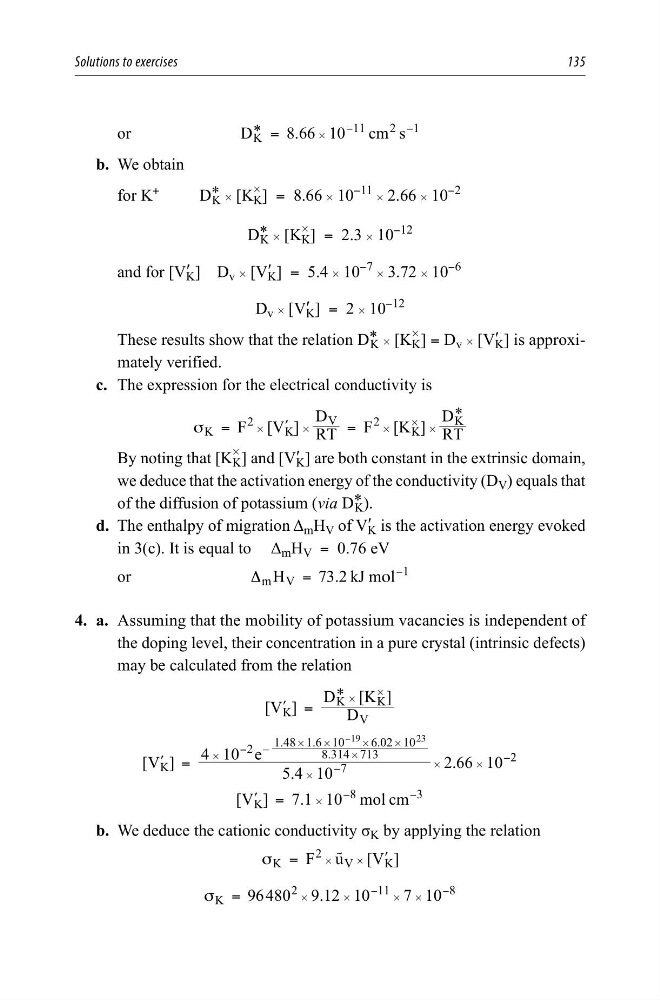
b. We obtain
for K
+
D * K # [K
#
K ] = 8.66 # 10
−11 # 2.66 # 10
−2
D * K # [K
#
K ] = 2.3 # 10
−12
and for [V ′
K ] D v # [V ′
K ] = 5.4 # 10
−7 # 3.72 # 10
−6
D v # [V ′
K ] = 2 # 10
−12
These results show that the relation D * K # [K
#
K ] = D v # [V ′ K ] is approximately verified.
c. The expression for the electrical conductivity is
F [V ] RT
D
F [K ] RT
D
K
2
K
V
2
K
K
σ =
=
#
#
#
# #
*
l
By noting that [K
#
K ] and [V ′
K ] are both constant in the extrinsic domain,
we deduce that the activation energy of the conductivity (D V ) equals that
of the diffusion of potassium (via D * K ).
d. The enthalpy of migration Δ m H V of V ′
K is the activation energy evoked
in 3(c). It is equal to Δ m H V = 0.76 eV
or
H
73.2 kJ m l
m V
1
ο
Δ
=
−
4. a. Assuming that the mobility of potassium vacancies is independent of
the doping level, their concentration in a pure crystal (intrinsic defects)
may be calculated from the relation
[ ]
[ ]
V
D
D
K
V
K
K
K =
#
#
*
l
[ ]
.
.
V
e
5 4 10
4 10
2 66 10
.
.
.
.
K
7
2
8 314 713
1 48 1 6 10
602 10
2
–
19
23
#
#
#
=
#
#
−
−
−
#
#
#
#
−
l
[ ]
.
V
m ol cm
7 1 10
K
8
3
#
=
−
−
l
b. We deduce the cationic conductivity σ K by applying the relation
F u [V ]
K
2
V
K
σ =
#
#
l
u
96 480 9.12 10
7 10
K
2
1 1
8
#
#
σ =
−
−
#
#
135
or
.
D
c m s
8 66 10
K
11
2 1
#
=
−
−
*
b. We obtain
for K
+
D * K # [K
#
K ] = 8.66 # 10
−11 # 2.66 # 10
−2
D * K # [K
#
K ] = 2.3 # 10
−12
and for [V ′
K ] D v # [V ′
K ] = 5.4 # 10
−7 # 3.72 # 10
−6
D v # [V ′
K ] = 2 # 10
−12
These results show that the relation D * K # [K
#
K ] = D v # [V ′ K ] is approximately verified.
c. The expression for the electrical conductivity is
F [V ] RT
D
F [K ] RT
D
K
2
K
V
2
K
K
σ =
=
#
#
#
# #
*
l
By noting that [K
#
K ] and [V ′
K ] are both constant in the extrinsic domain,
we deduce that the activation energy of the conductivity (D V ) equals that
of the diffusion of potassium (via D * K ).
d. The enthalpy of migration Δ m H V of V ′
K is the activation energy evoked
in 3(c). It is equal to Δ m H V = 0.76 eV
or
H
73.2 kJ m l
m V
1
ο
Δ
=
−
4. a. Assuming that the mobility of potassium vacancies is independent of
the doping level, their concentration in a pure crystal (intrinsic defects)
may be calculated from the relation
[ ]
[ ]
V
D
D
K
V
K
K
K =
#
#
*
l
[ ]
.
.
V
e
5 4 10
4 10
2 66 10
.
.
.
.
K
7
2
8 314 713
1 48 1 6 10
602 10
2
–
19
23
#
#
#
=
#
#
−
−
−
#
#
#
#
−
l
[ ]
.
V
m ol cm
7 1 10
K
8
3
#
=
−
−
l
b. We deduce the cationic conductivity σ K by applying the relation
F u [V ]
K
2
V
K
σ =
#
#
l
u
96 480 9.12 10
7 10
K
2
1 1
8
#
#
σ =
−
−
#
#