

Solutions to exercises
139
Solution 3.6 – Application of Nernst-Einstein relation to LiCF 3 SO 3
in poly(ethylene oxide) P(EO)
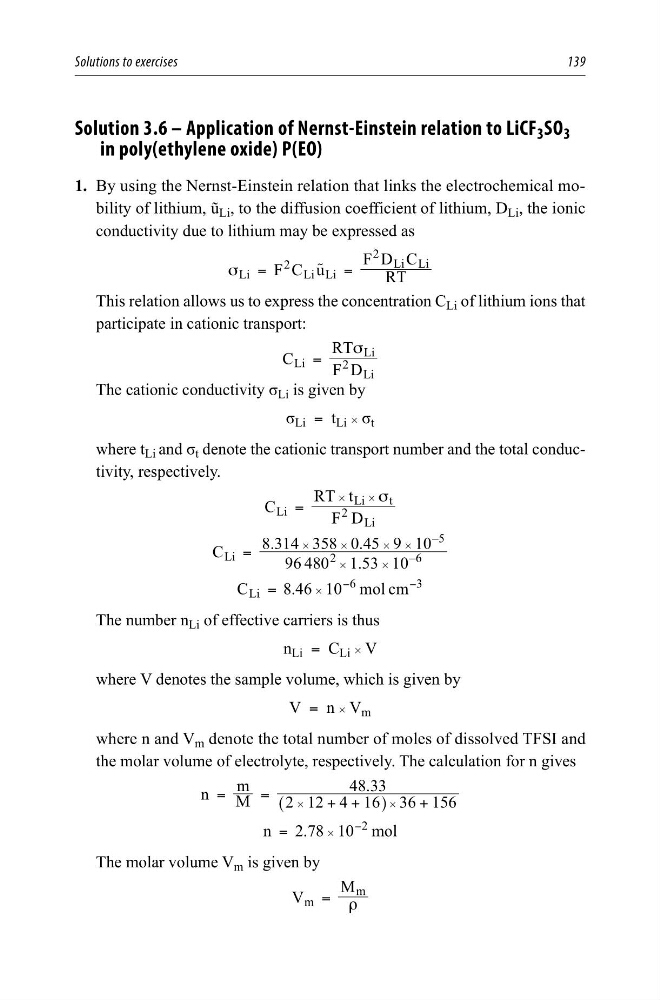
1. By using the Nernst-Einstein relation that links the electrochemical mobility of lithium, ũ Li , to the diffusion coefficient of lithium, D Li , the ionic
conductivity due to lithium may be expressed as
F C u
RT
F D C
Li
2 Li Li
2 Li Li
σ =
=
u
This relation allows us to express the concentration C Li of lithium ions that
participate in cationic transport:
C
F D
RT
Li
2 Li
Li
σ
=
The cationic conductivity σ Li is given by
σ Li = t Li # σ t
where t Li and σ t denote the cationic transport number and the total conductivity, respectively.
C
F D
RT t
Li
2 Li
Li
t
σ
=
#
#
C
96 480 1.53 10
8.314 358 0.45 9 10
Li
2
– 6
–5
#
#
=
#
#
#
#
.
C
m ol cm
8 46 10
Li
6
3
#
=
−
−
The number n Li of effective carriers is thus
n Li = C Li # V
where V denotes the sample volume, which is given by
V = n # V m
where n and V m denote the total number of moles of dissolved TFSI and
the molar volume of electrolyte, respectively. The calculation for n gives
.
n
M
m
2 12 4 16 36 156
48 33
=
=
+ +
+
#
#
^
h
.
n
m ol
2 78 10
2
#
=
−
The molar volume V m is given by
V
M
m
m
ρ
=
139
Solution 3.6 – Application of Nernst-Einstein relation to LiCF 3 SO 3
in poly(ethylene oxide) P(EO)
1. By using the Nernst-Einstein relation that links the electrochemical mobility of lithium, ũ Li , to the diffusion coefficient of lithium, D Li , the ionic
conductivity due to lithium may be expressed as
F C u
RT
F D C
Li
2 Li Li
2 Li Li
σ =
=
u
This relation allows us to express the concentration C Li of lithium ions that
participate in cationic transport:
C
F D
RT
Li
2 Li
Li
σ
=
The cationic conductivity σ Li is given by
σ Li = t Li # σ t
where t Li and σ t denote the cationic transport number and the total conductivity, respectively.
C
F D
RT t
Li
2 Li
Li
t
σ
=
#
#
C
96 480 1.53 10
8.314 358 0.45 9 10
Li
2
– 6
–5
#
#
=
#
#
#
#
.
C
m ol cm
8 46 10
Li
6
3
#
=
−
−
The number n Li of effective carriers is thus
n Li = C Li # V
where V denotes the sample volume, which is given by
V = n # V m
where n and V m denote the total number of moles of dissolved TFSI and
the molar volume of electrolyte, respectively. The calculation for n gives
.
n
M
m
2 12 4 16 36 156
48 33
=
=
+ +
+
#
#
^
h
.
n
m ol
2 78 10
2
#
=
−
The molar volume V m is given by
V
M
m
m
ρ
=