

122
3 – Transport in ionic solids
Exercise 3.16 – emf of a membrane crossed by an electrochemical
semipermeability flux
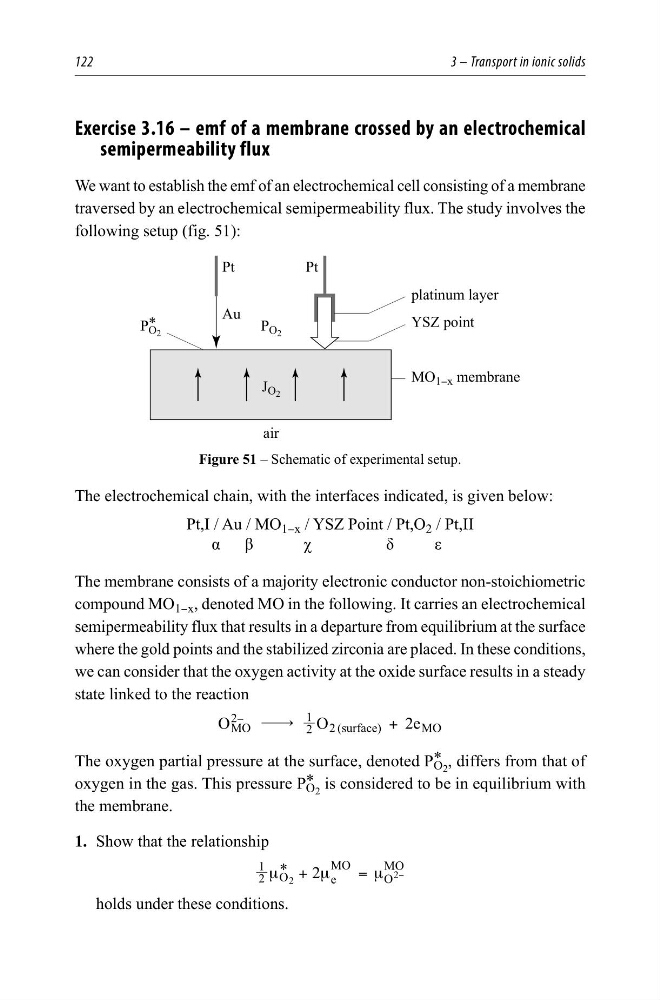
We want to establish the emf of an electrochemical cell consisting of a membrane
traversed by an electrochemical semipermeability flux. The study involves the
following setup (fig. 51):
SODWLQXPOD\HU
<6=SRLQW
02 <[ PHPEUDQH
3W
3W
$X
3 2
- 2
3 2
DLU
Figure 51 – Schematic of experimental setup.
The electrochemical chain, with the interfaces indicated, is given below:
Pt,I / Au / MO 1−x / YSZ Point / Pt,O 2 / Pt,II
α β
χ
δ
ε
The membrane consists of a majority electronic conductor non-stoichiometric
compound MO 1−x , denoted MO in the following. It carries an electrochemical
semipermeability flux that results in a departure from equilibrium at the surface
where the gold points and the stabilized zirconia are placed. In these conditions,
we can consider that the oxygen activity at the oxide surface results in a steady
state linked to the reaction
O MO
2−
$ O
e
2
(
)
surface
MO
2
1 2
+
The oxygen partial pressure at the surface, denoted P * O 2 , differs from that of
oxygen in the gas. This pressure P * O 2 is considered to be in equilibrium with
the membrane.
1. Show that the relationship
2
2
1 O
e
MO
O
MO
2
2
μ
μ
μ
+
=
−
*
holds under these conditions.
3 – Transport in ionic solids
Exercise 3.16 – emf of a membrane crossed by an electrochemical
semipermeability flux
We want to establish the emf of an electrochemical cell consisting of a membrane
traversed by an electrochemical semipermeability flux. The study involves the
following setup (fig. 51):
SODWLQXPOD\HU
<6=SRLQW
02 <[ PHPEUDQH
3W
3W
$X
3 2
- 2
3 2
DLU
Figure 51 – Schematic of experimental setup.
The electrochemical chain, with the interfaces indicated, is given below:
Pt,I / Au / MO 1−x / YSZ Point / Pt,O 2 / Pt,II
α β
χ
δ
ε
The membrane consists of a majority electronic conductor non-stoichiometric
compound MO 1−x , denoted MO in the following. It carries an electrochemical
semipermeability flux that results in a departure from equilibrium at the surface
where the gold points and the stabilized zirconia are placed. In these conditions,
we can consider that the oxygen activity at the oxide surface results in a steady
state linked to the reaction
O MO
2−
$ O
e
2
(
)
surface
MO
2
1 2
+
The oxygen partial pressure at the surface, denoted P * O 2 , differs from that of
oxygen in the gas. This pressure P * O 2 is considered to be in equilibrium with
the membrane.
1. Show that the relationship
2
2
1 O
e
MO
O
MO
2
2
μ
μ
μ
+
=
−
*
holds under these conditions.