

Exercises
121
a. Calculate the conductivity of CaF 2 at 661 °C under an argon atmosphere.
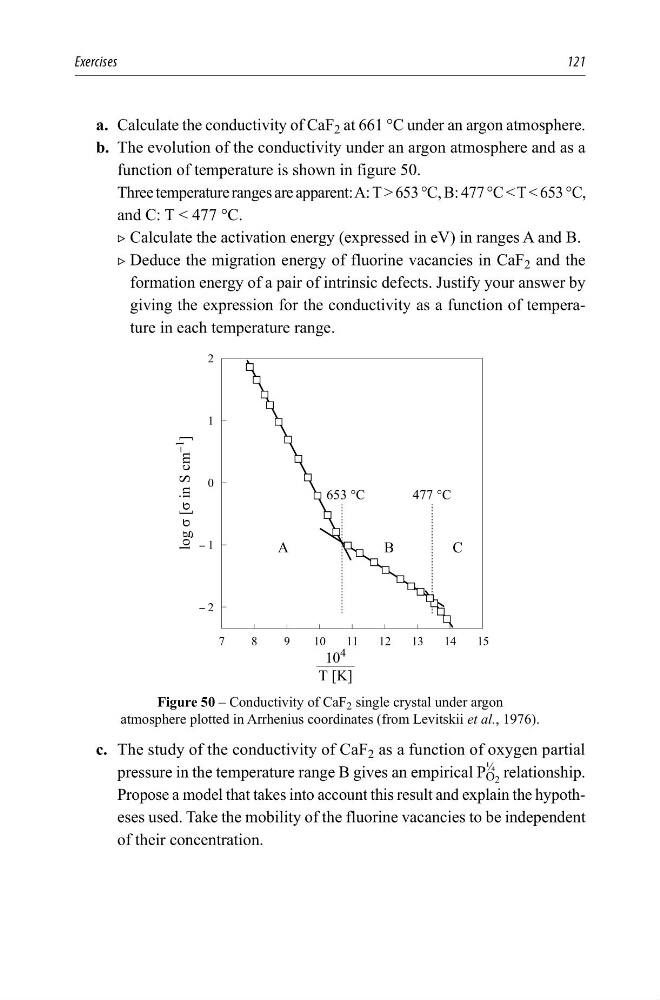
b. The evolution of the conductivity under an argon atmosphere and as a
function of temperature is shown in figure 50.
Three temperature ranges are apparent: A: T > 653 °C, B: 477 °C < T < 653 °C,
and C: T < 477 °C.
2 Calculate the activation energy (expressed in eV) in ranges A and B.
2 Deduce the migration energy of fluorine vacancies in CaF 2 and the
formation energy of a pair of intrinsic defects. Justify your answer by
giving the expression for the conductivity as a function of temperature in each temperature range.
<
<
²
7>.@
ORJı>ıLQ6FP
<
@
&
&
&
%
$
Figure 50 – Conductivity of CaF 2 single crystal under argon
atmosphere plotted in Arrhenius coordinates (from Levitskii et al., 1976).
c. The study of the conductivity of CaF 2 as a function of oxygen partial
pressure in the temperature range B gives an empirical P
¼
O 2 relationship.
Propose a model that takes into account this result and explain the hypotheses used. Take the mobility of the fluorine vacancies to be independent
of their concentration.
121
a. Calculate the conductivity of CaF 2 at 661 °C under an argon atmosphere.
b. The evolution of the conductivity under an argon atmosphere and as a
function of temperature is shown in figure 50.
Three temperature ranges are apparent: A: T > 653 °C, B: 477 °C < T < 653 °C,
and C: T < 477 °C.
2 Calculate the activation energy (expressed in eV) in ranges A and B.
2 Deduce the migration energy of fluorine vacancies in CaF 2 and the
formation energy of a pair of intrinsic defects. Justify your answer by
giving the expression for the conductivity as a function of temperature in each temperature range.
<
<
²
7>.@
ORJı>ıLQ6FP
<
@
&
&
&
%
$
Figure 50 – Conductivity of CaF 2 single crystal under argon
atmosphere plotted in Arrhenius coordinates (from Levitskii et al., 1976).
c. The study of the conductivity of CaF 2 as a function of oxygen partial
pressure in the temperature range B gives an empirical P
¼
O 2 relationship.
Propose a model that takes into account this result and explain the hypotheses used. Take the mobility of the fluorine vacancies to be independent
of their concentration.