

120
3 – Transport in ionic solids
Thermal expansion coefficient of liquid: α l = 1.455 # 10
−4
K
−1
Glass transition temperature of the mix 2SiO 2 -K 2 O: T G = 757 K
4. Given the experimental data, determine the temperature at which the curves
corresponding to the two domains cross. Compare this value with T 0 and
make your conclusion.
Exercise 3.15 – Study of single-crystal calcium fluoride CaF 2
in the presence of oxygen
Pure calcium fluoride CaF 2 is dominated by anionic Frenkel disorder. The
mobility of the calcium ions is assumed to be zero. The electric transport is
due to the fluorine vacancies. In the presence of oxygen, oxide ions can enter
the CaF 2 structure by substituting for fluorine in the anionic sublattice, which
releases gaseous fluorine. No electronic conduction occurs.
1. Give the relevant equilibria.
2. How should we interpret the increase in ionic conductivity?
3. We want to study the conductivity of CaF 2 as a function of temperature and
of oxygen partial pressure P O 2 . For this, we first measure the impedance
under an argon atmosphere (P O 2 = 3 # 10
−6
bar) of the following cell:
O 2 ,Pt / CaF 2 (single crystal) / Pt,O 2
The sample consists of a cylinder of length ℓ = 0.816 cm and diameter
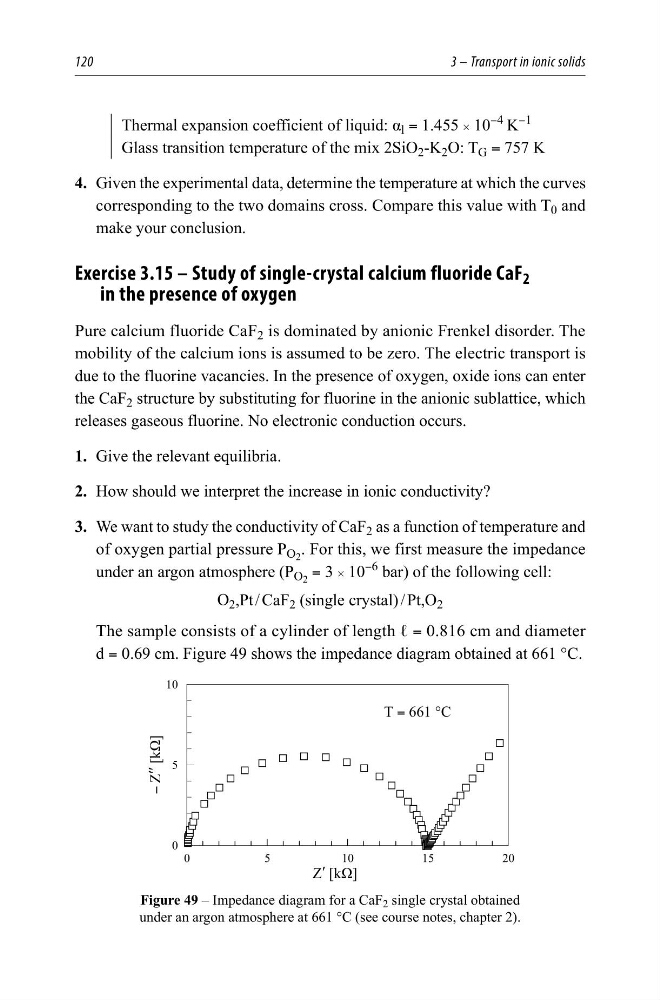
d = 0.69 cm. Figure 49 shows the impedance diagram obtained at 661 °C.
=ƍ>Nȍ@
<
=ƍƍ>Nȍ@
7&
Figure 49 – Impedance diagram for a CaF 2 single crystal obtained
under an argon atmosphere at 661 °C (see course notes, chapter 2).
3 – Transport in ionic solids
Thermal expansion coefficient of liquid: α l = 1.455 # 10
−4
K
−1
Glass transition temperature of the mix 2SiO 2 -K 2 O: T G = 757 K
4. Given the experimental data, determine the temperature at which the curves
corresponding to the two domains cross. Compare this value with T 0 and
make your conclusion.
Exercise 3.15 – Study of single-crystal calcium fluoride CaF 2
in the presence of oxygen
Pure calcium fluoride CaF 2 is dominated by anionic Frenkel disorder. The
mobility of the calcium ions is assumed to be zero. The electric transport is
due to the fluorine vacancies. In the presence of oxygen, oxide ions can enter
the CaF 2 structure by substituting for fluorine in the anionic sublattice, which
releases gaseous fluorine. No electronic conduction occurs.
1. Give the relevant equilibria.
2. How should we interpret the increase in ionic conductivity?
3. We want to study the conductivity of CaF 2 as a function of temperature and
of oxygen partial pressure P O 2 . For this, we first measure the impedance
under an argon atmosphere (P O 2 = 3 # 10
−6
bar) of the following cell:
O 2 ,Pt / CaF 2 (single crystal) / Pt,O 2
The sample consists of a cylinder of length ℓ = 0.816 cm and diameter
d = 0.69 cm. Figure 49 shows the impedance diagram obtained at 661 °C.
=ƍ>Nȍ@
<
=ƍƍ>Nȍ@
7&
Figure 49 – Impedance diagram for a CaF 2 single crystal obtained
under an argon atmosphere at 661 °C (see course notes, chapter 2).