

Exercises
119
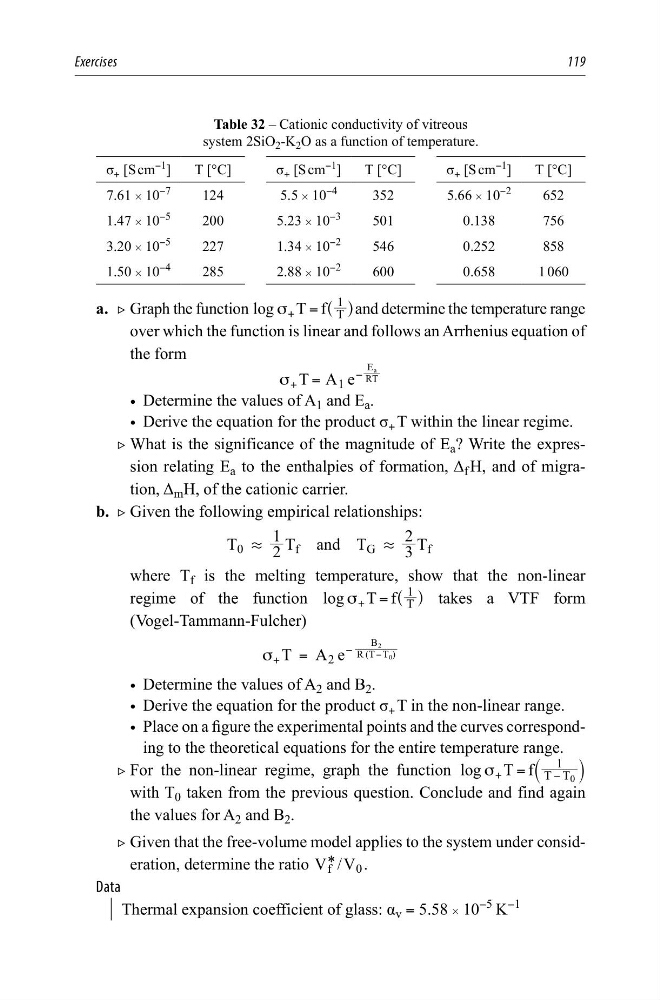
Table 32 – Cationic conductivity of vitreous
system 2SiO 2 -K 2 O as a function of temperature.
σ + [S cm
−1
]
T [°C]
σ + [S cm
−1
]
T [°C]
σ + [S cm
−1
]
T [°C]
7.61 # 10
−7
124
5.5 # 10
−4
352
5.66 # 10
−2
652
1.47 # 10
−5
200
5.23 # 10
−3
501
0.138
756
3.20 # 10
−5
227
1.34 # 10
−2
546
0.252
858
1.50 # 10
−4
285
2.88 # 10
−2
600
0.658
1 060
a. 2 Graph the function log T f T
1
σ =
+
^ h and determine the temperature range
over which the function is linear and follows an Arrhenius equation of
the form
T A e
1
RT
E a
σ =
+
−
• Determine the values of A 1 and E a .
• Derive the equation for the product σ + T within the linear regime.
2 What is the significance of the magnitude of E a ? Write the expression relating E a to the enthalpies of formation, Δ f H, and of migration, Δ m H, of the cationic carrier.
b. 2 Given the following empirical relationships:
T
T and T
T
2
1
3
2
f
G
f
0 .
.
where T f is the melting temperature, show that the non-linear
regime of the function log T f T
1
σ =
+
^ h takes a VTF form
(Vogel-Tammann-Fulcher)
T A e
2
R (T T )
B
0
2
σ
=
+
−
−
• Determine the values of A 2 and B 2 .
• Derive the equation for the product σ + T in the non-linear range.
• Place on a figure the experimental points and the curves corresponding to the theoretical equations for the entire temperature range.
2 For the non-linear regime, graph the function log T f T T
1
0
σ =
+
−
`
j
with T 0 taken from the previous question. Conclude and find again
the values for A 2 and B 2 .
2 Given that the free-volume model applies to the system under consideration, determine the ratio
/
V V
f
0
*
.
Data
Thermal expansion coefficient of glass: α v = 5.58 # 10
−5
K
−1
119
Table 32 – Cationic conductivity of vitreous
system 2SiO 2 -K 2 O as a function of temperature.
σ + [S cm
−1
]
T [°C]
σ + [S cm
−1
]
T [°C]
σ + [S cm
−1
]
T [°C]
7.61 # 10
−7
124
5.5 # 10
−4
352
5.66 # 10
−2
652
1.47 # 10
−5
200
5.23 # 10
−3
501
0.138
756
3.20 # 10
−5
227
1.34 # 10
−2
546
0.252
858
1.50 # 10
−4
285
2.88 # 10
−2
600
0.658
1 060
a. 2 Graph the function log T f T
1
σ =
+
^ h and determine the temperature range
over which the function is linear and follows an Arrhenius equation of
the form
T A e
1
RT
E a
σ =
+
−
• Determine the values of A 1 and E a .
• Derive the equation for the product σ + T within the linear regime.
2 What is the significance of the magnitude of E a ? Write the expression relating E a to the enthalpies of formation, Δ f H, and of migration, Δ m H, of the cationic carrier.
b. 2 Given the following empirical relationships:
T
T and T
T
2
1
3
2
f
G
f
0 .
.
where T f is the melting temperature, show that the non-linear
regime of the function log T f T
1
σ =
+
^ h takes a VTF form
(Vogel-Tammann-Fulcher)
T A e
2
R (T T )
B
0
2
σ
=
+
−
−
• Determine the values of A 2 and B 2 .
• Derive the equation for the product σ + T in the non-linear range.
• Place on a figure the experimental points and the curves corresponding to the theoretical equations for the entire temperature range.
2 For the non-linear regime, graph the function log T f T T
1
0
σ =
+
−
`
j
with T 0 taken from the previous question. Conclude and find again
the values for A 2 and B 2 .
2 Given that the free-volume model applies to the system under consideration, determine the ratio
/
V V
f
0
*
.
Data
Thermal expansion coefficient of glass: α v = 5.58 # 10
−5
K
−1