

104
3 – Transport in ionic solids
Exercise 3.2 – Study of oxygen mobility in solid solutions
(ThO 2 ) 1−x (YO 1.5 ) x
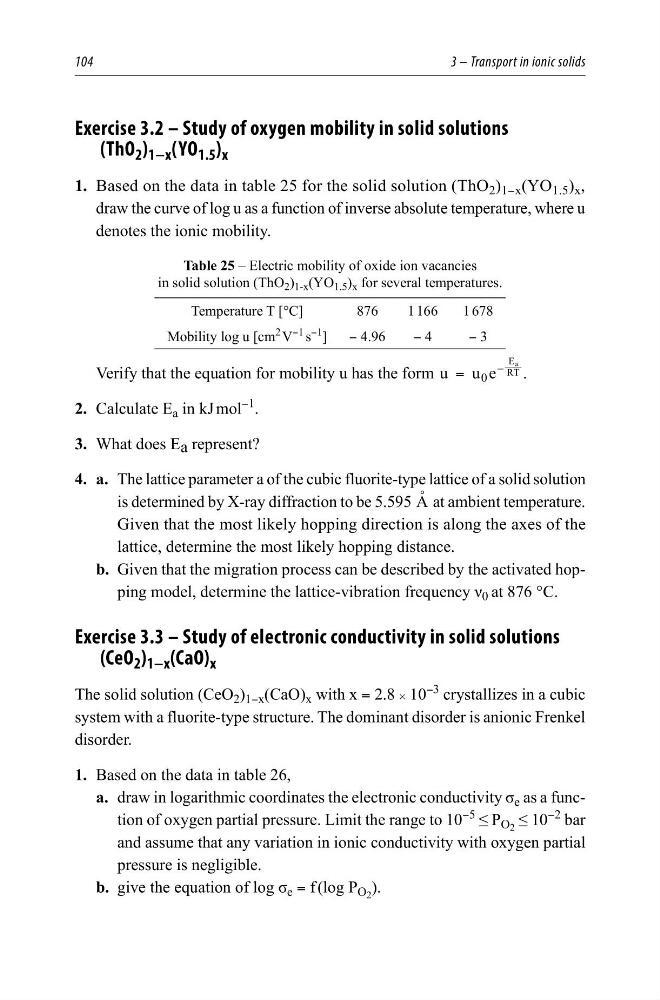
1. Based on the data in table 25 for the solid solution (ThO 2 ) 1−x (YO 1.5 ) x ,
draw the curve of log u as a function of inverse absolute temperature, where u
denotes the ionic mobility.
Table 25 – Electric mobility of oxide ion vacancies
in solid solution (ThO 2 ) 1-x (YO 1.5 ) x for several temperatures.
Temperature T [°C]
876
1 166
1 678
Mobility log u [cm
2
V
−1
s
−1
]
− 4.96
− 4
− 3
Verify that the equation for mobility u has the form u u e
0
RT
E a
=
−
.
2. Calculate E a in kJ mol
−1
.
3. What does E a represent?
4. a. The lattice parameter a of the cubic fluorite-type lattice of a solid solution
is determined by X-ray diffraction to be 5.595 A c at ambient temperature.
Given that the most likely hopping direction is along the axes of the
lattice, determine the most likely hopping distance.
b. Given that the migration process can be described by the activated hopping model, determine the lattice-vibration frequency ν 0 at 876 °C.
Exercise 3.3 – Study of electronic conductivity in solid solutions
(CeO 2 ) 1−x (CaO) x
The solid solution (CeO 2 ) 1−x (CaO) x with x = 2.8 # 10
−3
crystallizes in a cubic
system with a fluorite-type structure. The dominant disorder is anionic Frenkel
disorder.
1. Based on the data in table 26,
a. draw in logarithmic coordinates the electronic conductivity σ e as a function of oxygen partial pressure. Limit the range to 10
−5
≤ P O 2 ≤ 10
−2
bar
and assume that any variation in ionic conductivity with oxygen partial
pressure is negligible.
b. give the equation of log σ e = f (log P O 2 ).
3 – Transport in ionic solids
Exercise 3.2 – Study of oxygen mobility in solid solutions
(ThO 2 ) 1−x (YO 1.5 ) x
1. Based on the data in table 25 for the solid solution (ThO 2 ) 1−x (YO 1.5 ) x ,
draw the curve of log u as a function of inverse absolute temperature, where u
denotes the ionic mobility.
Table 25 – Electric mobility of oxide ion vacancies
in solid solution (ThO 2 ) 1-x (YO 1.5 ) x for several temperatures.
Temperature T [°C]
876
1 166
1 678
Mobility log u [cm
2
V
−1
s
−1
]
− 4.96
− 4
− 3
Verify that the equation for mobility u has the form u u e
0
RT
E a
=
−
.
2. Calculate E a in kJ mol
−1
.
3. What does E a represent?
4. a. The lattice parameter a of the cubic fluorite-type lattice of a solid solution
is determined by X-ray diffraction to be 5.595 A c at ambient temperature.
Given that the most likely hopping direction is along the axes of the
lattice, determine the most likely hopping distance.
b. Given that the migration process can be described by the activated hopping model, determine the lattice-vibration frequency ν 0 at 876 °C.
Exercise 3.3 – Study of electronic conductivity in solid solutions
(CeO 2 ) 1−x (CaO) x
The solid solution (CeO 2 ) 1−x (CaO) x with x = 2.8 # 10
−3
crystallizes in a cubic
system with a fluorite-type structure. The dominant disorder is anionic Frenkel
disorder.
1. Based on the data in table 26,
a. draw in logarithmic coordinates the electronic conductivity σ e as a function of oxygen partial pressure. Limit the range to 10
−5
≤ P O 2 ≤ 10
−2
bar
and assume that any variation in ionic conductivity with oxygen partial
pressure is negligible.
b. give the equation of log σ e = f (log P O 2 ).