

102
3 – Transport in ionic solids
For t
1
ion =
r
we have a solid electrolyte with
E
z F
d
th
i
i
X
b
a
2
α
μ
Δ
= −
#
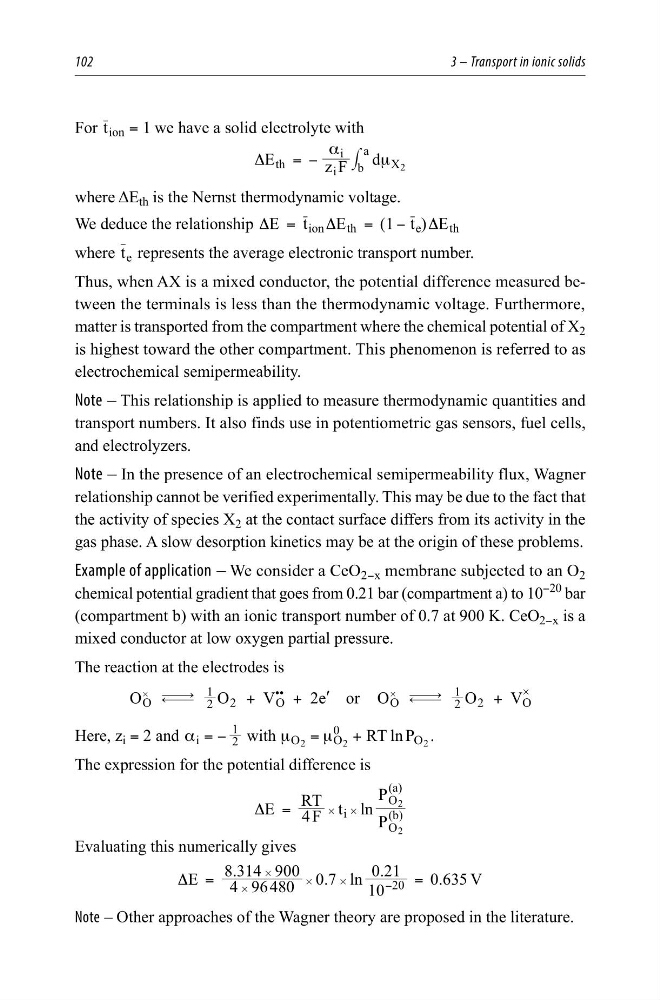
where ΔE th is the Nernst thermodynamic voltage.
We deduce the relationship E t
E
(1 t ) E
ion
th
e
th
Δ
Δ
Δ
=
= −
r
r
where t e represents the average electronic transport number.
Thus, when AX is a mixed conductor, the potential difference measured between the terminals is less than the thermodynamic voltage. Furthermore,
matter is transported from the compartment where the chemical potential of X 2
is highest toward the other compartment. This phenomenon is referred to as
electrochemical semipermeability.
Note – This relationship is applied to measure thermodynamic quantities and
transport numbers. It also finds use in potentiometric gas sensors, fuel cells,
and electrolyzers.
Note – In the presence of an electrochemical semipermeability flux, Wagner
relationship cannot be verified experimentally. This may be due to the fact that
the activity of species X 2 at the contact surface differs from its activity in the
gas phase. A slow desorption kinetics may be at the origin of these problems.
Example of application – We consider a CeO 2−x membrane subjected to an O 2
chemical potential gradient that goes from 0.21 bar (compartment a) to 10
−20
bar
(compartment b) with an ionic transport number of 0.7 at 900 K. CeO 2−x is a
mixed conductor at low oxygen partial pressure.
The reaction at the electrodes is
O O
#
m O
2
1 2 + V
••
O + 2e ′ or O O
#
m O
2
1 2 + V
#
O
Here, z i = 2 and i
2
1
α = − with
RT ln P
O
O
0
O
2
2
2
μ
μ
=
+
.
The expression for the potential difference is
E
4 F
RT
t ln P
P
i
O
(b)
O
(a)
2
2
Δ =
#
#
Evaluating this numerically gives
E
4 96 480
8.314 900
0.7 ln 10
0.21
0.635 V
20
Δ =
=
−
#
#
#
#
Note – Other approaches of the Wagner theory are proposed in the literature.
3 – Transport in ionic solids
For t
1
ion =
r
we have a solid electrolyte with
E
z F
d
th
i
i
X
b
a
2
α
μ
Δ
= −
#
where ΔE th is the Nernst thermodynamic voltage.
We deduce the relationship E t
E
(1 t ) E
ion
th
e
th
Δ
Δ
Δ
=
= −
r
r
where t e represents the average electronic transport number.
Thus, when AX is a mixed conductor, the potential difference measured between the terminals is less than the thermodynamic voltage. Furthermore,
matter is transported from the compartment where the chemical potential of X 2
is highest toward the other compartment. This phenomenon is referred to as
electrochemical semipermeability.
Note – This relationship is applied to measure thermodynamic quantities and
transport numbers. It also finds use in potentiometric gas sensors, fuel cells,
and electrolyzers.
Note – In the presence of an electrochemical semipermeability flux, Wagner
relationship cannot be verified experimentally. This may be due to the fact that
the activity of species X 2 at the contact surface differs from its activity in the
gas phase. A slow desorption kinetics may be at the origin of these problems.
Example of application – We consider a CeO 2−x membrane subjected to an O 2
chemical potential gradient that goes from 0.21 bar (compartment a) to 10
−20
bar
(compartment b) with an ionic transport number of 0.7 at 900 K. CeO 2−x is a
mixed conductor at low oxygen partial pressure.
The reaction at the electrodes is
O O
#
m O
2
1 2 + V
••
O + 2e ′ or O O
#
m O
2
1 2 + V
#
O
Here, z i = 2 and i
2
1
α = − with
RT ln P
O
O
0
O
2
2
2
μ
μ
=
+
.
The expression for the potential difference is
E
4 F
RT
t ln P
P
i
O
(b)
O
(a)
2
2
Δ =
#
#
Evaluating this numerically gives
E
4 96 480
8.314 900
0.7 ln 10
0.21
0.635 V
20
Δ =
=
−
#
#
#
#
Note – Other approaches of the Wagner theory are proposed in the literature.