

Course notes
101
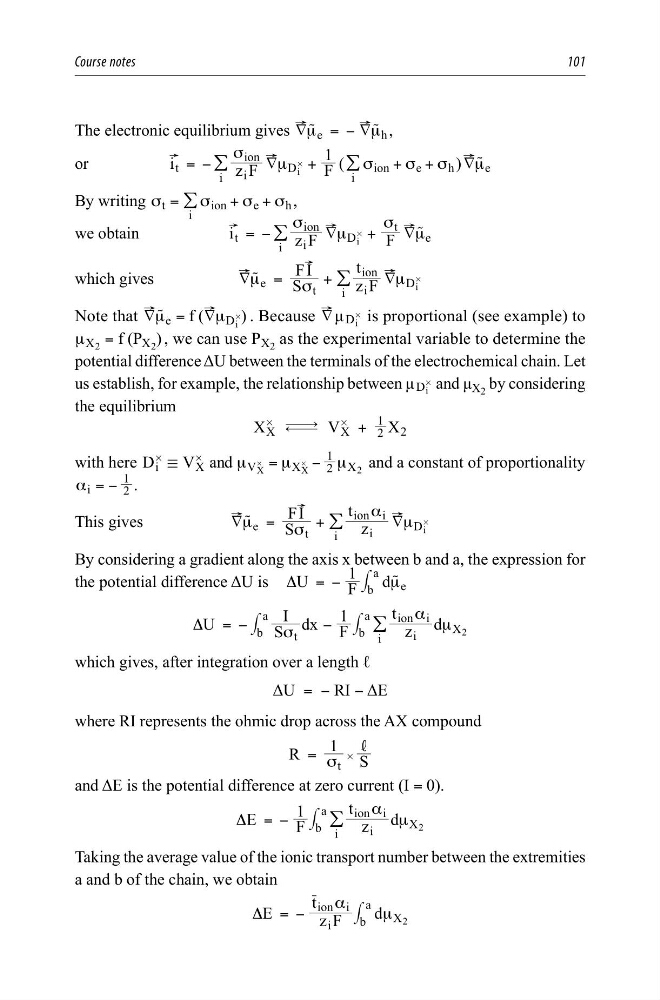
The electronic equilibrium gives
e
h
d
d
μ
μ
= −
u
u ,
or
i
z F
F
1
(
)
t
i
ion
i
D
i on
i
e
h
e
i
d
d
σ
μ
σ
σ σ
μ
= −
+
+ +
#
u
/
/
By writing t
i on
i
e
h
σ
σ
σ σ
=
+ +
/
,
we obtain
i
z F
F
t
i
ion
i
D
t
e
i
d
d
σ
μ
σ μ
= −
+
#
u
/
which gives
S
FI
z F
t
e
t
i
ion
i
D i
d
d
μ
σ
μ
=
+
#
u
/
Note that
f (
)
e
D i
d
d
μ
μ
=
#
u
. Because d μ D i
# is proportional (see example) to
f (P )
X
X
2
2
μ =
, we can use P X 2 as the experimental variable to determine the
potential difference ΔU between the terminals of the electrochemical chain. Let
us establish, for example, the relationship between μ D i
# and μ X 2 by considering
the equilibrium
X X
#
m V
X
X
2
1 2
+
#
with here D
V and
i
X
V
X
2
1 X
X
X
2
/
μ
μ
μ
=
−
#
#
#
#
and a constant of proportionality
i
2
1
α = − .
This gives
S
FI
z
t
e
t
i
ion i
i
D i
d
d
μ
σ
α μ
=
+
#
u
/
By considering a gradient along the axis x between b and a, the expression for
the potential difference ΔU is
U
F
1
d e
b
a μ
Δ = −
u
#
U
S
I
dx F
1
z
t
d
t
b
a
i
ion i
i
X
b
a
2
σ
α μ
Δ = −
−
/
#
#
which gives, after integration over a length ℓ
ΔU = − RI − ΔE
where RI represents the ohmic drop across the AX compound
R
1 S
t
,
σ
=
#
and ΔE is the potential difference at zero current (I = 0).
E
F
1
z
t
d
i
ion i
i
X
b
a
2
α μ
Δ = −
/
#
Taking the average value of the ionic transport number between the extremities
a and b of the chain, we obtain
E
z F
t
d
i
ion i
X
b
a
2
α
μ
Δ = −
r
#
101
The electronic equilibrium gives
e
h
d
d
μ
μ
= −
u
u ,
or
i
z F
F
1
(
)
t
i
ion
i
D
i on
i
e
h
e
i
d
d
σ
μ
σ
σ σ
μ
= −
+
+ +
#
u
/
/
By writing t
i on
i
e
h
σ
σ
σ σ
=
+ +
/
,
we obtain
i
z F
F
t
i
ion
i
D
t
e
i
d
d
σ
μ
σ μ
= −
+
#
u
/
which gives
S
FI
z F
t
e
t
i
ion
i
D i
d
d
μ
σ
μ
=
+
#
u
/
Note that
f (
)
e
D i
d
d
μ
μ
=
#
u
. Because d μ D i
# is proportional (see example) to
f (P )
X
X
2
2
μ =
, we can use P X 2 as the experimental variable to determine the
potential difference ΔU between the terminals of the electrochemical chain. Let
us establish, for example, the relationship between μ D i
# and μ X 2 by considering
the equilibrium
X X
#
m V
X
X
2
1 2
+
#
with here D
V and
i
X
V
X
2
1 X
X
X
2
/
μ
μ
μ
=
−
#
#
#
#
and a constant of proportionality
i
2
1
α = − .
This gives
S
FI
z
t
e
t
i
ion i
i
D i
d
d
μ
σ
α μ
=
+
#
u
/
By considering a gradient along the axis x between b and a, the expression for
the potential difference ΔU is
U
F
1
d e
b
a μ
Δ = −
u
#
U
S
I
dx F
1
z
t
d
t
b
a
i
ion i
i
X
b
a
2
σ
α μ
Δ = −
−
/
#
#
which gives, after integration over a length ℓ
ΔU = − RI − ΔE
where RI represents the ohmic drop across the AX compound
R
1 S
t
,
σ
=
#
and ΔE is the potential difference at zero current (I = 0).
E
F
1
z
t
d
i
ion i
i
X
b
a
2
α μ
Δ = −
/
#
Taking the average value of the ionic transport number between the extremities
a and b of the chain, we obtain
E
z F
t
d
i
ion i
X
b
a
2
α
μ
Δ = −
r
#